
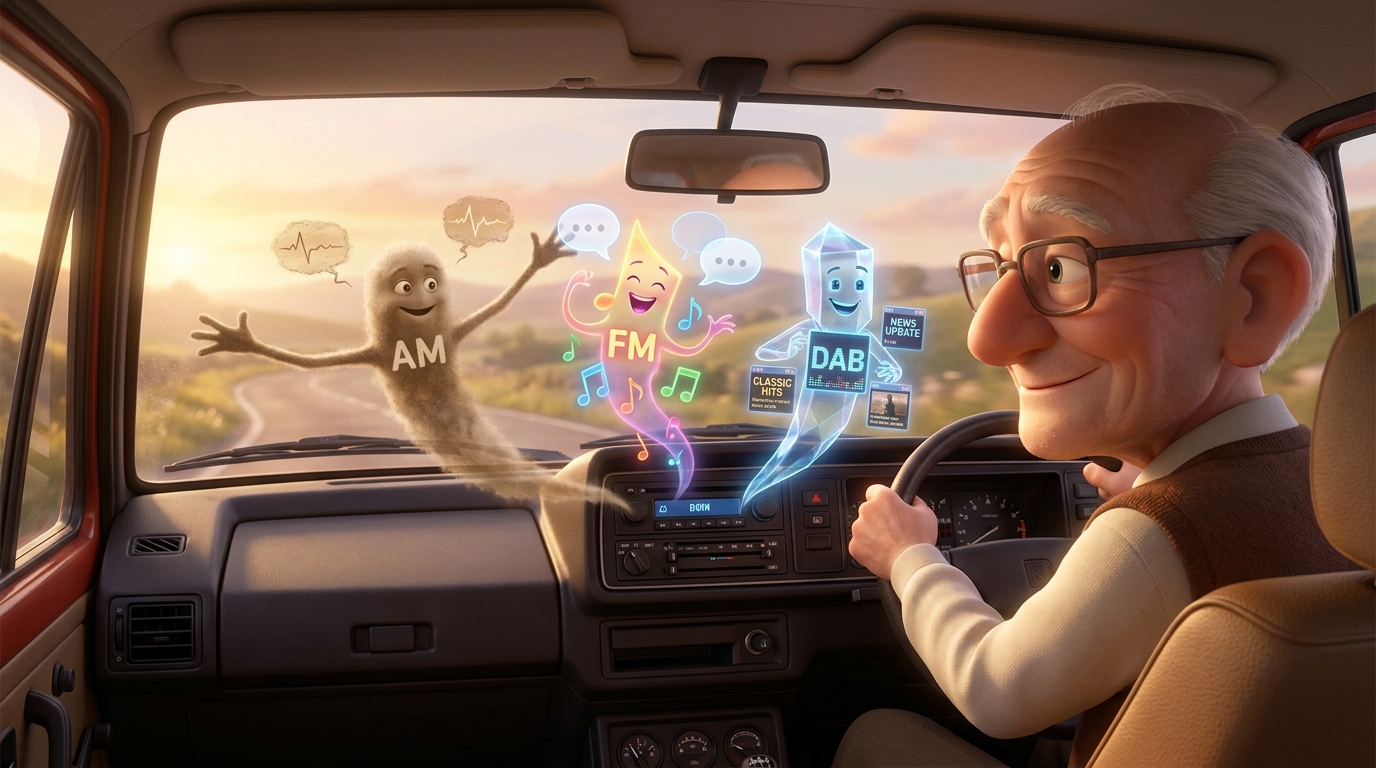
When I first started thinking about writing this piece on car radio tuning, I wondered if anyone still cared. I mean, we’ve got Spotify, Apple Music, and podcasts coming out of our ears. But here’s the thing: every single time I get in my car, I still reach for those radio presets. And I’m not alone. Even in 2026, millions of us are still twisting dials and punching buttons to find our favourite stations, whether it’s for the traffic updates, the local news, or just because we fancy a surprise instead of our carefully curated playlists.
Car radio tuning matters because it’s one of the few remaining free sources of information and entertainment that doesn’t require a data plan, a subscription, or even your phone to be charged. When your smartphone dies halfway through a journey, when you’ve exhausted every podcast in your queue, or when you just want to know if that traffic jam ahead is going to ruin your day, the humble car radio is there. It’s reliable, it’s immediate, and it connects you to what’s happening right now, right where you are.
Understanding FM AM DAB radio isn’t just about nostalgia, it’s about making the most of a technology that’s evolved brilliantly over the decades and continues to serve us well. Plus, knowing how to tune car radio properly means you’ll never be that person frantically pressing buttons while trying to find the traffic report as you approach a motorway junction.
What Car Radio Is Actually For (And What It Isn’t)
Your car radio is brilliant at delivering live, local, and immediate content. It excels at giving you news as it happens, traffic updates that might save you an hour in gridlock, weather warnings, emergency broadcasts, and yes, a decent selection of music and chat to keep you company on the road.
What it’s not designed for is giving you complete control over every single song you hear. It won’t let you skip tracks you don’t fancy, it won’t remember exactly where you left off in that true crime series, and it definitely won’t play that obscure B-side from 1974 that you’ve been craving. That’s not a failing, that’s just not what it’s meant to do.
The beauty of radio is in its serendipity and its universality. Everyone listening to Radio 2 at the same time hears the same thing. There’s something rather lovely about that shared experience, something we’ve lost a bit in our on-demand world. And when there’s a genuine emergency, when the weather turns dangerous or there’s a major incident, radio can reach everyone simultaneously without relying on internet infrastructure that might be overloaded or unavailable.
The Evolution of Car Radio Tuning: From AM to FM to DAB
Understanding the journey of car radio tuning helps make sense of why your modern car might still have all three options available. Each technology built on what came before, solving problems and adding capabilities.
AM Radio: The Original
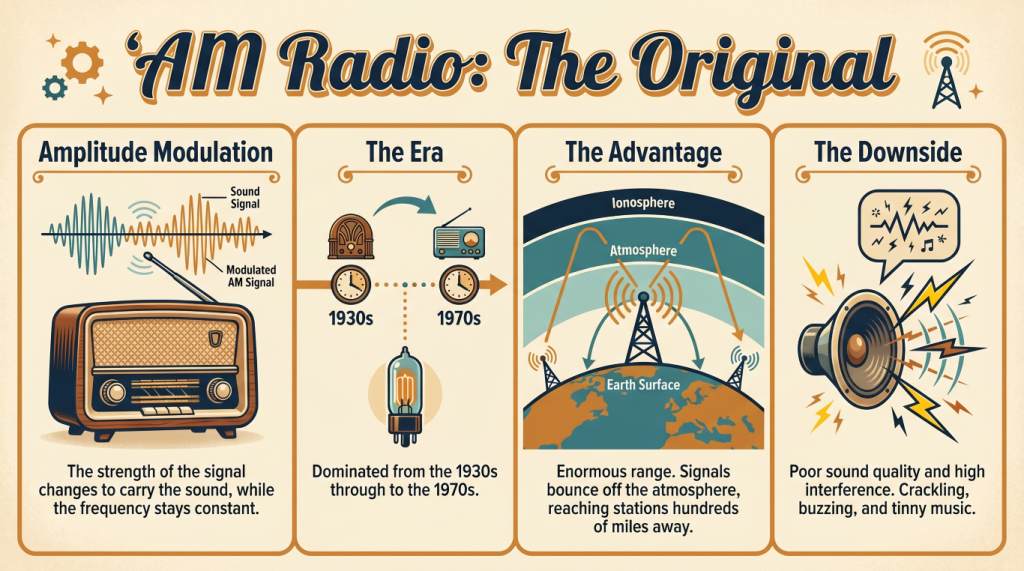
AM stands for Amplitude Modulation, but don’t let that scare you. Think of it like this: imagine you’re trying to send a message by varying how loudly you shout. Sometimes you shout louder, sometimes quieter, but you keep shouting at the same steady rhythm. That’s essentially AM radio. The strength of the signal changes to carry the sound, while the frequency stays constant.
AM radio dominated from the 1930s through to the 1970s. Its big advantage was range. AM signals can travel enormous distances, bouncing off the atmosphere and reaching far beyond the horizon. You could pick up stations from hundreds of miles away, especially at night when atmospheric conditions were just right. I remember my dad telling me about listening to American stations from our house in the Midlands on clear nights, which seemed like absolute magic.
The downside? Sound quality was pretty poor, and AM was incredibly susceptible to interference. Every electrical storm, every power line, every bit of electrical equipment would create crackling and buzzing. Music on AM always sounded a bit tinny and flat.
FM Radio: The Quality Upgrade
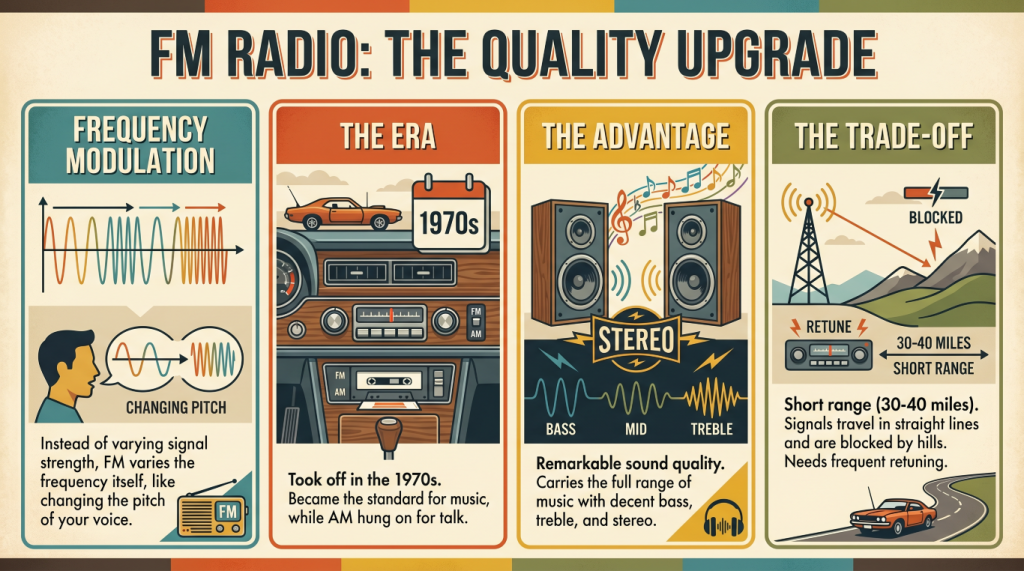
FM, or Frequency Modulation, arrived in car radios during the 1950s and 1960s, though it didn’t really take off until the 1970s. Instead of varying the strength of the signal like AM, FM varies the frequency itself. Imagine instead of shouting louder and quieter, you’re changing the pitch of your voice up and down very slightly, very quickly. The person listening can decode those pitch changes back into sound.
The transformation in sound quality was remarkable. FM could carry the full range of music properly, with decent bass and treble. It could even do stereo, which AM couldn’t manage. Suddenly, listening to music in your car didn’t sound like it was coming through a telephone line.
FM became the standard for music stations, while AM hung on for talk radio and news. The trade-off was range. FM signals travel in straight lines and don’t bounce off the atmosphere like AM does. You generally need to be within about 30 to 40 miles of the transmitter for decent reception. Drive into a valley or behind a hill, and you’d lose the signal.
Learning how to tune car radio on FM meant understanding that you needed to change stations more frequently on long journeys as you moved out of range of one transmitter and into range of another.
DAB: The Digital Revolution
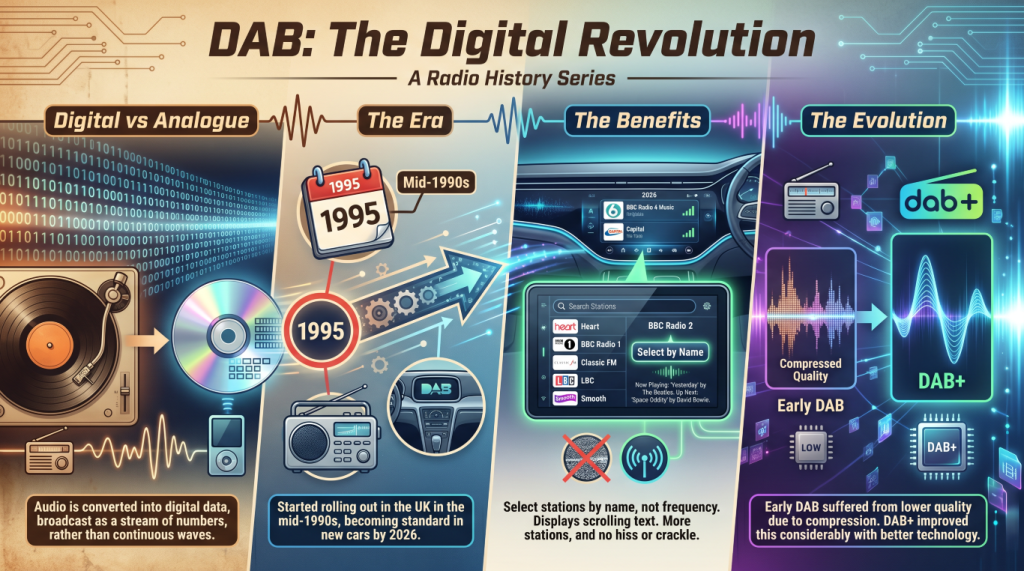
DAB, which stands for Digital Audio Broadcasting, started rolling out in the UK in the mid-1990s, but it’s really only been in the last 15 years or so that it’s become standard in new cars. By 2026, most new vehicles come with DAB as standard, though FM and AM usually remain available too.
DAB is fundamentally different because it’s digital rather than analogue. Instead of continuous waves being modulated, the audio is converted into digital data, broadcast as a stream of numbers, and then converted back to sound in your radio. Think of it like the difference between a vinyl record (analogue) and a CD (digital).
The benefits are substantial. DAB offers better sound quality than FM, more stations in the same amount of radio spectrum, and additional information like song titles, artist names, and scrolling text displayed on your radio screen. You also get far less interference, no more of that annoying hiss and crackle as you drive. The signal is either there or it isn’t, there’s no gradual degradation.
DAB also made car radio tuning simpler in many ways. Instead of remembering that your favourite station is on 95.8 FM, you just select it by name from a list. The radio finds it automatically.
The main criticism of early DAB was that it sometimes offered lower audio quality than FM because broadcasters compressed the signal too much to fit more stations in. DAB+, introduced more widely in the 2010s, improved this considerably with better compression technology. Some stations now sound genuinely excellent on DAB+.
How Car Radio Tuning Actually Works: The Technical Bit Made Simple
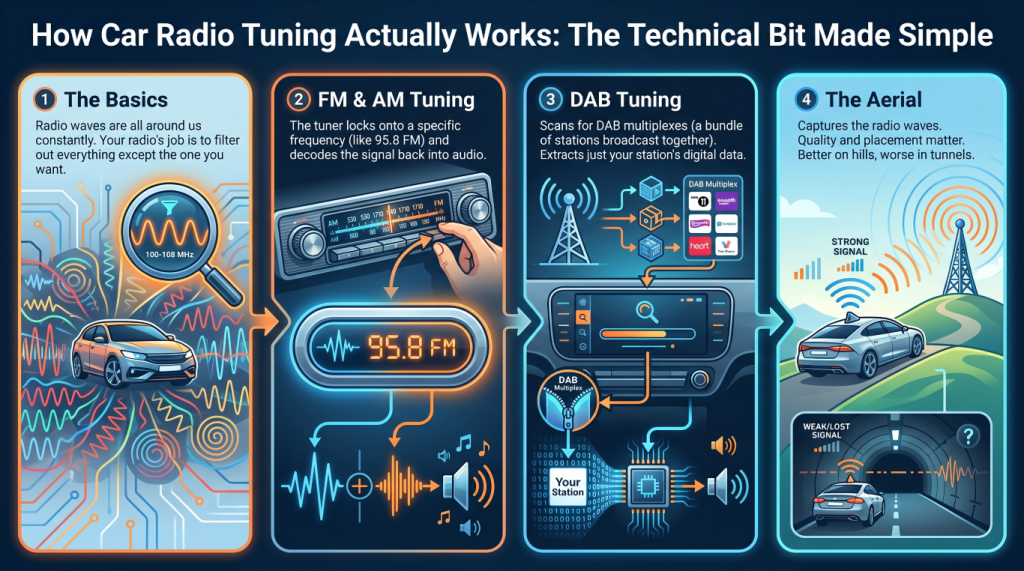
Right, let’s walk through what happens when you tune your car radio, whether you’re using FM AM DAB radio or any combination thereof. I promise to keep this straightforward.
When you turn on your car radio and select a frequency or station, you’re essentially telling your radio’s receiver to listen to one very specific part of the electromagnetic spectrum. Radio waves are all around us constantly, thousands of them, all at different frequencies. Your radio’s job is to filter out everything except the one you want.
For FM and AM, this works through a component called a tuner. When you select 95.8 FM, you’re telling the tuner to look for radio waves oscillating at 95.8 million times per second. The tuner locks onto that frequency, filters out everything else, and then decodes the modulation (remember, the variations in amplitude for AM or frequency for FM) back into audio signals. These signals get amplified and sent to your speakers.
The tuning process used to be entirely manual, you’d physically turn a dial that mechanically adjusted the tuner circuit. Modern radios use digital tuning, where pressing a button sends an electronic signal to adjust the tuner, but the principle remains the same.
DAB works rather differently. Instead of tuning to a specific frequency, your DAB radio scans a range of frequencies looking for DAB multiplexes. A multiplex is like a bundle of stations all broadcast together on the same frequency. When you select a station, the radio extracts just that station’s digital data from the multiplex, decodes it, and converts it to audio. This is why DAB radios often take a moment to find and lock onto a station when you first turn them on, they’re scanning and decoding digital data rather than just tuning to a frequency.
The aerial on your car (that little shark fin on the roof of modern cars, or the traditional rod on older ones) captures these radio waves. The quality of your aerial and its placement makes a huge difference to reception. This is why reception often improves when you’re on top of a hill and worsens in tunnels, it’s all about the aerial having a clear path to the transmitter.
The Future of Car Radio: What’s Coming Next
Here’s where things get interesting, and perhaps a little uncertain. The future of car radio tuning is caught between tradition and transformation.
In the UK, there’s been talk for years about switching off FM radio entirely, much like we did with analogue television. The government has set various targets for this, but as of 2026, FM is still going strong. The current policy suggests FM won’t be switched off until DAB listening reaches 50% of all radio listening and national DAB coverage matches FM coverage. We’re getting close, but we’re not quite there yet.
What seems more likely is that we’ll see a gradual transition where new cars simply stop including FM/AM as standard, making DAB and internet radio the default options. Some manufacturers are already doing this in certain markets.
Internet radio, delivered through your car’s data connection, is increasingly common in newer vehicles. This offers unlimited stations from around the world and perfect audio quality, but it relies on mobile data coverage and costs money in data charges. It’s brilliant when it works, but it’s not as universally reliable as broadcast radio.
I suspect we’ll see a hybrid future for quite some time. DAB for local and national stations, internet radio for specialist content and international stations, and probably FM hanging around as a backup for longer than anyone officially admits. There’s something reassuring about having a technology that works without depending on data networks or subscriptions.
Wrapping It All Up
So there we have it, the complete story of car radio tuning from the crackly AM sets that cost a fortune to the sleek DAB systems in modern vehicles. Understanding FM AM DAB radio isn’t just about technical knowledge, it’s about appreciating how this technology has evolved to serve us better while remaining fundamentally simple and accessible.
Car radio tuning has come an extraordinarily long way from those early days of interference and poor reception. We’ve moved from one type of modulation to another, from analogue to digital, from manual dials to automatic scanning. Yet the core purpose remains unchanged: connecting drivers to information, entertainment, and the world around them without fuss or subscription fees.
Knowing how to tune car radio properly, whether it’s finding the best FM station for traffic updates or scanning for DAB stations in a new area, remains a useful skill. It’s one of those things that seems simple until you’re in an unfamiliar car trying to find a station while navigating an unfamiliar road, then suddenly it matters quite a lot.
The future will likely bring more change, more integration with internet services, possibly the eventual retirement of FM. But I’d bet that some form of broadcast radio will remain in our vehicles for decades to come. It’s too useful, too reliable, and too universal to disappear entirely.
And honestly, there’s something rather wonderful about a technology that’s been refined over nearly a century, that works brilliantly at what it does, and that doesn’t require you to remember another password or agree to another terms of service agreement. Sometimes the old ways, improved and updated, are still the best ways.
Now, if you’ll excuse me, I need to go preset some DAB stations in my car. I’ve been putting it off for months, and I’ve just convinced myself it’s actually worth doing properly.
Walter
Leave a Reply