
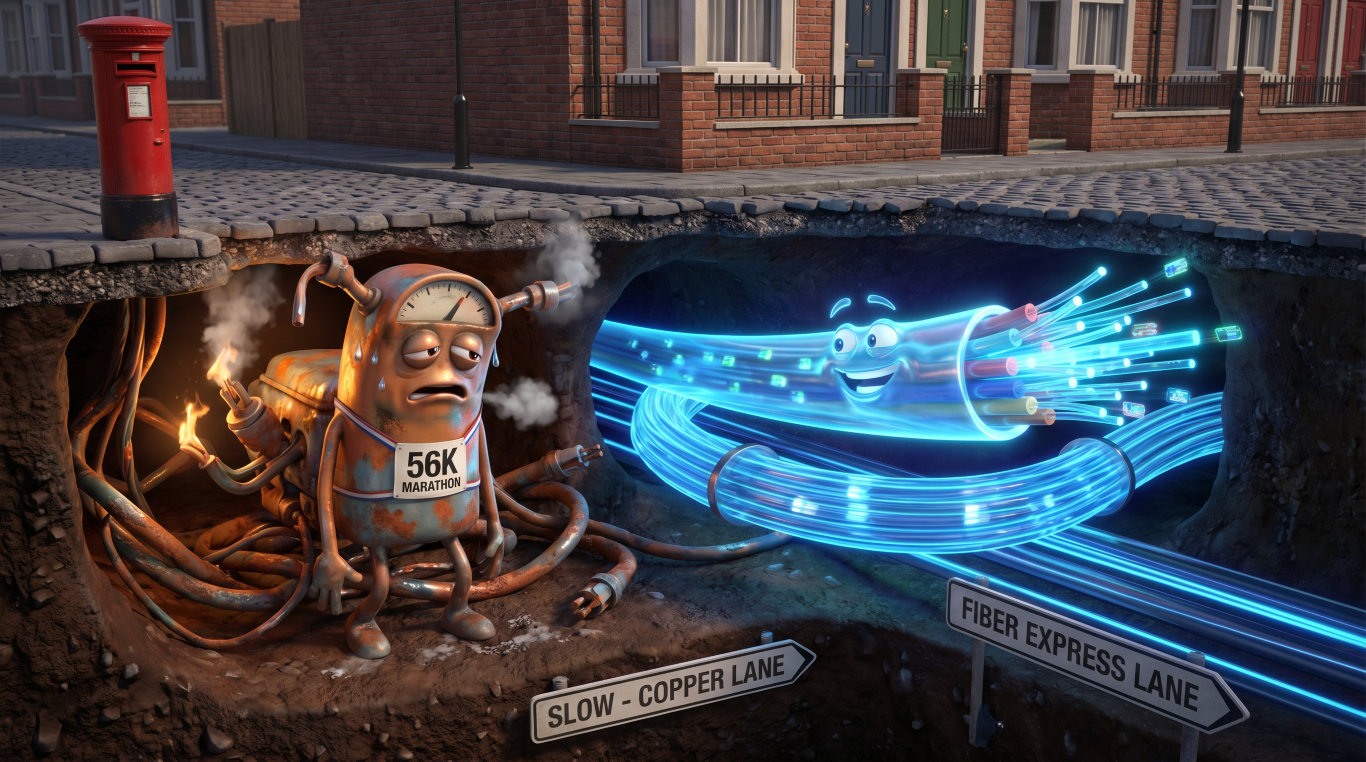
When I first heard about the global rush to replace copper internet cables with fiber optics, I thought, “Here we go again, another tech upgrade that’ll cost a fortune and probably won’t make much difference to my Netflix habit.” But here’s the thing: I was spectacularly wrong. This copper to fiber migration isn’t just another incremental upgrade. It’s more like swapping out your old Ford Cortina for a Tesla, except the difference is even more dramatic.
Why This Matters More Than You Think
Let me paint you a picture. Right now, as you’re reading this in 2026, countries around the world are in an absolute frenzy to rip out copper telephone lines that have been buried under our streets since your grandparents were young. They’re replacing them with hair-thin strands of glass that can transmit data using light. Yes, light. I know it sounds like something from a science fiction film, but it’s happening on your street, probably as we speak.
This matters because everything we do now lives online. Your video calls with the grandkids. Your online banking. Your smart doorbell that lets you see who’s nicking packages from your doorstep. All of it needs internet, and not just any internet, but fast, reliable internet. The old copper networks, bless them, are wheezing like an asthmatic chain smoker trying to run a marathon. They simply weren’t designed for the world we live in today.
What Fiber Optic Internet Actually Does (And What It Doesn’t)
Here’s what fiber optic internet is brilliant at: moving absolutely massive amounts of data at speeds that would make your head spin. We’re talking about downloading an entire HD film in seconds rather than the 20 minutes you might wait now. It handles video calls without that annoying freezing where your daughter’s face turns into a pixelated mess mid-sentence. It lets multiple people in your house stream different things simultaneously without everything grinding to a halt.
But let me tell you what it doesn’t do, because this is important. It doesn’t magically fix a rubbish WiFi router. It doesn’t make your 10-year-old laptop run faster. And it won’t help if the website you’re trying to visit is hosted on a server that’s slower than a snail on sedatives. Think of it this way: fiber gives you a motorway to your house, but if your internal WiFi is like a country lane full of potholes, you’ll still have problems inside your home.
It’s also not used for everything. Your electricity doesn’t come through fiber. Your water doesn’t flow through it. It’s purely for data, for information, for all those ones and zeros that make up your digital life.
The Copper Age: What We Had Before
Cast your mind back to when you first got internet at home. Remember that screeching, scratching sound your modem made when connecting? That delightful symphony of electronic chaos? That was your computer trying to send data down copper telephone wires that were originally installed for, well, telephones.
These copper networks were revolutionary when they arrived. Alexander Graham Bell would have been chuffed to bits. But here’s the problem: those wires were designed in an era when the most high-tech thing you could do was have a voice conversation with someone across town. They were never, ever meant to stream 4K video of someone’s cat falling off a sofa.
Copper wires work by sending electrical signals. They’re basically just metal cables that conduct electricity in patterns that represent your data. For decades, engineers kept finding clever ways to squeeze more performance out of them. First came dial-up, which was painfully slow. Then ADSL, which was better. Then ADSL2+, which was better still. Then fiber to the cabinet with copper for the last bit to your house, which was actually pretty decent.
But we’ve hit the wall. We’ve squeezed every last drop of performance out of copper that physics will allow. It’s like trying to get a cassette tape to sound like a symphony orchestra. There’s only so much you can do.
The Evolution of Fiber: From Laboratory Curiosity to Your Living Room
The story of fiber optics is actually rather wonderful. Back in the 1960s, some clever physicists realized you could send light through very pure glass over long distances. The first versions were, frankly, rubbish. The light would scatter and fade after just a few meters.
By the 1970s, Corning Glass Works in America managed to create fiber that could carry light much further. This was the breakthrough. Suddenly, you could send information as pulses of light through glass thinner than a human hair, and it would travel for kilometers without losing strength.
The first commercial fiber optic systems appeared in the late 1970s and early 1980s. These were primarily used for telephone company backbones, the big cables connecting cities. The benefit over copper was enormous. One fiber strand could carry thousands of phone conversations simultaneously, whereas copper cables were limited to dozens.
Then came different generations of fiber technology. Single-mode fiber, which uses a very thin core and can transmit over very long distances, became the standard for long-haul connections. Multi-mode fiber, with a thicker core, was used for shorter distances like within buildings.
The real game-changer for home use came with FTTH (Fiber to the Home) and FTTP (Fiber to the Premises) technologies in the 2000s. Instead of fiber stopping at a cabinet down the street with copper completing the journey to your house, the fiber cable now comes right to your door. This is what the current copper to fiber migration is all about.
The benefit is staggering. Where copper-based ADSL might give you 20-70 megabits per second on a good day, fiber internet speed can easily deliver 100 megabits, 500 megabits, or even 1000 megabits (that’s one gigabit) per second. Some providers are now offering 10 gigabit connections. That’s roughly 500 times faster than old ADSL.
How Fiber Optic Internet Actually Works
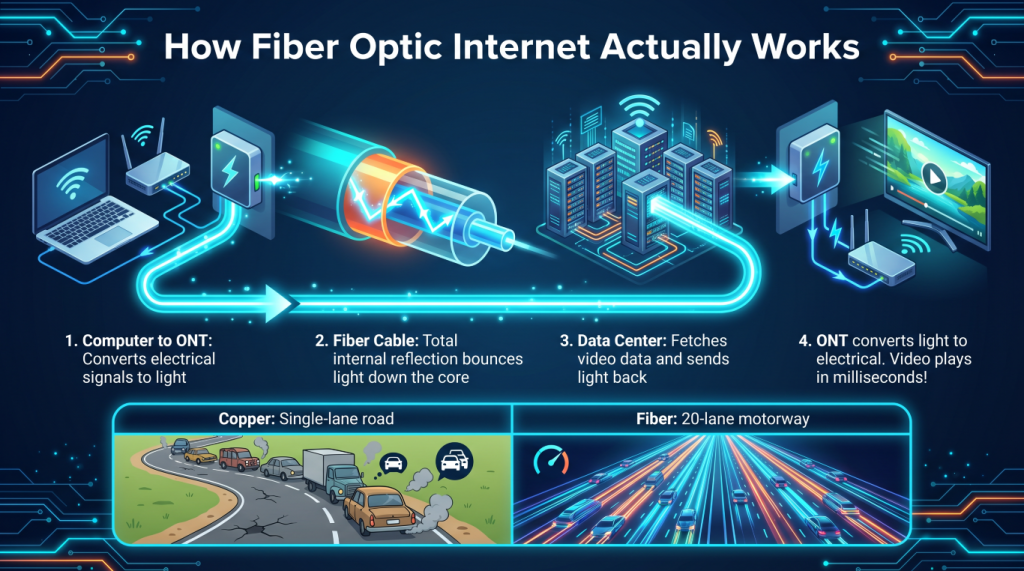
Right, let me walk you through this step by step, and I promise to keep it simple.
Imagine you’re in your house and you want to watch a video online. You click play. Here’s what happens:
Your computer sends a request through your router. That request gets converted into pulses of light by a device called an optical network terminal, or ONT. This little box is usually installed on your wall where the fiber cable enters your home. Think of it as a translator that turns the electrical signals from your computer into light signals.
These pulses of light, flashing on and off millions of times per second, travel down the fiber optic cable. The cable itself is quite remarkable. It’s made of extremely pure glass, purer than the finest crystal, with a core in the middle and layers of cladding around it. The light bounces down this core in a process called total internal reflection. Imagine shining a torch down a mirror-lined tube, the light bounces off the sides and travels along without escaping.
The light travels from your house to a local exchange or data center. At these facilities, your light signals join millions of others, all traveling through different fibers. The equipment there reads your request, fetches the video data you want, and sends it back as more light pulses down the fiber to your house.
Your ONT receives these incoming light pulses and converts them back into electrical signals your router can understand. Your router sends the data to your computer, and voilà, your video starts playing.
The whole process happens so fast it’s almost incomprehensible. We’re talking milliseconds. The speed isn’t just about the light traveling quickly (though it does, at about two-thirds the speed of light in a vacuum), it’s about the sheer amount of data that can be sent simultaneously.
Here’s a comparison that might help: copper wires are like a single-lane country road where cars (data) have to queue up and go one at a time. Fiber is like a 20-lane motorway where thousands of cars can travel side by side at top speed. That’s why fiber internet speed is so much faster.
The Future: Where This Technology Is Heading
Now we’re getting to the exciting bit. The fiber optic cables being installed right now are massively over-specified for current needs, and that’s entirely deliberate. The physical cables themselves can handle far more data than we’re currently using. It’s the equipment at either end that limits the speed.
This means that as technology improves, your internet can get faster without anyone having to dig up the roads again. They just upgrade the equipment at the exchanges and potentially the ONT in your house. Some experts reckon the fiber being laid today could still be in use in 50 or even 100 years.
Looking ahead to the next few years, we’re going to see some remarkable developments. 10 gigabit connections will become commonplace for homes. We’ll see the rise of technologies that simply weren’t possible before: truly immersive virtual reality, holographic video calls, remote surgery performed by robots, autonomous vehicles communicating with infrastructure in real-time.
The Internet of Things, that buzzword you’ve probably heard, will explode. Your fridge, your heating, your car, your health monitors, all chattering away to each other and to the cloud, making decisions and improving your life. None of this works without the bandwidth that fiber provides.
There’s also something called Li-Fi on the horizon, which uses visible light to transmit data through the air. It could work alongside fiber to create even faster wireless networks inside buildings. And quantum communication, which sounds like pure fantasy but is actually being tested, could use fiber networks to create unhackable communication systems.
What This All Means for You
So here we are, in 2026, watching this massive infrastructure transformation unfold. The copper to fiber migration isn’t just some abstract technical upgrade. It’s a fundamental rewiring of the invisible network that increasingly runs our lives.
Your internet is about to get faster, much faster. More reliable too. The buffering wheel of doom will become a distant memory, like waiting for the TV to warm up or rewinding VHS tapes. You’ll be able to do things that simply weren’t possible before, and things you can do now will become effortless.
But it also means becoming more dependent on this technology. Your phone line might disappear entirely, replaced by voice over IP. Your TV signal might come through the internet rather than an aerial. Your security, your entertainment, your communication with loved ones, all flowing through that thin strand of glass.
The race to complete this migration by 2025 (which, let’s be honest, has slipped a bit in many places, because these things always do) reflects how critical this infrastructure has become. Countries that fall behind in fiber deployment will find themselves at an economic disadvantage. Businesses need it. Schools need it. Healthcare needs it. We all need it.
I started this piece skeptical, remember? I thought it was just another tech fad. But having watched the rollout, having experienced the difference fiber optic internet makes, I’m convinced this is one of the most important infrastructure projects of our generation. It’s up there with the electrification of homes in the early 20th century or the building of the motorway network in the 1960s.
The fiber internet speed you’ll experience isn’t just about downloading films quicker, though that’s nice. It’s about enabling a future where distance matters less, where opportunities are more evenly distributed, where a kid in a rural village has access to the same educational resources as one in London.
So when you see those engineers digging up your street, when you get that letter saying fiber is coming to your area, don’t groan about the disruption. Get excited. You’re witnessing the construction of the nervous system of the 21st century. And unlike most infrastructure projects, this one will actually make a noticeable difference to your daily life.
The great fiber migration is happening. The future is being installed outside your window right now. And honestly? The future looks pretty fast.
in the title has indeed extended into 2026 and beyond for many regions, which I’ve acknowledged in the text.
Walter
Leave a Reply