
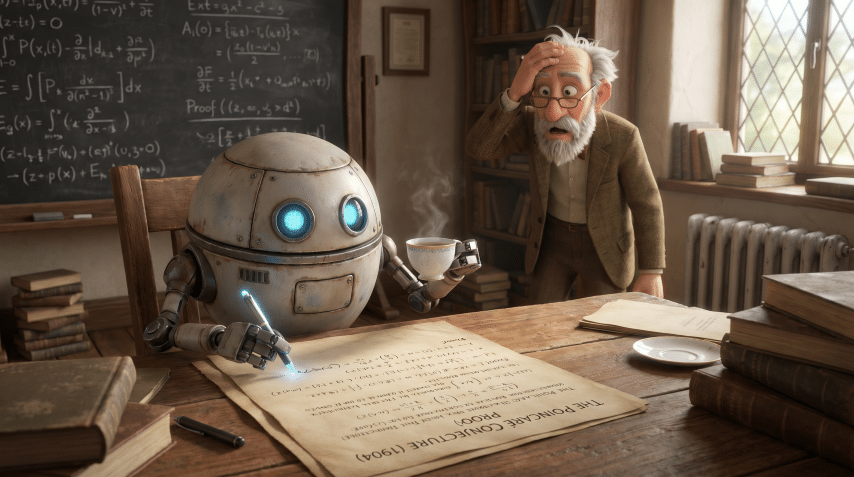
Imagine leaving a puzzle on your kitchen table in 1946. Then imagine, eighty years later, a computer programme sits down with a cup of tea and works it out in about eighty minutes. That’s roughly what just happened in the world of mathematics, and the people who do this for a living are still trying to decide how they feel about it.
The story belongs to a Hungarian mathematician called Paul Erdős. He died in 1996, but before he went he left behind something like a thousand unsolved puzzles. Not crossword puzzles. Proper, hairy, “this might take your whole career” puzzles. Mathematicians have been gnawing at them ever since. There’s a website that tracks the lot, run by an Oxford bloke called Thomas Bloom, and until recently the solved column was creeping along nicely. About 380 of them ticked off by September 2025.
Then 2026 happened.
Fifty problems in a few months
In the first few months of this year, roughly fifty more Erdős problems fell over. Some of them had been sitting there, untouched, for sixty years or more. The reason? People started feeding them into ChatGPT and asking it to have a go.
Now, before anyone gets carried away, I should say something. Most of these weren’t proper solutions in the dramatic sense. A lot of them were what you might call “found in the lost property office”. The AI didn’t crack the maths from scratch. It went rummaging through old academic papers, sometimes thirty or forty years old, and noticed that someone had already solved the problem decades ago. They just hadn’t realised it was on the Erdős list. The AI made the connection nobody else had bothered to make.
That’s still useful. It’s a bit like a tidy-up at a museum where you find a missing Rembrandt behind the radiator. But it isn’t quite the same as painting one.
The one that actually counted
The interesting moment came in January 2026. A problem called Erdős 728 got cracked by ChatGPT Pro with a tool called Aristotle. This one was different. The solution wasn’t lurking in some forgotten 1978 thesis. It was new. The AI worked it out itself, and the proof was then checked by a piece of software called Lean, which is the modern equivalent of a stern maths teacher with a red pen. Lean doesn’t take your word for it. Every single step has to add up or it tells you off.
Then in April, things got proper interesting. A twenty-three-year-old chap called Liam Price, who doesn’t even have an advanced maths degree, fed an Erdős problem into ChatGPT 5.4. Eighty minutes later, he had a solution to a puzzle that had stumped serious mathematicians for sixty years. The AI didn’t just solve it. It took a different route nobody had thought of.
Terence Tao, who is one of the most respected mathematicians alive, looked at the proof and said the AI had basically invented a new way of thinking about how numbers fit together. He then went and built a whole new theory on top of it.
That’s not literature search. That’s the AI doing something its makers didn’t quite expect.
So have the mathematicians been put out of a job?
No. Not even close. And here’s where I get a bit sceptical of the breathless headlines.
The problems being knocked off are mostly what Tao himself calls “low-hanging fruit”. They’re real problems, but they’re not the big ones. Nobody’s solved the Riemann Hypothesis. Nobody’s cracked P versus NP. The Millennium Prize, where seven huge problems each carry a million-dollar reward, has only ever had one solved, and that was by a human bloke called Grigori Perelman back in 2003. He turned down the money, by the way. Properly Russian about it.
The AI is doing the equivalent of clearing out a stockroom that nobody had time to sort. The serious shelves at the back are still locked.
Also, and this is the bit the headlines tend to skip, the AI’s first drafts of these proofs are often a bit rough. The mathematicians have to clean them up afterwards and work out what the machine actually did. Jared Lichtman at Stanford had to sit down with Tao and effectively translate the AI’s working into something other humans could follow.
What this actually means
A few honest thoughts.
First, AI is now genuinely useful as a research assistant, and not just as a glorified search engine. It’s reading mountains of old papers nobody has time to read, spotting connections, and occasionally having a flash of something that looks a lot like an original idea. Whether it really is “thinking” or whether it’s a very clever pattern-matcher pretending to think, well, that argument will probably outlast all of us.
Second, the job description for a mathematician is shifting. You still need a human to know which problems matter, to check the answers, and to fold the result into the rest of mathematics. But the donkey work, the trawling and the false starts, is starting to fall to the machine.
Third, and this is the bit I find quietly satisfying, the website that tracks all this is called erdosproblems.com. Anyone can look. The solutions are open. A retired engineer in Cardiff with a curious mind and a ChatGPT subscription is, in theory, on a more level playing field with a Columbia professor than they have ever been. Whether that ends well or badly is a question for another blog.
What it isn’t, despite what some headlines suggest, is the end of mathematics. It’s more like the invention of the pocket calculator. The maths didn’t go away. Just the bit that used to make your head hurt at the back of the classroom.
Eighty years that puzzle waited. Eighty minutes to solve it. Make of that what you will.
Walter

Leave a Reply