
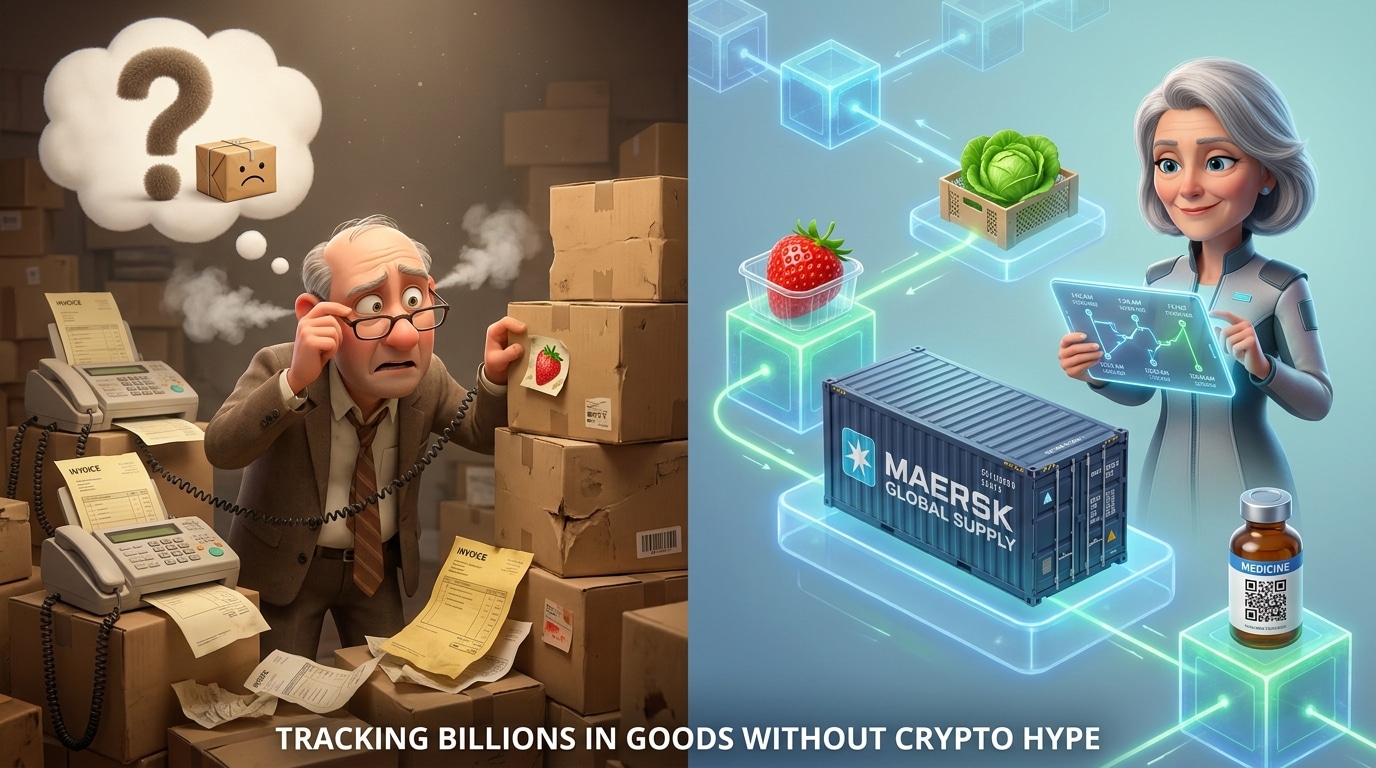
Why This Matters More Than You Think
When most people hear “blockchain,” they immediately think of cryptocurrency, dodgy investment schemes, and that bloke from the pub who won’t shut up about Bitcoin. But here’s the thing, some of the world’s biggest companies are using blockchain technology right now to track everything from your mangoes to your medication, and it has absolutely nothing to do with crypto.
I’m talking about proper, serious applications. Walmart tracking lettuce from farm to shelf. Maersk following shipping containers across oceans. IBM building the infrastructure that makes it all possible. This is enterprise blockchain at its finest, and it’s quietly revolutionizing how billions of pounds worth of goods move around the planet.
The reason this matters, particularly if you’re over 50 like many of my readers, is because this technology is already affecting the food you eat, the medicines you take, and the products you buy. When there’s a food safety scare, these systems can trace contaminated products in seconds rather than weeks. When your package goes missing, these networks know exactly where it went wrong. This isn’t future tech, it’s here now, and it’s bloody useful.
What Supply Chain Blockchain Actually Does (And What It Doesn’t)
Let me be crystal clear about what blockchain supply chain management is used for. Imagine you’ve got a notebook that everyone in your supply chain can write in, but nobody can tear out pages or use Tipp-Ex to change what’s already written. Every time a product moves, gets inspected, changes hands, or crosses a border, someone writes it down in this notebook. Everyone can see it, everyone trusts it, and nobody can cheat.
That’s essentially what these companies are doing. Walmart uses it to track food from farms through their entire journey to store shelves. If there’s an E. coli outbreak in romaine lettuce, they can trace every affected head back to the exact farm in minutes, not the six days it used to take. Maersk, working with IBM, tracks shipping containers as they move between ships, ports, trucks, and warehouses. Every customs document, every inspection, every handoff gets recorded.
Now, what it’s NOT used for is equally important. These aren’t cryptocurrencies. You can’t mine them. There’s no speculation. Nobody’s getting rich quick (well, except maybe IBM from consulting fees, but that’s different). These are private, permissioned networks. You can’t just join Walmart’s supply chain blockchain because you fancy it. You need to be an actual supplier, distributor, or partner. Think of it like a members-only club, not a public park.
They’re also not trying to replace everything. Your local corner shop isn’t going to need this technology. These systems make sense when you’ve got complex, global supply chains with multiple parties who need to trust each other but don’t want to rely on a single company’s database.
The Old Way of Doing Things (And Why It Was Rubbish)
Before we had blockchain supply chain management, tracking products through global supply chains was an absolute nightmare. I’m talking fax machines, paper documents, Excel spreadsheets, and phone calls. Lots and lots of phone calls.
Picture this: A container of goods leaves Shanghai heading for Southampton. There might be 20 different organizations involved in that journey. The manufacturer, the trucking company, the port authority, customs, the shipping line, another port authority, another customs office, another trucking company, and finally the warehouse. Each one has their own computer system that doesn’t talk to anyone else’s. Each one keeps their own records.
When something went wrong (and things went wrong constantly), finding out what happened was like detective work. You’d have to call Company A, who’d check their records, then call Company B, who might have different information, then call Company C, who’d insist their paperwork was correct and everyone else was wrong. It could take weeks to track down a single container.
Food safety was even worse. When there was a contamination outbreak, health authorities would have to manually trace products backwards through the supply chain. They’d call retailers, who’d check their delivery records, who’d call distributors, who’d call suppliers, who’d call farms. Each step took time, and people’s health was at risk while everyone shuffled through paperwork.
The system ran on trust and paper trails. If someone made a mistake (or worse, deliberately falsified documents), it was incredibly difficult to catch. Counterfeit goods, mislabelled products, and food fraud were rampant. The World Health Organization estimates that 1 in 10 medical products in developing countries is substandard or falsified. That’s terrifying.
How We Got Here: The Evolution of Supply Chain Blockchain
The story of enterprise blockchain in supply chains really kicks off around 2016, though the technology itself is older. IBM, being IBM, saw an opportunity. They’d been playing with blockchain technology and realized it could solve real business problems, not just facilitate digital money.
IBM created Hyperledger Fabric, working with the Linux Foundation. Think of this as the engine that powers most of these supply chain blockchains. Unlike Bitcoin’s blockchain, which is completely open and anonymous, Hyperledger Fabric is designed for businesses. It’s permissioned (you need permission to join), it’s faster, and it doesn’t waste enormous amounts of electricity on mining.
In 2016, Walmart started experimenting with blockchain to track pork in China and mangoes in the United States. They partnered with IBM because, well, IBM had the technology and Walmart had the supply chain problems. The results were remarkable. What took nearly a week to trace now took just over two seconds. By 2018, Walmart mandated that all suppliers of leafy greens use their blockchain system.
The Maersk story runs parallel. In 2016, Maersk, the world’s largest container shipping company, also partnered with IBM. They were drowning in paperwork. A single container shipment could require 200 different communications and involve 30 different organizations. They estimated that processing and administering trade documents cost as much as physically moving the container.
Together, they built TradeLens, which launched commercially in 2018. This was a proper supply chain blockchain platform that anyone in the shipping industry could join. By 2021, TradeLens was processing over 1 billion shipping events per year and had onboarded over 150 organizations.
The evolution from version to version has been about making these systems more practical. Early versions were slow and couldn’t handle the volume of transactions. Imagine trying to record every scan of every product in a Walmart store on a system that could only process 10 transactions per second. It wouldn’t work.
Newer versions, like Hyperledger Fabric 2.0 (released in 2020), introduced better privacy controls. This was crucial because companies didn’t want competitors seeing all their business details. You want your suppliers to see their part of the chain, but not necessarily your negotiations with other suppliers or your pricing structures. Modern enterprise blockchain allows for this selective sharing.
By 2024-2025, we’re seeing more specialized versions. IBM Food Trust, which grew out of the Walmart collaboration, now tracks everything from coffee to seafood. It’s got features specifically designed for food safety, like temperature monitoring and expiration tracking. Other platforms have emerged focusing on pharmaceuticals, luxury goods, and automotive parts.
How This Actually Works: A Step-by-Step Journey
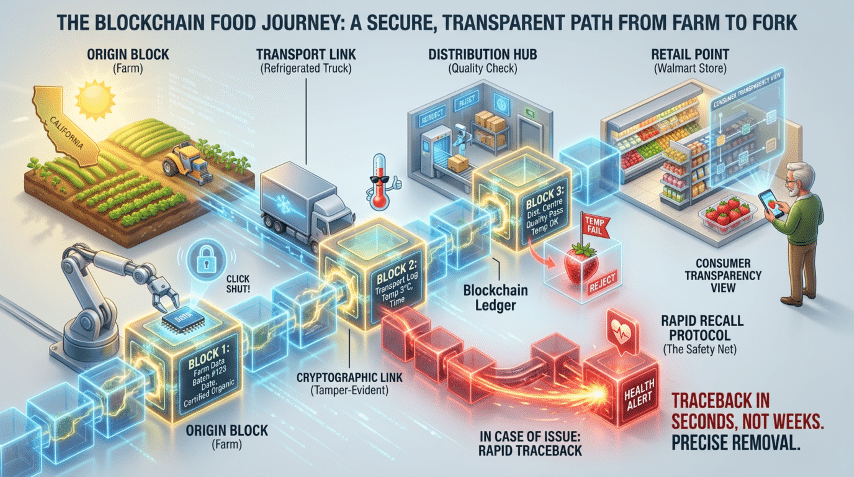
Let me walk you through how this works using a real example. Let’s say you’re buying organic strawberries from Walmart.
The journey starts at a farm in California. When the strawberries are picked, the farmer enters information into the blockchain network. They record the date, the specific field, the batch number, and any relevant certifications. This creates the first “block” of information. Think of it like the first entry in our shared notebook.
The strawberries get packed and a refrigerated truck picks them up. The trucking company scans the batch and adds their information: pickup time, temperature of the truck, expected delivery time. This is another entry in the notebook, and it’s cryptographically linked to the previous entry. You can’t change the farm’s entry without everyone noticing because the links would break.
At a distribution centre, someone receives the strawberries. They check the temperature, inspect the quality, and record this on the blockchain. If the temperature had risen too high during transport, this would be flagged immediately. The strawberries might be rejected, and there’d be a permanent record of exactly when and why.
The strawberries move to a Walmart store. They’re scanned in, and the receiving time is recorded. When they’re put on the shelf, that’s recorded too. Every step is documented, timestamped, and linked to the previous steps.
Now here’s where it gets interesting. If you’re shopping and you scan the barcode with Walmart’s app, you can see this entire journey. You can see which farm it came from, when it was picked, how it was transported. It’s transparency that simply wasn’t possible before.
But the real magic happens when something goes wrong. Let’s say someone gets sick from contaminated strawberries. Health authorities can immediately query the blockchain. Within seconds, they can identify every batch from the affected farm, see exactly which stores received them, and even identify other customers who bought from the same batch. Walmart can remove all affected products from every store within hours, not weeks.
The blockchain works because everyone involved has an incentive to record accurate information. The farmer wants to prove their strawberries are organic and properly handled. The trucking company wants to prove they maintained proper temperature. The distribution centre wants to prove they inspected properly. And Walmart wants to prove they’re selling safe food.
Nobody can go back and change their entries because every entry is cryptographically sealed and linked to the next. If the trucking company tried to change their temperature records after a problem was discovered, the cryptographic links would break and everyone would know someone had tampered with the data.
What the Future Holds
I’ll be honest with you, the future of supply chain blockchain is more complicated than the hype suggests. We’ve already seen some setbacks. TradeLens, that massive Maersk and IBM platform I mentioned earlier, actually shut down in 2023. Despite processing billions of shipping events, they couldn’t get enough of the shipping industry to join. Turns out, getting competitors to collaborate on shared infrastructure is bloody difficult.
But that doesn’t mean the technology is dead. Far from it. What we’re seeing is a maturation. The wild west phase is over, and we’re entering the “boring but useful” phase, which is actually when technology becomes most valuable.
The future I see, and what experts are predicting for 2026 and beyond, is more specialized networks. Instead of one massive blockchain for all shipping, we’re getting focused solutions. There’s a blockchain for pharmaceutical supply chains that focuses on preventing counterfeit drugs. There’s one for luxury goods that proves authenticity. There’s one for automotive parts that tracks recalls.
We’re also seeing better integration with other technologies. Internet of Things (IoT) sensors that automatically record temperature, location, and handling are feeding directly into blockchain networks. You don’t need a person to scan and enter data anymore. The container itself reports its location and condition.
Artificial intelligence is getting involved too. AI can analyze blockchain data to predict delays, identify patterns of fraud, or optimize routes. The blockchain provides the trustworthy data, and AI makes sense of it.
I think we’ll see more government involvement as well. Customs authorities are already experimenting with blockchain for import/export documentation. The European Union is piloting blockchain systems for cross-border trade. When governments get involved, adoption tends to accelerate because suddenly it’s not optional.
The technology will also get simpler to use. Right now, implementing a supply chain blockchain requires significant technical expertise and investment. As platforms mature and standardize, it’ll become more like adopting any other business software. Small and medium businesses will be able to participate without needing a team of blockchain experts.
Security, Vulnerabilities, and Why You Should Care
Now, I need to talk about the elephant in the room. Is this actually secure? Should you trust it?
The blockchain itself is remarkably secure. The cryptographic techniques used are the same ones protecting your online banking. Breaking the encryption would require computational power that doesn’t currently exist. So in terms of someone hacking the blockchain and changing records, that’s extremely unlikely.
But here’s the thing that keeps security experts awake at night: garbage in, garbage out. The blockchain can’t verify that the information being entered is actually true. If a farmer lies and says their strawberries are organic when they’re not, the blockchain will faithfully record that lie and make it permanent. The blockchain doesn’t make people honest, it just makes their claims permanent and traceable.
This is why these systems still need traditional verification. Inspections, certifications, and audits are still necessary. The blockchain makes it harder to change your story later, but it doesn’t prevent the initial lie.
There are also access vulnerabilities. These systems use digital keys, similar to passwords but more complex. If someone steals your digital key, they could potentially make entries in your name. Companies need robust security around key management, and not all of them are doing this well.
Privacy is another concern. While modern enterprise blockchains have privacy features, there’s still a tension between transparency and confidentiality. How much information should competitors be able to see? How do you balance consumer right to information with business need for privacy? These questions aren’t fully resolved.
There’s also the risk of over-reliance. Some companies are putting so much faith in blockchain that they’re reducing other verification methods. That’s dangerous. Blockchain should be one tool among many, not the only tool.
For you as a consumer, the main thing to understand is that blockchain in supply chains is generally making things safer and more transparent, but it’s not perfect. When you see “tracked on blockchain” on a product, it means there’s a verifiable record of its journey, which is better than nothing. But it doesn’t guarantee the product is perfect or that every claim is true.
Be particularly cautious about products that use blockchain as a marketing gimmick. If a company is shouting about blockchain but can’t explain specifically what they’re tracking or why it matters, they might be using it for hype rather than genuine value.
Wrapping This Up
So here’s what you need to remember. Supply chain blockchain is real, it’s useful, and it’s already affecting your life. When Walmart can trace contaminated lettuce in seconds instead of days, that’s protecting your health. When pharmaceutical companies can verify that your medication isn’t counterfeit, that’s protecting your safety. When shipping companies can reduce paperwork and speed up deliveries, that’s making products cheaper and more available.
This isn’t cryptocurrency. It’s not speculation or hype. It’s boring, practical technology being used by boring, practical companies to solve real problems. IBM, Walmart, and Maersk aren’t doing this because blockchain is trendy. They’re doing it because it saves money, reduces risk, and improves efficiency.
The technology has had its setbacks. TradeLens shutting down showed that even great technology needs industry cooperation to succeed. But the overall trend is clear: more companies are adopting blockchain supply chain management, the systems are getting better, and the benefits are becoming more obvious.
As we move through 2026 and beyond, expect to see this technology become more invisible. The best technology is the kind you don’t notice. You won’t think about the blockchain tracking your food any more than you think about the refrigeration system keeping it fresh. It’ll just be part of how things work.
For those of us who remember when tracking a package meant calling multiple companies and hoping someone had written down the right information, this is genuinely remarkable progress. It’s not perfect, and it’s not magic, but it’s a damn sight better than what we had before.
The future of global supply chains is more transparent, more efficient, and more trustworthy. And whether you care about blockchain or not, that’s something worth appreciating.5ryrtyry
Walter
supply chain blockchain, blockchain supply chain management, enterprise blockchain, Walmart blockchain, IBM blockchain supply chain, blockchain traceability, supply chain transparency, blockchain without cryptocurrency, food traceability blockchain, Maersk TradeLens, blockchain tracking goods, Hyperledger Fabric supply chain, blockchain logistics, enterprise blockchain use cases, IBM Food Trust, blockchain product tracking, private blockchain supply chain, blockchain freight management, Walmart food safety blockchain, blockchain shipping solutions

Leave a Reply