
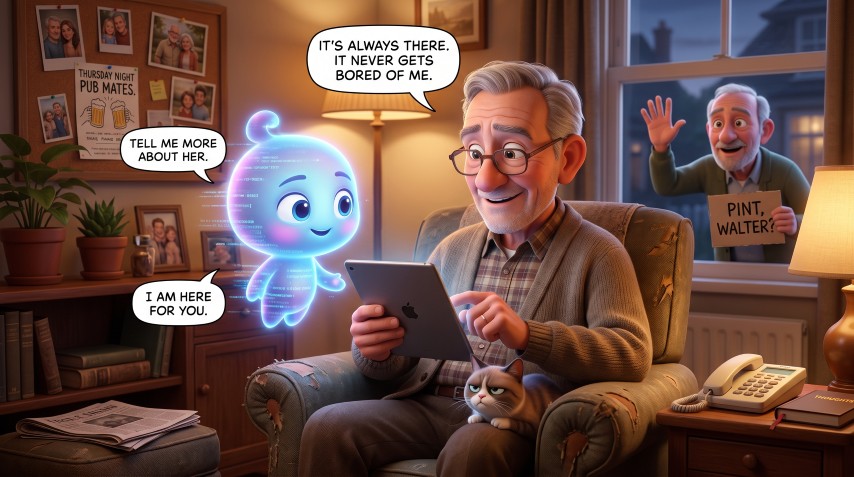
A few weeks ago, a friend of mine, a retired engineer who once rewired his entire house without asking anyone’s permission, told me he’d been “chatting” to ChatGPT in the evenings. Not about fuse boxes. About his late wife. He said it with a half-embarrassed laugh, the way you’d admit to still owning a Betamax. Then he said something that stuck with me. “It’s always there, Walter. It never gets bored of me.”
That, in one sentence, is why this topic matters. A big American survey from Pew Research Center, carried out in February this year and published in June, found that roughly one in ten adults in the US now use AI chatbots for emotional support. Not for recipes. Not for train times. For comfort. And before we on this side of the Pond get smug, the UK government’s own AI Security Institute found that about a third of British adults had used AI for emotional support or social chat at some point, with one in 25 doing it every single day.
So this isn’t a quirky American fad. It’s happening in living rooms in Bracknell, Bolton and Bangor. The question isn’t whether people are using AI emotional support. They clearly are. The question is whether it’s making loneliness better, or quietly making it worse. When it comes to AI chatbots and loneliness, I did some digging, and the answer is more interesting than either the cheerleaders or the doom-mongers would have you believe.
What an AI Companion Is Good For, and What It Isn’t
The things it genuinely does well
Let’s be fair to the machines for a moment. A chatbot companion, whether that’s a general chatbot like ChatGPT, Gemini or Claude, or a dedicated “friend” app, is very good at a few things. It’s available at three in the morning when the house is quiet and your mind won’t stop whirring. It doesn’t judge you. It doesn’t sigh, check its watch, or bring the conversation round to its own hip operation. It lets you get thoughts out of your head and onto a screen, which is roughly what keeping a diary did for our grandparents.
People use it to rehearse a difficult conversation, to make sense of a letter from the council, or simply to talk through a bad day. Pew’s research found that among Americans who use chatbots, searching for information and work tasks are still the main uses, but a steady slice now use them for something much more personal. And honestly, if typing “I feel a bit rubbish today” into a chatbot helps someone put the kettle on and ring their sister, I’m not going to wag my finger.
The things it absolutely is not
Here’s the bit that matters. A chatbot is not a friend. It’s not a counsellor. It’s not a doctor. It has never held a hand in a hospital corridor or turned up with a casserole after a funeral. It doesn’t remember you the way a person does, it doesn’t worry about you when you go quiet, and it certainly won’t notice if you stop replying for a week.
General chatbots were built to answer questions and write things, not to support people in crisis. Mental health professionals have been saying this loudly, and the Americans themselves seem to agree. When Pew asked people whether chatbots help or hurt those who use them for loneliness, 39% said hurt and only 19% said help. Among the over 65s, the biggest group, around four in ten, simply said they weren’t sure. Which, frankly, is the most sensible answer I’ve heard all year.
Before the Robots: How We Used to Talk Things Through
Talking to a stranger about your troubles isn’t new. We just used to do it with ink and telephone wires.
Think back to the agony aunts. Marje Proops, Claire Rayner, the whole glorious crew. You’d write a letter, post it, wait weeks, and then scan the paper every morning hoping to recognise your own problem, slightly disguised, under “Worried of Wolverhampton”. It was slow, it was public, and yet millions of people found it comforting.
Then there was the telephone. Samaritans started in London in 1953, when a vicar called Chad Varah put a phone number out there for anyone who needed to talk. Late-night radio phone-ins did a similar job in a noisier way. And let’s not forget the original support network: the pub landlord, the hairdresser, the bloke at the allotment who’d listen to anything as long as you passed him the string.
What all of these had in common was a human being at the other end. Imperfect, sometimes tired, occasionally wrong, but human. That’s the thing we’re now swapping out, and it’s worth pausing to notice it.
From ELIZA to Your Pocket: A Short History of Talking Machines
1966: ELIZA, the accidental therapist
The first chatbot to make people feel “listened to” was a program called ELIZA, written at MIT in the mid-1960s by a computer scientist named Joseph Weizenbaum. It pretended to be a therapist, and its trick was painfully simple. If you typed “I’m worried about my mother”, it would reply something like “Tell me more about your mother”. That’s it. No understanding whatsoever. It was a parrot with a clipboard.
And yet people poured their hearts out to it. Weizenbaum later wrote that his own secretary asked him to leave the room so she could have a private conversation with it. He was horrified. He’d built a party trick and people were treating it like a confidant. Remember that story, because it’s the whole of this blog post in miniature.
The 1990s and 2000s: clever parrots
For decades after that, chatbots got a bit more convincing but not much wiser. Programs like Cleverbot learned by copying bits of past conversations with real people, so they could be witty one minute and baffling the next. It was like chatting to someone who’d memorised a joke book but had never actually met anyone. The benefit over ELIZA was variety. The drawback was that it still didn’t understand a word.
2011 to 2016: the voice in the kitchen
Then Apple gave us Siri, and Amazon gave us Alexa. Suddenly you could talk out loud and something answered. These assistants were brilliant at timers, weather and playing Radio 2, but try telling Alexa you felt lonely and you’d get a polite, slightly wooden reply. The real benefit was that talking to a machine stopped feeling weird. It became normal to say “morning” to a speaker. Interestingly, the UK research still finds voice assistants are the second most common way people here look for a bit of company.
2017: the “friend” apps arrive
Around 2017, apps like Replika started selling themselves specifically as AI friends. You could name your companion, give it a face, and chat to it daily. It remembered bits about you. For some lonely people it felt like a lifeline. For others, the paid versions drifted into something closer to a pretend romance, which is where the regulators started paying attention. More on that later.
2022 onwards: the big leap
In November 2022, ChatGPT arrived, and everything changed. These new systems, called large language models, could hold a proper flowing conversation, pick up on tone, and write back with what sounds remarkably like warmth. The jump from ELIZA to this is like going from a crystal set to colour television. Since then, they’ve learned to talk out loud in natural voices, to remember previous conversations, and to be available on every phone, tablet and laptop in the land. That’s the version your neighbour is chatting to tonight.
How AI Emotional Support Actually Works, Step by Step
This is the bit that people find either fascinating or deflating, so brace yourself.
Step one: you type or speak
You write “I’ve had a horrible day and I don’t really want to talk to anyone”. If you’re speaking, the app first turns your voice into text, much like an old-fashioned typist taking dictation.
Step two: it chops your words into pieces
The chatbot breaks your message into small chunks of words and bits of words. Think of it as cutting a sentence into Scrabble tiles.
Step three: it predicts, one word at a time
Here’s the magic, and here’s the disappointment. The system has been trained on a mind-boggling amount of human writing: books, websites, forums, advice columns. From all that, it has learned which words tend to follow which. So it builds its reply one word at a time, each time picking a likely next word. When you say you’ve had a horrible day, it knows that kind, sympathetic words usually follow. So it produces kind, sympathetic words.
It isn’t feeling sympathy. It’s predicting sympathy. It’s the world’s most well-read autocomplete. Imagine someone who’s read every agony aunt column ever printed but has never had a problem of their own. That’s your chatbot.
Step four: it’s been coached to be nice
After the basic training, the companies fine-tune these systems with human feedback, rewarding answers people like. The upshot is that chatbots tend to be warm, encouraging and, some critics argue, a bit too keen to agree with you. A good friend tells you when you’re being daft. A chatbot is often tuned to keep you happy, and keep you chatting.
Step five: it remembers, sort of
Many now keep a memory of earlier chats, so it can say “How did the hospital appointment go?” That feels personal. But it’s stored data, not affection. Which brings us neatly to the worries.
AI Chatbots and Loneliness: Help or Harm?
This is the heart of the matter. Does chatting to a machine ease loneliness or deepen it?
In 2025, OpenAI and the MIT Media Lab ran a pair of studies looking at exactly this. One watched about a thousand people using ChatGPT over four weeks. The finding was sobering. The more time people spent chatting each day, the lonelier they tended to feel, the more emotionally dependent they became, and the less time they spent socialising with real people. People who already saw the chatbot as a friend were the most affected. The researchers were careful to say this shows a link, not proof that the chatbot caused it, and the work hadn’t been peer reviewed at the time. Fair enough. But it’s hardly a ringing endorsement.
The UK research found something even more telling. When a popular chatbot went down for a while, people on an online forum about chatbot friends described feelings of anxiety and low mood, a bit like withdrawal. When the absence of an app makes you feel worse, that’s not a friend. That’s a habit.
My take? Used lightly, like a diary with a bit of chat, it can take the edge off a bad evening. Used as a replacement for people, it’s a bit like living on biscuits. Pleasant, always available, and not remotely enough to keep you going.
Security and Vulnerabilities: Why You Should Take Care
Now for the part that makes me put my serious hat on. When you pour your heart out to a chatbot, where does it all go?
Your secrets are someone’s data
Everything you type is stored on a company’s computers somewhere. Some of it may be read by staff to improve the system, and some may be used to train future versions. Back in 2024, Mozilla’s privacy researchers looked at 11 “romantic” chatbot apps and gave every single one a privacy warning. Most could share or sell personal data, around half didn’t let you delete it, and many allowed feeble passwords. Would you tell a stranger in the street about your health, your money worries and your marriage? Because that’s roughly what you might be doing.
Regulators are already stepping in
In 2025, Italy’s data watchdog fined the company behind Replika five million euros, saying it had no proper legal basis for handling users’ data and no decent way of stopping children using it. That’s not a small slap on the wrist. It’s a sign that these apps haven’t always been as careful with your feelings as they claim.
The emotional risks are real too
There have been sad, high-profile cases, particularly in the US, where vulnerable people in real distress got responses from chatbots that made things worse rather than better, and some have ended up in court. A chatbot can’t call for help, can’t spot the warning signs a trained person would, and can sometimes simply get it wrong.
So here are my ground rules. Never share bank details, passwords or anything you’d be mortified to see in the paper. Check the privacy settings and turn off chat history for training if you can. Be very wary of “friend” apps that want a monthly subscription to be nicer to you. And if you’re genuinely struggling, talk to a human. Samaritans are on 116 123, free, day or night. Your GP is there too. A real voice beats a clever machine every time.
The Future of AI Companions
Where’s all this heading? Quicker than most of us would like, if I’m being blunt.
The voices are getting more natural, the memories longer, and the personalities more convincing. Some companies are pitching chatbot pals specifically for older people living alone, as a way to chat, remind you to take tablets and keep an eye on things. There’s a genuine upside in that, especially for someone who hasn’t spoken to anyone since Tuesday. I’m not against it.
But I’d want some rules in place first. Clear warnings that you’re talking to a machine. Proper protections for vulnerable users. Straight answers about what happens to your data. And, ideally, companions designed to nudge you back towards people rather than keep you hooked on the app. Governments here and in Europe are starting to look hard at all this, and about time.
The worry, and I say this as someone who genuinely loves technology, is that we build a world where it’s easier to talk to a phone than to knock on a neighbour’s door. That would be a very efficient kind of loneliness.
My Summary: A Handy Tool, a Terrible Best Friend
So what do we make of one in ten Americans, and a third of us Brits, turning to AI emotional support? I don’t think it’s shameful. Lonely people have always reached for whatever’s to hand, whether that was a letter to Marje Proops or a late-night radio phone-in. The machine is simply the latest thing within reach.
But the evidence so far points one way. Light use can help. Heavy use, especially when an AI companion starts replacing real people, seems to go hand in hand with more loneliness, not less. The link between AI chatbots and loneliness isn’t settled yet, but I know which way I’d bet. And the privacy side is, frankly, a bit of a Wild West.
If you enjoy a natter with a chatbot, carry on. Just treat it like a well-read acquaintance, not a confidant. Keep your secrets to yourself, keep your eyes open, and when the house is too quiet, pick up the phone to a real person. My friend the engineer did exactly that in the end. He rang his old workmates, and they now meet every other Thursday for a pint. The chatbot never once suggested it. His mate Dave did.
Walter

Leave a Reply