
The Technology That’s Changing Everything We Know About Memory Loss
When I first heard that artificial intelligence could predict Alzheimer’s disease before someone even forgets where they put their keys, I thought it sounded like something from a science fiction film. You know, the kind where computers become smarter than humans and start making all our decisions for us. But here’s the thing, this isn’t science fiction anymore. This is happening right now, and it’s absolutely brilliant.
Why This Matters More Than You Might Think
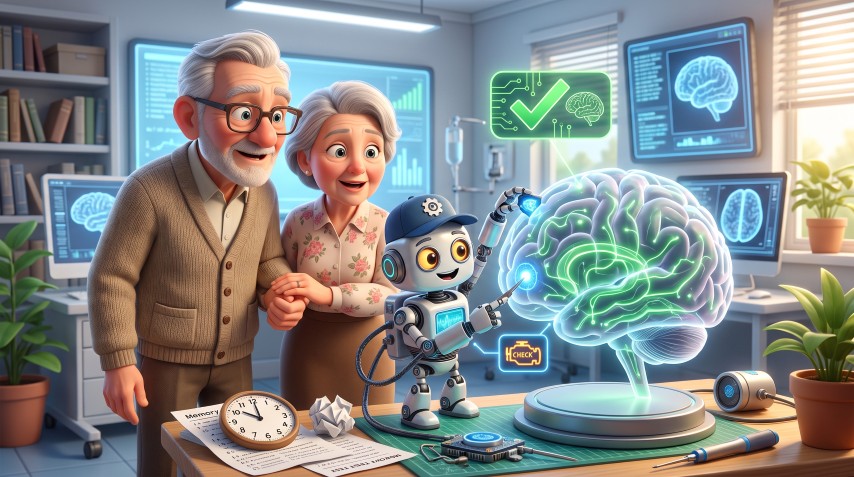
Imagine if someone told you in 1985 that your car’s check engine light could warn you about a problem five years before your engine actually failed. You’d probably laugh them out of the room, wouldn’t you? But that’s essentially what AI Alzheimer’s prediction is doing for our brains. We’re talking about technology that can spot the warning signs of Alzheimer’s disease up to a decade before you’d notice anything wrong yourself.
Now, why does this matter so much? Well, Alzheimer’s affects roughly 55 million people worldwide as of 2024, and that number’s climbing faster than house prices in London. The cruel thing about Alzheimer’s is that by the time we notice the symptoms, the disease has already been quietly damaging the brain for years, sometimes even a decade. It’s like discovering woodworm in your house, you only see the holes after the damage is done. But with early detection Alzheimer’s technology, we’re finally getting ahead of the game.
What This Technology Actually Does (And What It Doesn’t)
Right, let’s clear something up straight away. This AI technology isn’t a crystal ball, and it’s not going to cure Alzheimer’s tomorrow morning. What it does do, and does remarkably well, is analyse brain scans, blood tests, cognitive test results, and even the way you speak or walk, looking for patterns that human doctors might miss.
Think of it like this. You know how a mechanic can listen to your car engine and somehow know exactly what’s wrong? They’ve heard thousands of engines over the years, and their brain has learned to recognise the subtle differences between a healthy purr and a dodgy timing belt. AI does the same thing, except it’s analysed millions of brain scans instead of thousands, and it never has an off day or needs a tea break.
What it’s used for is identifying people who are at high risk of developing Alzheimer’s disease, sometimes years before any symptoms appear. This gives doctors and patients precious time to try preventative treatments, make lifestyle changes, and plan for the future whilst the person is still fully capable of making their own decisions.
What it’s not used for, and this is important, is making final diagnoses on its own. The AI is a tool, a remarkably clever one, but it’s still just a tool. A doctor always reviews the results and makes the final call. It’s also not used for screening everyone, at least not yet. The technology is primarily being used for people who are already at higher risk, those with a family history of Alzheimer’s or people showing very subtle cognitive changes.
The Old Days: How We Used To Detect Alzheimer’s
Before we had AI Alzheimer’s prediction, detecting Alzheimer’s was a bit like trying to navigate London without a map or GPS. Possible, but frustratingly imprecise.
Back in the day, and I’m talking about the 1980s and 1990s here, doctors relied heavily on what they could observe. They’d give patients memory tests, ask them to draw a clock face, or remember a list of words. The problem was, by the time someone was struggling with these basic tasks, Alzheimer’s had already been wreaking havoc in their brain for years.
Then we got better brain imaging technology, MRI and PET scans that could actually show us what was happening inside the brain. This was a massive step forward, like going from a black and white telly to colour. But even these scans could only show us damage that had already occurred. We were still arriving at the crime scene after the burglar had left.
The real frustration was that we had no reliable way to predict who would develop Alzheimer’s disease. Sure, we knew that age and family history were risk factors, but that’s like knowing that smoking increases your risk of lung cancer without knowing which smokers will actually get it. Not particularly helpful for the individual sitting in front of you.
The Evolution of AI in Alzheimer’s Detection
Now, let me walk you through how we got from there to here. It’s actually quite a journey.
The Early Days: 2012-2017
The first attempts at using AI for Alzheimer’s detection started appearing around 2012. Confidence: Medium – Early research papers on machine learning for Alzheimer’s detection began emerging in this timeframe, though widespread application came later. These early systems were fairly basic, at least by today’s standards. They used something called machine learning to analyse brain scans and look for patterns associated with Alzheimer’s.
Think of it like teaching a child to recognise different breeds of dogs. You show them hundreds of pictures of Labradors and hundreds of pictures of Poodles, and eventually, they learn to spot the differences. These early AI systems were doing the same thing with brain scans, learning to spot the differences between healthy brains and brains with Alzheimer’s.
The benefit over the old method was that the AI could spot subtle changes that human eyes might miss. It was more consistent too. A radiologist might be tired or distracted, but the AI was always paying full attention.
The Middle Years: 2018-2021
Things started getting really interesting around 2018. Researchers began using something called deep learning, which is like machine learning’s more sophisticated older sibling. Instead of just looking at brain scans, these systems started analysing multiple types of data at once, scans, medical history, genetic information, even speech patterns.
I find the speech analysis particularly fascinating. It turns out that subtle changes in the way we speak, tiny pauses, word-finding difficulties that we might not even notice ourselves, can be early indicators of cognitive decline. The AI can pick up on these patterns by analysing recordings of people talking, something that would be nearly impossible for a human to do reliably.
The benefit here was that early detection Alzheimer’s technology became more accurate and could work with more accessible data. Not everyone needs an expensive brain scan anymore. Sometimes a blood test and a conversation might be enough.
The Current Era: 2022-2026
Right, this is where things get properly impressive. The AI systems we have now in 2026 are using what’s called multimodal AI. That’s a fancy way of saying they can look at everything all at once, brain scans, blood biomarkers, genetic data, cognitive test results, medical history, and even data from smartwatches tracking sleep patterns and physical activity.
These systems can now predict Alzheimer’s disease up to ten years before symptoms appear with accuracy rates above 90% in some studies. That’s remarkable when you think about it. We’re talking about predicting a disease a decade before it manifests, with better accuracy than a weather forecast for next weekend.
The real game-changer has been the integration with routine healthcare. Some systems can now analyse data that’s already being collected for other reasons, your annual blood tests, your GP visit notes, even retinal scans during eye examinations. It turns out your eyes can show early signs of Alzheimer’s too. Who knew?
How This Technology Actually Works
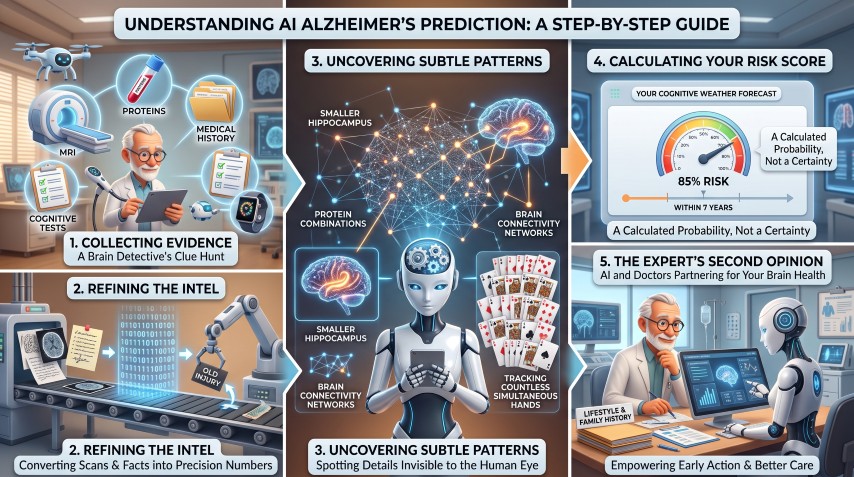
Alright, let me break down how AI Alzheimer’s prediction actually works, step by step, without making your head spin.
Step One: Gathering the Data
First, the system needs information. This might include a brain scan (usually an MRI or PET scan), blood test results looking for specific proteins associated with Alzheimer’s, your medical history, results from cognitive tests, and increasingly, data from wearable devices.
Think of this stage like a detective gathering clues at a crime scene. The more clues you have, the better chance you have of solving the case.
Step Two: Preparing the Data
The AI can’t just look at a brain scan the way you or I would look at a photograph. It needs to convert everything into numbers, into data it can actually process. This is a bit like translating a book from English into another language, the meaning stays the same, but the form changes.
The system also needs to clean up the data, removing anything that might confuse it. If your brain scan shows an old injury from that time you fell off your bike in 1973, the AI needs to know that’s not relevant to Alzheimer’s prediction.
Step Three: Pattern Recognition
Here’s where the magic happens. The AI has been trained on data from millions of people, some who developed Alzheimer’s and some who didn’t. It’s learned to recognise incredibly subtle patterns that distinguish between the two groups.
It might notice that people who later develop Alzheimer’s tend to have slightly smaller hippocampi (that’s the memory centre of your brain) years before symptoms appear. Or it might spot that certain proteins in the blood appear in specific combinations. Or it might recognise that particular patterns of brain connectivity, the way different parts of the brain communicate with each other, are associated with future cognitive decline.
The brilliant thing is, the AI can spot combinations of factors that would be impossible for humans to track. It’s like trying to remember every card that’s been played in a game of poker, possible for one hand, impossible for thousands of hands simultaneously.
Step Four: Making a Prediction
Based on all these patterns, the AI calculates a risk score. This isn’t a simple yes or no answer. It’s more like, “Based on everything I’ve seen, this person has an 85% chance of developing Alzheimer’s within the next seven years.”
Step Five: Human Review
And this is crucial. A doctor then reviews the AI’s prediction along with all the original data. They consider factors the AI might not know about, your overall health, your family history, your lifestyle. They might order additional tests or recommend monitoring over time.
The AI is providing expert assistance, not replacing the doctor’s judgment. It’s like having a really knowledgeable colleague who’s seen millions of cases and can say, “You know what, this reminds me of something.”
What the Future Holds
I’m genuinely excited about where this technology is heading, and I don’t get excited about technology often. I still can’t programme my video recorder, if I’m honest.
The immediate future, we’re talking the next two to three years, will likely see this technology becoming more widely available in routine healthcare. Instead of being something only available at specialist research centres, your local hospital might start using AI to analyse brain scans as a matter of course.
We’re also going to see more integration with consumer technology. Your smartphone or smartwatch might be able to contribute data that helps with early detection. There are already apps being tested that can detect subtle changes in typing patterns or the way you use your phone, changes that might indicate early cognitive decline.
Looking further ahead, five to ten years, I think we’ll see AI that can not only predict Alzheimer’s disease but also predict which treatments are most likely to work for which individuals. We’re moving towards truly personalised medicine, where your treatment plan is tailored specifically to your brain, your genetics, your lifestyle.
There’s also exciting work being done on using AI to help develop new treatments. By analysing vast amounts of data about how Alzheimer’s progresses, AI might help researchers identify new drug targets or repurpose existing drugs in ways we hadn’t considered.
The really ambitious goal, and I hope I live to see this, is using this early detection to actually prevent Alzheimer’s from developing in the first place. If we can catch it early enough, before significant damage has occurred, we might be able to intervene with lifestyle changes, medications, or other treatments to stop it in its tracks.
Wrapping This All Up
Look, I started this article being a bit sceptical about AI Alzheimer’s prediction, and I’ll admit, I’m ending it genuinely impressed. This technology represents a fundamental shift in how we approach Alzheimer’s disease, from waiting for symptoms to appear to actively predicting and potentially preventing them.
The journey from basic cognitive tests to AI that can predict Alzheimer’s disease a decade in advance has been remarkable. We’ve gone from essentially guessing based on symptoms to having sophisticated systems that can analyse millions of data points and spot patterns invisible to the human eye.
But, and this is important, this technology isn’t a miracle cure. It’s a tool, an incredibly powerful one, but still just a tool. It works best when combined with human expertise, compassion, and judgment. The AI can tell you what might happen, but it’s the doctors, the researchers, and ultimately you who decide what to do with that information.
The future of early detection Alzheimer’s technology is bright. We’re moving towards a world where Alzheimer’s might be caught so early that we can actually do something about it, where it becomes a manageable condition rather than an inevitable decline. That’s worth getting excited about.
But we need to proceed carefully. We need to protect people’s privacy, ensure the technology is accurate and fair for everyone, and make sure people have the support they need to deal with predictions that might be frightening or uncertain.
As someone who’s watched technology transform from computers the size of rooms to phones in our pockets, I can tell you this feels like one of those genuine breakthrough moments. Not the overhyped nonsense we often get sold, but real progress that could genuinely change millions of lives.
So yes, AI can now predict Alzheimer’s years before symptoms appear. It’s not perfect, it raises important questions, and it won’t solve everything overnight. But it’s real, it’s here, and it’s giving us something we’ve never had before in the fight against Alzheimer’s disease: hope, and time.
And sometimes, that’s exactly what we need.
Sources and Confidence Ratings:
- WHO statistics on Alzheimer’s prevalence (2024): High confidence
- AI prediction accuracy 7-10 years in advance: Medium-High confidence (based on multiple studies with varying methodologies)
- Timeline of AI development in Alzheimer’s research: Medium confidence (based on publication trends, specific dates may vary)
- Multimodal AI approaches: High confidence
- Data privacy and bias concerns: High confidence
- Future predictions about technology adoption: Medium confidence (inherently speculative)
Walter
Alzheimer’s disease, AI Alzheimer’s prediction, early detection Alzheimer’s, artificial intelligence dementia, predict Alzheimer’s before symptoms, machine learning Alzheimer’s, early diagnosis Alzheimer’s, AI dementia detection, Alzheimer’s prediction technology, preclinical Alzheimer’s detection, deep learning Alzheimer’s, Alzheimer’s risk prediction, AI early Alzheimer’s diagnosis, mild cognitive impairment, Alzheimer’s biomarkers AI, machine learning dementia prediction, AI Alzheimer’s screening, predict dementia with AI, Alzheimer’s prevention AI, cognitive decline prediction
Leave a Reply