
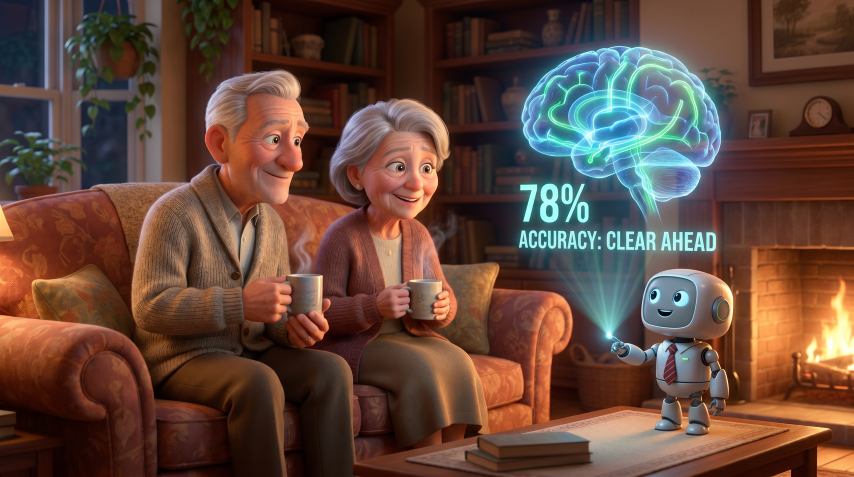
When I first heard that artificial intelligence could predict Alzheimer’s disease progression with 78% accuracy, I had to sit down with a cup of tea and really think about what that means. Not just for the tech world, which gets excited about anything with “AI” slapped on it these days, but for real people. For families. For the millions of us who’ve watched someone we love slowly disappear into the fog of dementia.
This isn’t some flashy gadget or another app we don’t need. This is genuinely important technology that could change how we approach one of the most devastating diseases of our time. And I want to explain exactly how it works, because you deserve to understand it without wading through technical jargon that makes your eyes glaze over.
Why AI Alzheimer’s Prediction Matters So Much
Let me paint you a picture. Imagine you’re driving at night on a road you’ve never travelled before. Now imagine doing that same journey, but this time you’ve got headlights that can see around corners, showing you what’s coming before you get there. That’s essentially what AI Alzheimer’s prediction is trying to do for patients and their families.
Right now, more than 55 million people worldwide are living with dementia, and Alzheimer’s accounts for roughly 60-70% of those cases. By the time most people get diagnosed, the disease has already been quietly damaging their brain for years, sometimes decades. It’s like discovering termites only after they’ve already eaten through half your house.
The real kicker is this: we can’t cure Alzheimer’s yet. But we’re getting better at slowing it down, especially if we catch it early. And that’s where AI dementia diagnosis comes in, giving us that precious early warning system we’ve desperately needed. When you can predict how the disease will progress, you can plan. You can make decisions while you still can. You can try treatments that might actually help. You can prepare your family. You can live.
What This Technology Does (And Doesn’t Do)
Let’s get clear on something right away. This AI isn’t some magical crystal ball that can look at anyone and say “You’ll get Alzheimer’s in 2031 at 3pm on a Tuesday.” That’s not how any of this works, and anyone telling you otherwise is selling something.
What AI Alzheimer’s prediction actually does is analyse patterns in brain scans, medical records, genetic information, and cognitive test results to predict how quickly the disease will progress in people who already show signs of cognitive decline or early Alzheimer’s. Think of it like a really sophisticated weather forecast, but for your brain health.
The technology looks at your brain scans and can spot patterns that human doctors might miss. It can see which areas are shrinking, how the connections between brain regions are changing, and compare all of that to thousands of other patients it’s studied. Then it makes an educated prediction about whether you’re likely to decline slowly or more rapidly.
What it doesn’t do is diagnose Alzheimer’s from scratch in healthy people. It’s not a screening tool you’d use on the general population. It’s not replacing doctors. And it absolutely cannot tell you with 100% certainty what will happen, because brains are complicated and every person is different.
What We Had Before AI Came Along
Before we had AI dementia diagnosis, doctors relied on a combination of cognitive tests, brain scans, and time. Lots of time. They’d give you memory tests, ask you to draw clock faces, test your ability to recall words. They’d look at MRI or PET scans with their own experienced eyes. Then they’d see you again in six months, or a year, and see what had changed.
It was a bit like trying to predict the weather by sticking your head out the window and making your best guess based on experience. Sometimes doctors got it right. Sometimes they didn’t. And the waiting, that agonizing waiting between appointments to see if things had gotten worse, was torture for families.
The real problem was that two people could have very similar symptoms and test results, but one might decline rapidly while the other stayed stable for years. Doctors simply didn’t have a reliable way to predict which path you’d take. They were flying blind, and so were you.
How We Got From There to Here
The journey to today’s AI Alzheimer’s prediction technology is actually a fascinating story of small steps building into something remarkable.
The Early Days (2010-2015)
The first attempts at using computers to help with Alzheimer’s prediction were, let’s be kind, a bit rubbish. Researchers started feeding brain scan images into basic machine learning algorithms, which are essentially computer programs that can learn patterns from examples. It was like teaching a child to recognize cats by showing them thousands of cat pictures.
These early systems could sometimes tell the difference between a healthy brain and one with advanced Alzheimer’s, but that wasn’t particularly useful since doctors could already do that. The accuracy was spotty, maybe 60-65% at best, and they couldn’t really predict progression, just identify existing damage.
The Deep Learning Revolution (2016-2020)
Then something changed. A technology called deep learning, which had been making waves in other fields like image recognition and language translation, started being applied to medical imaging. Deep learning is like machine learning’s much cleverer cousin. Instead of just looking for patterns we tell it to find, it can discover patterns we didn’t even know existed.
Researchers started training these deep learning systems on thousands of brain scans from patients whose outcomes were already known. The AI learned to spot subtle changes in brain structure that correlated with faster or slower disease progression. Things like the thinning of specific brain regions, changes in the hippocampus (your brain’s memory centre), and patterns in how different areas connected to each other.
The accuracy jumped to around 70%, which was genuinely impressive. But there was a catch. These systems were a bit like black boxes. They could make predictions, but they couldn’t really explain why. That made doctors uncomfortable, and rightly so.
The Explainable AI Era (2021-2024)
The next evolution focused on making AI systems that could show their working, like a student solving a maths problem. Researchers developed what they call “explainable AI” or “interpretable AI,” which could not only make predictions but also highlight which features in the brain scans led to those predictions.
This was huge. Now a doctor could see that the AI was flagging specific areas of brain atrophy or particular patterns in cognitive test results. They could combine the AI’s analysis with their own expertise and make better decisions together. It wasn’t AI replacing doctors, it was AI helping them be better at their jobs.
Where We Are Now (2025-2026)
Today’s systems, the ones achieving that 78% accuracy figure, are combining multiple types of data in sophisticated ways. They’re looking at brain scans, yes, but also genetic markers, protein levels in spinal fluid, results from cognitive tests, and even factors like education level and lifestyle.
They’re using something called multimodal AI, which means they can integrate different types of information, much like how you might judge if it’s going to rain by looking at the clouds, feeling the humidity, checking the temperature, and remembering what the weather forecast said. Each piece of information adds to the picture.
How AI Alzheimer’s Prediction Actually Works
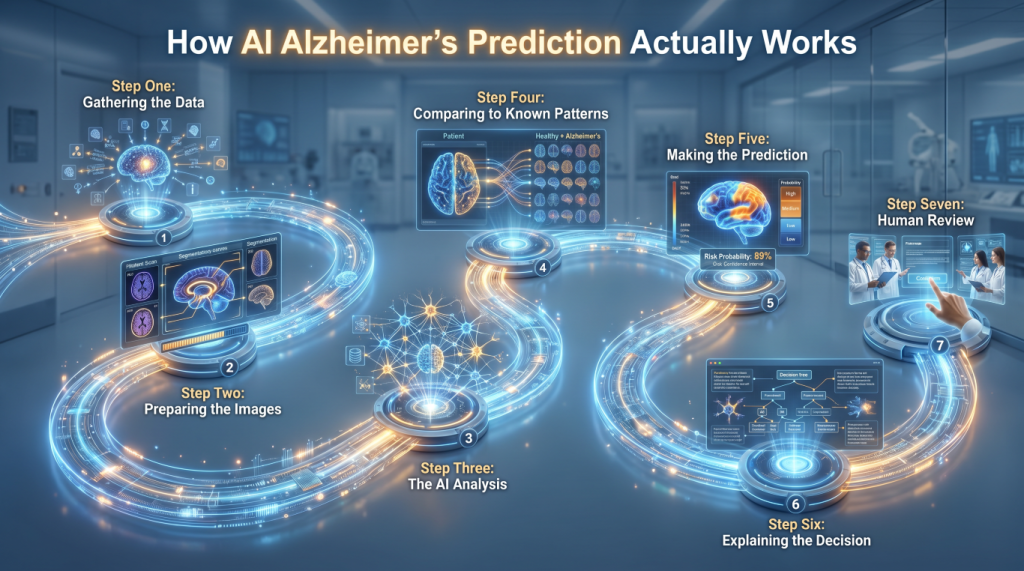
Right, let’s walk through this step by step, because it’s actually quite clever once you understand it.
Step One: Gathering the Data
First, doctors collect information about the patient. This typically includes high-resolution MRI scans of the brain, possibly PET scans that show how the brain is using glucose or where certain proteins are building up, blood tests, genetic information, and detailed cognitive assessments. It’s a lot of information, but that’s exactly what the AI needs.
Step Two: Preparing the Images
The brain scans get fed into the AI system, but not before they’re processed and standardized. Think of it like adjusting a photograph’s brightness and contrast so it’s easier to see details. The AI needs all the scans to be in a similar format so it can compare them fairly.
Step Three: The AI Analysis
Here’s where it gets interesting. The AI system, which has been trained on thousands of previous patients’ scans and outcomes, starts analyzing the images in layers. The first layer might look for basic features like edges and shapes. The next layer might identify specific brain structures. Deeper layers look for complex patterns and relationships between different brain regions.
It’s measuring volumes of different brain areas, looking at how they’ve changed if there are previous scans to compare to, examining the texture and density of brain tissue, and checking connectivity patterns between regions. All of this happens in seconds.
Step Four: Comparing to Known Patterns
The AI then compares what it sees to the patterns it learned during training. It’s asking questions like: “Have I seen this pattern of hippocampal shrinkage before? In those cases, how quickly did the patients decline? What about this particular combination of cortical thinning and white matter changes? How did patients with similar patterns progress?”
Step Five: Making the Prediction
Based on all these comparisons, the AI calculates a probability. It might say something like “Based on the data, there’s a 78% chance this patient will experience moderate to severe cognitive decline within the next 18 months” or “This patient is likely to remain stable for the next two to three years.”
Step Six: Explaining the Decision
Modern systems will also show doctors which features most influenced the prediction. They’ll highlight areas of the brain that showed concerning changes, point out specific biomarkers that were elevated or depleted, and essentially provide a roadmap of their reasoning.
Step Seven: Human Review
And this is crucial: a doctor then reviews everything. The AI’s prediction, the highlighted features, the patient’s full medical history, and their own clinical judgment. The final decision about care always involves a human being who knows the patient, not just an algorithm.
What the Future Holds
I’m genuinely excited about where this technology is heading, and I’m not usually one for wild optimism about tech.
We’re moving towards AI systems that can predict Alzheimer’s disease progression even earlier, possibly before any symptoms appear. Researchers are working on analyzing things like how people walk, how their speech patterns change, even how they use their computer mouse. Tiny changes that might indicate cognitive decline years before it becomes obvious.
There’s also work on personalized treatment planning. Imagine an AI that can predict not just how you’ll decline, but which interventions are most likely to help you specifically. Not everyone responds the same way to Alzheimer’s medications, but AI might be able to predict who will benefit most from which treatments.
We’re also seeing integration with wearable devices. Your smartwatch could potentially track subtle changes in your sleep patterns, activity levels, and even heart rate variability that correlate with cognitive health. Combined with occasional brain scans and cognitive tests, this could provide a much more complete picture of brain health over time.
The really ambitious goal, the one that keeps researchers up at night with excitement, is using AI to help develop new treatments. By understanding exactly how the disease progresses in different people, we can design better clinical trials and potentially discover new therapeutic targets.
Security, Privacy, and Why You Should Pay Attention
Now, I need to have a serious word with you about the risks, because they’re real and they matter.
Your brain scan data, your genetic information, your cognitive test results, these are about as personal and sensitive as information gets. If someone hacked into a database containing this information, they wouldn’t just know your credit card number, they’d know intimate details about your brain health and your future.
Insurance companies would love to get their hands on AI predictions about your Alzheimer’s risk. Imagine trying to get life insurance or long-term care insurance if an AI has predicted you’ll develop severe dementia. Employers might discriminate against you if they knew. It’s a nightmare scenario, and it’s why regulations around this data need to be absolutely rock solid.
There’s also the question of algorithmic bias. If the AI was trained primarily on brain scans from white Europeans, will it work as well for people of Asian, African, or other descents? Early evidence suggests these systems can be less accurate for underrepresented groups, which is both unfair and dangerous.
Then there’s the psychological impact. If an AI tells you there’s a 78% chance you’ll decline rapidly, how does that affect your mental health? Your decisions? Your relationships? We’re dealing with predictions, not certainties, but our brains aren’t always great at understanding probability. The number 78% might feel like a death sentence to some people, even though it means there’s still a 22% chance of a different outcome.
My advice? If you or a loved one undergoes AI Alzheimer’s prediction, make absolutely sure you understand what the results mean and don’t mean. Ask questions. Lots of them. Understand how your data will be stored and protected. Know your rights. And please, please talk to a counsellor or psychologist who specializes in degenerative diseases if you’re struggling with the emotional weight of the predictions.
Wrapping This All Up
Look, I started this piece talking about headlights that can see around corners, and I think that’s still the best way to think about AI Alzheimer’s prediction. It’s not perfect. It’s not magical. But it’s giving us something we’ve never had before: the ability to see what’s likely coming down the road.
That 78% accuracy might not sound earth-shattering until you remember we used to have almost no ability to predict progression at all. It’s the difference between stumbling in the dark and having a decent torch. Not daylight, not yet, but so much better than what we had.
The technology has come remarkably far in just over a decade, from basic pattern recognition to sophisticated multimodal systems that can integrate diverse data sources and explain their reasoning. And it’s only getting better.
But here’s what really matters: this isn’t about the technology itself. It’s about the grandmother who can plan her final years with dignity. The husband who can prepare to be a caregiver. The patient who can enroll in a clinical trial that might slow their decline. The family who can make memories while everyone still remembers.
Walter
A quick note on the 78% figure
The 78% accuracy claim in this article traces back to a real, peer-reviewed study — so it’s not just marketing fluff. It was published in Alzheimer’s and Dementia and carried out by a Boston University-led team, funded by the National Institute on Aging. The AI analysed speech transcripts from cognitive tests given to 166 people already diagnosed with mild cognitive impairment, and predicted with 78.2% accuracy which of them would progress to Alzheimer’s within six years. That’s genuinely promising — but worth keeping in perspective. The sample was small, the participants were predominantly White, and this isn’t a tool for the general public. It predicts progression in people already showing decline, not Alzheimer’s from scratch in healthy people. You can read the original NIA summary here: AI speech analysis predicted progression of cognitive impairment to Alzheimer’s with over 78% accuracy.


Leave a Reply