
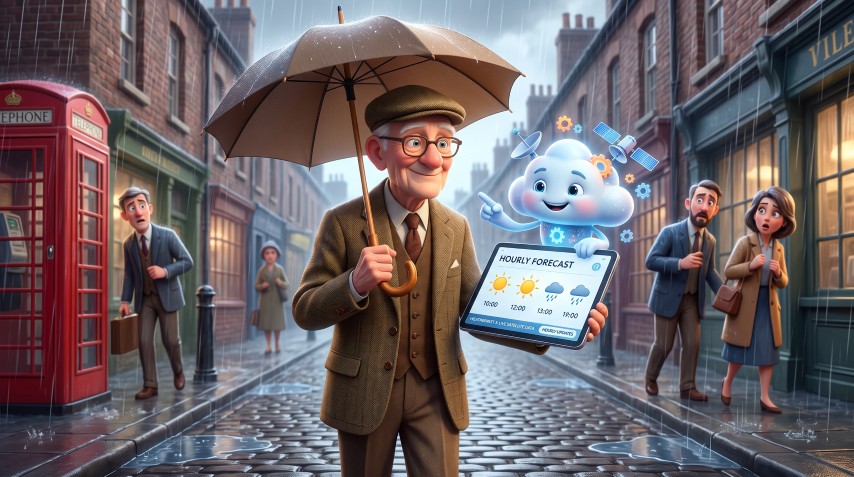
I have spent a good portion of my life being wrong about the weather. Not slightly wrong. Spectacularly, soakingly wrong. I have set off for a walk in a linen shirt because the little sun icon on my phone said so, and arrived home looking like I had been dragged out of a canal. And every time I blamed the forecast rather than myself, because that is what we do in this country. The weather is a national grievance and the forecast is the poor soul who takes the blame.
So when Google announced at the start of September 2026 that its newest AI weather model can update its picture of the entire planet’s atmosphere every single hour, using live satellite images, I paid attention. Not because I care about the technology for its own sake, though I do, but because it might finally settle the argument I have with my own coat rack every morning.
Why the weather forecast is the most important technology you never think about
We have got very casual about this. You glance at your phone, see a number and a cloud, and decide whether to take the brolly. It feels about as impressive as a kettle.
It is not. Predicting the weather is one of the hardest computational problems humans have ever attempted, and we do it, free, several billion times a day. The atmosphere is a churning fluid wrapped round a spinning ball, warmed unevenly, full of water that keeps changing state, and it is genuinely chaotic in the mathematical sense. A tiny difference at the start becomes an enormous difference three days later. That is not a flaw in the forecast, that is the physics.
And a great deal rides on getting it right. Airlines route aircraft around it. Farmers decide when to cut and when to wait. The National Grid works out how much the wind farms will produce tomorrow so it knows how much gas to burn. When the forecast gains even a few hours of useful warning, people do not get flooded and somebody somewhere does not lose a harvest. That is why AI weather forecasting matters far more than it sounds like it should.
What it is for, and what it is definitely not for
The headlines make it sound as though Google has replaced the Met Office. It has not, and is not trying to.
What it is good at
WeatherNext 3, which is the unglamorous name of the thing, is a global model. It produces a picture of temperature, wind, rainfall, cloud and pressure across the whole planet and runs it forward in time, out to fifteen days on its four main daily runs and two days on the hourly top-ups in between. Google says it is the first global weather model to refresh every hour.
Its sweet spot is the medium range, two to fifteen days ahead, exactly the window most of us plan our lives in. Is the weekend going to be all right? Should I book the caravan? It is also very good at tropical cyclones.
There is a useful new trick aimed at renewable energy. It forecasts wind speed at 100 metres up, roughly the height of a modern turbine’s blades, and how much sunlight actually reaches the ground through the cloud. If you run a wind farm, that is the difference between a good day on the electricity market and an expensive one.
What it is not for
It is not an official warning system, and Google says so itself in blunt language. Its documentation calls it experimental, provided as-is, and explicitly not a substitute for official forecasts, watches or warnings. If there is a red warning for wind, that comes from the Met Office, and the Met Office is who you listen to.
Nor is it a nowcasting system, the bit that tells you whether the shower over Reading will reach your washing line in twenty minutes. That is a different job, done mostly with radar. And it is not a climate model. Weather is next Tuesday, climate is decades. Different problem, different tools, endlessly confused by people on the internet.
What we had before, and it is genuinely mad
To appreciate where we have got to, you need to know where we started, and that is one of my favourite stories in science.
The idea that you could calculate the weather from physics, rather than guess it from a barometer and a bad feeling in your knee, goes back to a Norwegian called Vilhelm Bjerknes around 1904. The man who actually tried it was an English Quaker named Lewis Fry Richardson. In 1917 he was driving an ambulance on the Western Front, and between ferrying wounded men back from the line, sitting on a heap of hay in a cold billet, he tried to calculate by hand, with a slide rule, how the pressure over central Europe would change over six hours.
It took him six weeks. The answer was completely, hilariously wrong.
But Richardson was not daft, he was early. In his 1922 book he imagined a forecast factory. A vast circular hall, walls painted as a map of the world, tiers of galleries holding around 64,000 people, each doing the sums for their own patch of the globe. A conductor on a dais shone a beam of light on any section running ahead or falling behind, keeping the orchestra in time. He reckoned that many people working flat out could just about calculate the weather as fast as the weather happened.
He was, if anything, optimistic. Later estimates put the real figure at well over a million. But look at that description again, thousands of small processors working on their own patch in parallel, coordinated by a central controller, and tell me he did not describe a modern computer thirty years before anyone built one.
The physics machines take over
Nothing much happened until 1950, when Jule Charney, John von Neumann and colleagues got time on ENIAC, one of the first electronic computers. Working day and night for over a month, they produced a twenty four hour forecast that took about twenty four hours to calculate. Useless in practice, world-changing in principle.
From that came seventy years of what the trade calls numerical weather prediction. You take fifty billion or so observations a day from satellites, balloons, ships and ground stations, build a three dimensional grid of the atmosphere, and make a supercomputer solve the equations of fluid motion step by step, forward in time. It works brilliantly. The Met Office’s current setup runs on a cloud supercomputer built with Microsoft, capable of something like 60 quadrillion calculations a second, and today’s four day forecast is about as reliable as a one day forecast was thirty years ago.
The snag is cost and speed. It needs a building full of very hot, very expensive computers, and it takes hours to run. Which is where the machines that learned from the data, rather than the equations, come in.
The versions, in plain English
Google’s weather work has come in four steps, each fixing a specific complaint about the one before.
GraphCast, 2023
The first one that made people sit up. GraphCast was trained on about four decades of historical records and, instead of solving physics equations, it learned the patterns. Give it today’s atmosphere and it predicts tomorrow’s, then the day after, for ten days. It matched or beat Europe’s leading physics model on over ninety per cent of the measures tested, in under a minute on a single machine rather than hours on a supercomputer. It won the MacRobert Award in 2024.
The complaint: it gave you one answer. A single confident line. Weather is not one answer, it is a range of possibilities, and a forecast that cannot tell you how sure it is cannot tell you about risk.
GenCast, 2024
GenCast fixed that. Instead of one forecast it produced fifty or more plausible futures, an ensemble, so you could see how much they agreed. If all fifty say rain, take the coat. If thirty say rain and twenty say sunshine, nobody knows yet. It beat the European ensemble system, the acknowledged world leader, on ninety seven per cent of tests out to fifteen days.
The complaint: producing all those scenarios was slow, and it updated only every twelve hours.
WeatherNext 2, late 2025
This one was about efficiency. A new design Google calls a Functional Generative Network produced a full sixty four member ensemble in a single pass, roughly eight times faster than before, in under a minute on one chip. It beat the previous model on 99.9 per cent of variables and forecast ranges, quietly took over the weather in Google Search, Maps, Pixel and Gemini, and was later open sourced.
The complaint, and this is the big one: like almost every AI weather model, it was fed data already chewed over by the traditional physics systems, which batch up their observations every six hours. So even a lightning-fast model was working from a picture of the sky that could be six hours old. Fast car, out of date map.
WeatherNext 3, September 2026
Which brings us to now. WeatherNext 3 reads live satellite pictures directly, a global mosaic from the geostationary satellites, feeding them straight into the model alongside the traditional analysis. It no longer waits for the six hourly data cycle to catch up.
That single change unlocks the rest. Because it is not waiting, it starts a fresh forecast every hour, twenty four times a day. Because it also trained on raw readings from actual weather stations, its temperature forecasts come out at about five kilometre detail and match what a real thermometer in a real field reads. Google claims up to fifty per cent better rain and snow forecasts a day or more ahead, and it currently tops Operational WeatherBench, an independent scoreboard run by a startup called Brightband.
In human terms, when a front develops quickly on a Saturday morning, the old approach might not notice for hours. This one notices at the top of the hour.
How it actually works, step by step
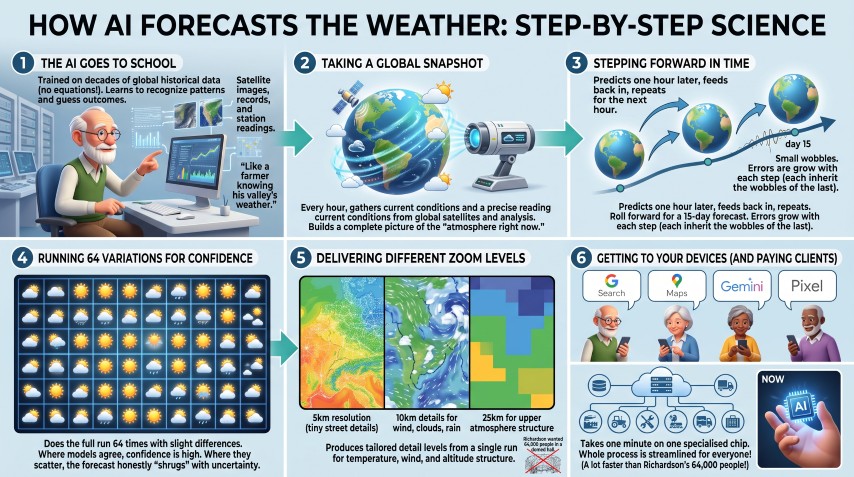
Strip away the jargon and it is not mysterious.
Step one, it went to school. The model was trained on decades of historical records, satellite images and station readings. Nobody taught it the equations of fluid dynamics. It saw millions of examples of what the sky looked like, and what it looked like six hours later, until it got very good at guessing the second from the first. Think of an old farmer who has watched the same valley for fifty years and can tell you it will turn by teatime. He cannot show you his working either.
Step two, it takes a snapshot. Every hour it takes the live satellite mosaic plus the best available analysis of current conditions, and builds its picture of the atmosphere right now.
Step three, it steps forward. It predicts what that picture looks like an hour later, feeds the prediction back in as the new starting point, and does it again. Roll that forward 360 times and you have a fifteen day forecast. This is why errors grow with distance, each step inherits the wobbles of the one before.
Step four, it does it sixty four times over. Where those sixty four versions agree, confidence is high. Where they scatter, it is honest enough to say so. That spread is the forecast’s way of shrugging.
Step five, it answers at different zoom levels. From one run it produces roughly five kilometre detail for temperature at station level, ten kilometre for wind, cloud and rain, and twenty five kilometre for the structure of the atmosphere higher up.
Step six, it lands on your phone. Via Search, Maps, Gemini and Pixel for the rest of us, and via cloud platforms for the businesses that pay for it.
The whole run takes a minute on one specialised chip. Richardson wanted 64,000 people in a domed hall.
Where this is all heading
The obvious direction is smaller and sooner. We have gone from twenty five kilometre squares to five in about three years. The prize everyone is chasing is street level, saying that this village gets the hail and the next one does not, and saying it for the next two hours rather than the next two days.
The second is that the AI stops borrowing and starts observing. WeatherNext 3 is a big step towards a model that takes raw observations directly rather than pre-digested output from the physics systems. Follow that road far enough and forecasting no longer depends on the traditional pipeline at all.
The third, and I think the most likely, is a marriage rather than a takeover. Nobody serious in meteorology thinks AI is about to make the physics models redundant. The Met Office’s own chief AI officer has said machine learning will not replace them any time soon, and the Met Office has been building its own AI model with the Alan Turing Institute called FastNet, named after one of the shipping forecast sea areas and a nod to Robert FitzRoy, who invented the public weather forecast in the first place. FastNet respects the physics while it learns, and already scores comparably to the Met Office’s flagship global model on some measures. That hybrid, human forecasters plus physics plus AI, is where the money is going.
There is a satisfying environmental angle too. Traditional forecasting burns colossal amounts of electricity, while a model that does a comparable job in a minute on one chip is dramatically cheaper to run. That means countries with no supercomputer budget could get forecasts they cannot afford today. More than the umbrella business, that is the bit that genuinely excites me.
The summary, for those who skipped to the end
Google’s newest AI weather model, WeatherNext 3, released at the beginning of September 2026, is a genuine step forward. By reading live satellite images directly instead of waiting for six hourly batches of processed data, it produces a fresh global forecast every hour, at around five kilometre detail for temperature, with rain and snow forecasts Google claims are up to fifty per cent better a day or more out. It runs in about a minute on a single chip, currently leads the independent scoreboard, and now feeds the weather you see in Google Search, Maps and Gemini.
It sits at the end of a line running from Richardson’s imaginary hall of 64,000 clerks, through ENIAC grinding out a day’s forecast in a day, through seventy years of ever larger supercomputers, to GraphCast, GenCast and WeatherNext 2. And it is not the end of that line either.
It is not a replacement for your national weather service, it is measurably weaker than the old physics models at the record-breaking extremes that matter most, and it carries security risks nobody has fully solved. Treat it as a very well informed friend rather than an oracle.
But on the ordinary question of whether you need your umbrella on Thursday, AI weather forecasting has quietly become better than anything humanity has ever had. Which means that when I get soaked next week, I shall have to admit it was my own fault for not looking.
Walter
Leave a Reply