
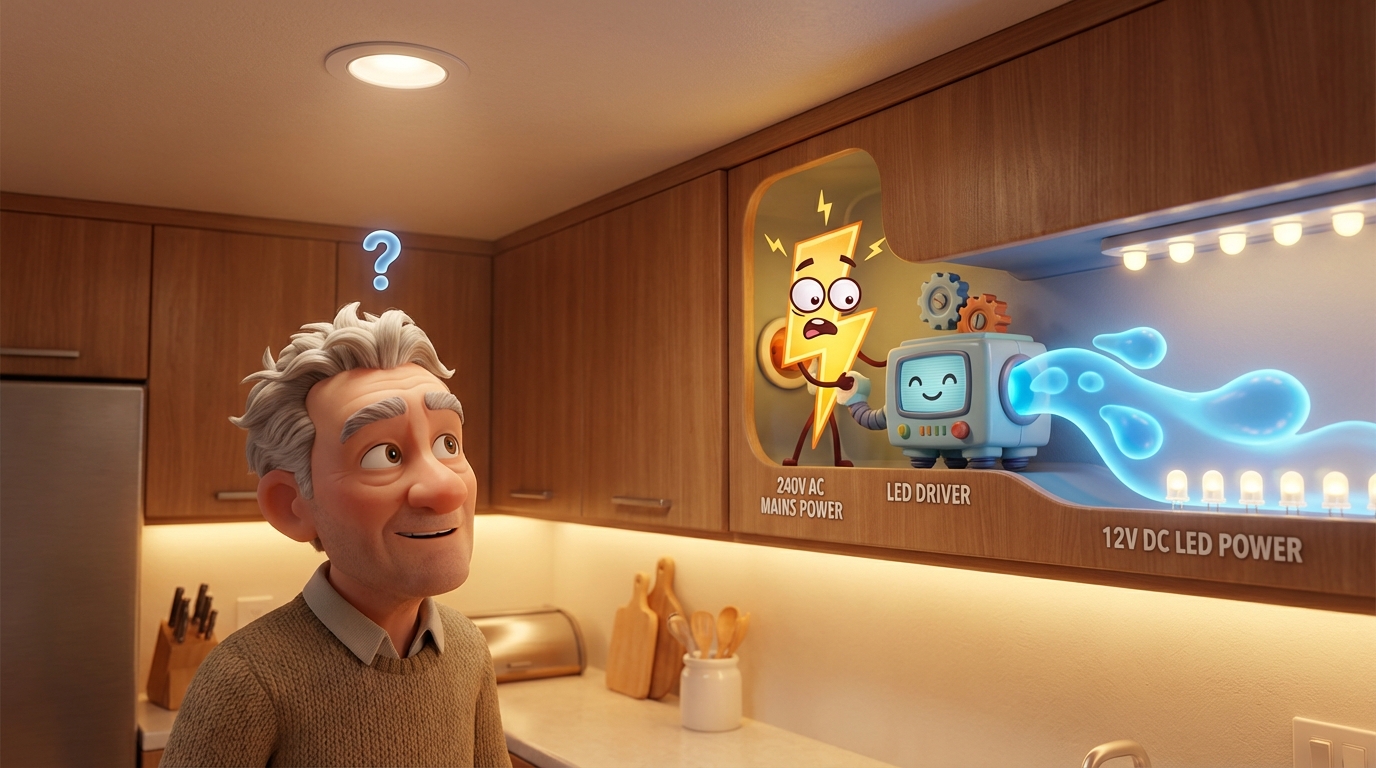
The first time I looked up at my kitchen ceiling and really thought about those lovely LED spotlights, I had a proper moment. There they were, running on 12 volts of direct current, yet plugged into the same mains supply that powers my kettle at 240 volts of alternating current. It felt a bit like discovering your car runs on lemonade when you’ve been filling it with petrol all along.
But here’s the thing. This isn’t magic, and it’s not even particularly new technology. It’s just brilliant engineering that’s become so commonplace we don’t even notice it anymore. And understanding how it works isn’t just satisfying for your inner curiosity, it’s actually quite important for your safety, your electricity bills, and making smart choices when you’re upgrading your home.
Why This Technology Matters More Than You Think
You might be wondering why anyone bothered creating lights that run on 12V DC when we’ve got perfectly good 240V AC coming out of every socket in the house. Fair question. The answer is safety, efficiency, and frankly, because LED technology demanded it.
Think about it this way. If you’ve ever changed a traditional light bulb whilst standing on a stepladder in your kitchen, you’ve probably been at least a tiny bit nervous. That’s 240 volts you’re mucking about with. Touch the wrong bit, and you’re having a very bad day indeed. But 12 volts? You could lick it. I mean, don’t, obviously, but you could. It’s the same voltage as your car battery, and people poke around with those all the time without rubber gloves and a priest on standby.
The other brilliant thing about running LEDs at lower voltages is efficiency. LEDs are fundamentally low-voltage devices. They’re happiest at around 2 to 4 volts each, depending on the colour and type. Running them at 12V DC means we can group a few together and power them in a way that makes them incredibly efficient. And efficiency means lower electricity bills and less heat, which in turn means your lights last absolutely ages.
What It’s Used For (And What It Isn’t)
You’ll find 12V LED systems all over the place once you start looking. Kitchen downlights, bathroom spotlights, under-cabinet lighting, garden lights, caravan and boat lighting, display cabinets, and even some desk lamps. Basically, anywhere you want bright, efficient, safe lighting that doesn’t cost the earth to run.
What you won’t find running on 12V DC are high-power appliances. Your kettle, your oven, your washing machine, they all need the full 240V AC because they’re power-hungry beasts. Converting 240V AC down to 12V DC loses a tiny bit of energy in the process (nothing’s perfect), so it only makes sense for devices that benefit from the lower voltage. Your toaster doesn’t care about safety or efficiency in the same way, it just wants raw power to burn your bread.
The other thing 12V systems aren’t brilliant for is running long distances. Voltage drop becomes a real problem when you’re pushing low voltage through long cables. This is why your house is wired at 240V in the first place, it travels better. So if you’re trying to light up a shed at the bottom of a very long garden, you’re better off running mains voltage down there and converting it locally, rather than converting it in your house and running 12V all that way.
The Bad Old Days Before LED Transformers
Cast your mind back to the 1990s and early 2000s. Remember halogen downlights? Those little spotlights that seemed so modern and fancy compared to the old-fashioned pendant bulbs our parents had? They ran on 12V too, and they needed transformers to step down the voltage from the mains.
But my word, those halogen bulbs were hot. I mean properly hot. Hot enough to fry an egg on, not that you’d want to. They guzzled electricity like it was going out of fashion, they needed replacing every year or so, and the transformers that powered them were these big, heavy, warm lumps of copper wire and iron cores that sat in your ceiling getting quietly annoyed with life.
Those old electromagnetic transformers worked through a principle called electromagnetic induction, discovered by Michael Faraday back in 1831. Essentially, you run alternating current through a coil of wire, which creates a magnetic field, which induces a current in another coil of wire nearby. By having different numbers of turns in each coil, you can step the voltage up or down. Clever stuff, but heavy, inefficient by modern standards, and they hummed. Oh, how they hummed.
The Evolution of Getting From 240V AC to 12V DC
The journey from those old electromagnetic transformers to the sleek LED transformer 12V systems we have today is actually quite a tale, and it happened faster than you might think.
The Electromagnetic Era
Those original transformers I mentioned, they only converted AC to AC. They’d take your 240V AC from the mains and give you 12V AC out the other end. That was fine for halogen bulbs, which don’t care whether they’re getting AC or DC, they just want voltage. But it wasn’t fine for LEDs, which absolutely do care. LEDs need DC, direct current, flowing one way only.
Enter the Electronic Transformer
By the late 1990s and early 2000s, manufacturers started producing electronic transformers. These were smaller, lighter, and more efficient than their electromagnetic cousins. They used high-frequency switching technology to convert the voltage, which meant they could be much more compact. You might remember these if you ever tried to retrofit LED bulbs into old halogen fittings and found they flickered or didn’t work at all. That’s because these electronic transformers were still outputting AC, just doing it in a fancier way.
The Modern LED Driver (The Proper Solution)
This is where we get to the good stuff. Modern LED lighting uses what’s properly called an LED driver, though you’ll also hear it called a 12V LED power supply or an AC to DC converter LED. These devices do the whole job properly. They take your 240V AC mains supply and convert it to smooth, stable 12V DC that LEDs absolutely love.
The benefit over the previous generation is enormous. They’re smaller, often no bigger than a deck of cards. They’re more efficient, wasting less energy as heat. They’re quieter, no more humming. And they’re specifically designed to provide the stable DC output that LEDs need to perform at their best, without flickering, without dimming over time, and without shortening the bulb’s lifespan.
How It Actually Works, Step By Step
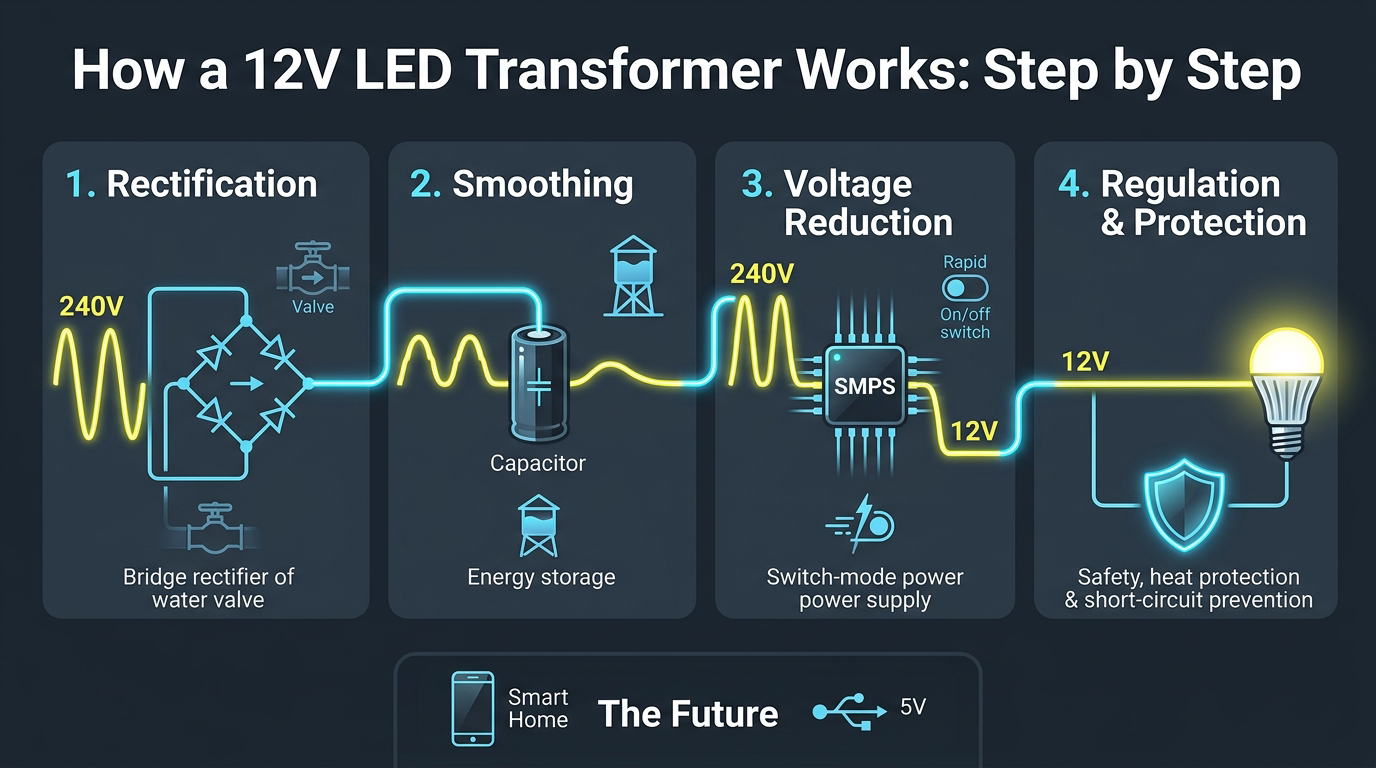
Right, let’s get into the nitty-gritty of how your LED transformer 12V actually does its job. I promise this won’t hurt.
Step One: Rectification
When 240V AC arrives at your LED driver, the first job is to convert that alternating current into direct current. AC is called alternating because it’s constantly changing direction, flowing backwards and forwards 50 times per second in the UK. It’s like a river that changes which way it flows 50 times every second, which sounds exhausting.
The driver uses components called diodes, which are basically one-way valves for electricity. They only let current flow in one direction. By arranging four diodes in a clever pattern called a bridge rectifier, the driver catches the current flowing in both directions and forces it all to flow the same way. Imagine standing by that backwards-and-forwards river with a very clever bucket system, scooping water from both directions and pouring it all the same way into a channel. That’s rectification.
At this point, you’ve got DC, but it’s not smooth. It’s lumpy, pulsing DC, still remembering its AC origins.
Step Two: Smoothing
Next, the driver uses capacitors to smooth out those lumps. Capacitors are like electrical storage tanks. They charge up when there’s extra current available and release it when the current dips. This smooths out the pulsing DC into something much more stable and constant. Think of it like a water tower in the town supply, evening out the pressure when everyone flushes their toilets at the same time during the advert break.
Step Three: Voltage Reduction
Now we’ve got smooth DC, but it’s still at around 240 volts (actually a bit higher after rectification, but let’s not complicate things). We need to get it down to 12 volts. Modern LED drivers do this using a technique called switch-mode power supply (SMPS) technology.
This is genuinely clever. The driver rapidly switches the current on and off, thousands of times per second, and uses a transformer (yes, there’s still a small transformer in there) along with some clever electronics to step the voltage down. By controlling how long the current is switched on versus off, the driver can precisely regulate the output voltage. It’s like controlling the temperature of your shower by rapidly flicking between full hot and full cold so quickly that you only feel the average temperature. Except, you know, it actually works, unlike my shower.
Step Four: Regulation and Protection
The final job of a good LED driver is to keep that 12V DC absolutely stable, regardless of what’s happening with the mains supply or how many LED bulbs you’ve got connected. It monitors the output constantly and adjusts the switching to compensate for any changes. Most modern drivers also include protection circuits that shut everything down if there’s a short circuit, if things get too hot, or if the voltage goes wonky.
What the Future Holds
The technology isn’t standing still, not by a long shot. The latest LED drivers are getting even smaller and more efficient. Some are now so compact they can fit inside the light fitting itself, which makes installation much tidier.
We’re also seeing more integration with smart home systems. Modern AC to DC converter LED units increasingly include wireless connectivity, letting you control your lights from your phone, set schedules, and even adjust the colour temperature. Some can communicate with each other to create sophisticated lighting scenes across your whole house.
There’s also a push towards even lower voltages in some applications. Some manufacturers are experimenting with 24V systems, which offer better performance over longer cable runs while still maintaining that extra-low voltage safety benefit. And at the other end of the scale, some ultra-efficient LEDs are being designed to run on as little as 5V, the same as a USB charger.
The really interesting development is in the area of power over Ethernet (PoE) lighting. This technology delivers both power and data down the same network cable, meaning your lights can be controlled individually and precisely, all while running on safe low-voltage DC. It’s mostly in commercial buildings at the moment, but I reckon we’ll see it in homes before too long.
Bringing It All Together
So there you have it. Your LED kitchen lights run on 12V DC because it’s safer, more efficient, and better suited to how LEDs actually work. The clever bit of kit that makes this possible, your LED transformer 12V, takes the 240V AC from your mains supply and converts it through a series of electronic wizardry involving rectification, smoothing, voltage reduction, and regulation.
We’ve come a long way from the heavy, hot, humming transformers of the halogen era. Modern LED drivers are compact, efficient, and increasingly smart. They’re saving us money on our electricity bills, they’re lasting for years without replacement, and they’re doing it all while being much safer than mains voltage lighting.
The future looks bright, if you’ll pardon the terrible pun. We’re heading towards even more integrated, intelligent lighting systems that can adapt to our needs, save even more energy, and maybe even improve our wellbeing through better light quality and control.
Just remember to be sensible about security if you’re going the smart route, buy quality components from reputable suppliers, and use the right type of AC to DC converter LED for your specific lights. Your ceiling will thank you, your electricity meter will thank you, and you’ll have the quiet satisfaction of understanding a piece of everyday technology that most people never think twice about.
And next time someone asks you how your LED lights can possibly run on 12V DC when the mains is 240V AC, you can smile knowingly and say, “Well, funny you should ask…” Then you can watch their eyes glaze over as you explain rectification and switch-mode power supplies. Or you could just send them this article. Either way, you’re welcome.
Walter

Leave a Reply