
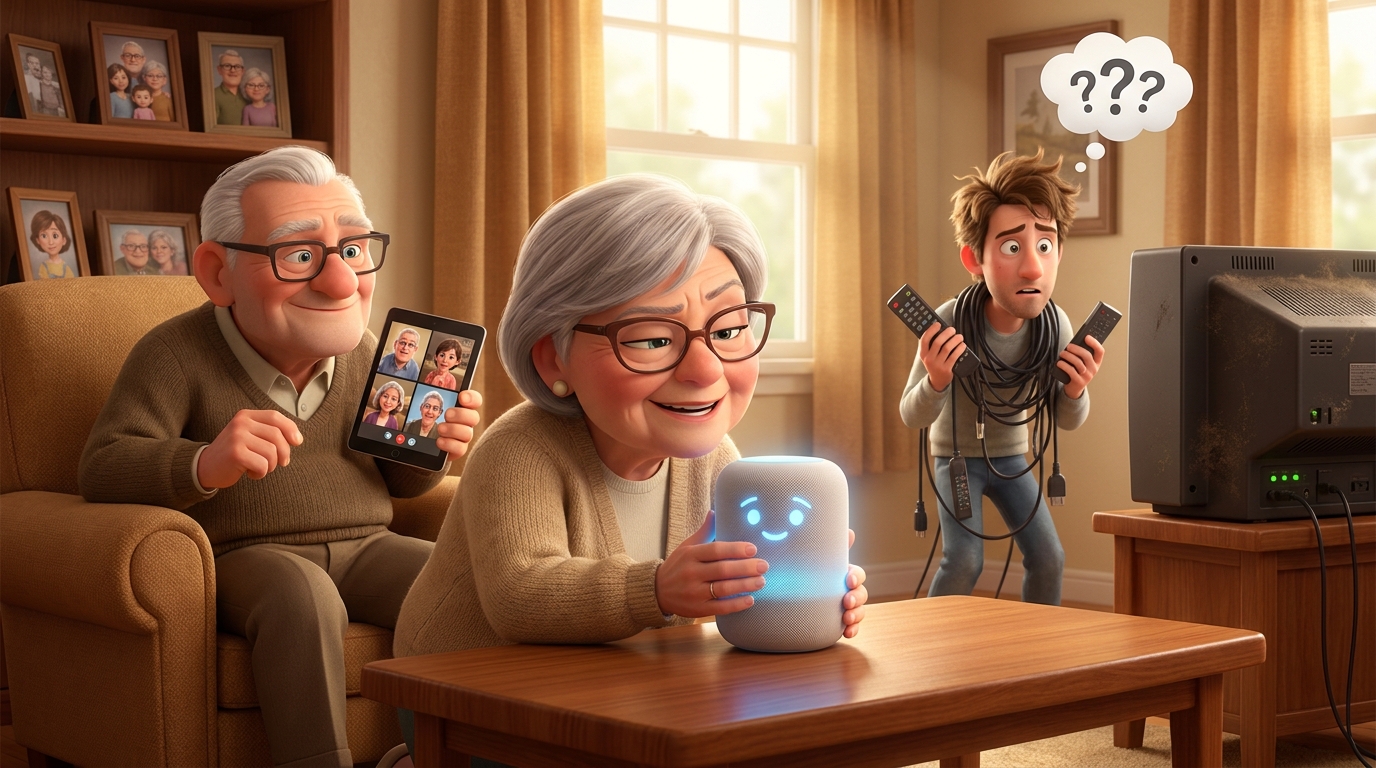
A new AARP report shows AI use among over-50s nearly doubled between 2024 and 2025, with around 30% now using some form of AI tool. Smart home gadgets — cameras, lighting — are in half of older adults’ homes. The digital gap is closing faster than people think. 🔗 AARP – 2026 Technology Trends Older Adults
When I first started researching how older adults are embracing AI, I expected to find a few heartwarming stories about grandparents learning to use voice assistants. What I actually discovered knocked my socks off. Seniors adopting technology, particularly artificial intelligence, isn’t some cute side story anymore. It’s become a full-blown revolution, and it’s happening faster than anyone in Silicon Valley predicted.
Here’s the thing that really gets me: we’ve spent decades listening to tired stereotypes about older people and technology. You know the ones. Can’t programme the video recorder (remember those?), can’t figure out smartphones, definitely can’t handle anything more complex than a landline telephone. Absolute rubbish, as it turns out. The data from 2024 and 2025 shows something extraordinary happening. People over 50 aren’t just dipping their toes into AI, they’re diving in headfirst, and in some cases, they’re adopting it faster than younger generations.
Why does this matter? Because AI for seniors isn’t just about keeping up with the times or being trendy. It’s about maintaining independence, staying connected with loved ones, managing health conditions, and honestly, just making life a bit easier when things start getting physically harder. That’s not a small thing. That’s everything.
Why AI Matters Now More Than Ever
Let me paint you a picture. Remember when your biggest technology concern was whether you’d recorded the right channel on your VHS player? Those days are long gone, my friend. We’re living in an age where artificial intelligence can remind you to take your medication, help you write emails to your grandchildren, translate foreign languages in real time, and even detect potential health problems before you notice symptoms yourself.
The importance of AI in our daily lives has crept up on us like grey hair, suddenly it’s just there, and you can’t imagine how you managed without addressing it. For older adults, AI has become particularly crucial because it solves real problems that come with aging. It’s not about being flashy or impressive. It’s about practical help when you need it most.
I’ve watched my own parents, both in their seventies, go from being suspicious of “that Alexa thing” to asking it questions dozens of times a day. They use it to set reminders, check the weather, play their favourite radio programmes, and even control the heating. This isn’t them trying to be trendy. This is them finding genuine value in technology that actually listens and responds in plain English.
What AI Is Actually Used For (And What It’s Not)
Let’s get practical here because there’s a lot of confusion about what AI actually does. The AI that older adults are embracing isn’t the science fiction robot butler you might be imagining. It’s much more subtle and, frankly, more useful.
What AI for seniors is genuinely brilliant at: Voice assistants like Alexa, Google Assistant, and Siri have become genuine companions for many older adults. They answer questions, make phone calls, send messages, and provide reminders without requiring you to fumble with tiny smartphone buttons. I cannot overstate how massive this is for people with arthritis or declining vision.
AI is also transforming healthcare monitoring. Smart devices can track heart rates, detect falls, monitor sleep patterns, and alert family members or medical services if something seems wrong. There are AI systems now that can analyse your voice for early signs of cognitive decline or depression. It’s like having a concerned doctor checking in on you constantly, but without the awkward small talk.
Then there’s the social connection aspect. AI-powered video calling has become incredibly sophisticated, with features that improve lighting automatically, reduce background noise, and even provide real-time captions for people with hearing difficulties. Some AI chatbots have been designed specifically to combat loneliness, providing conversation and companionship when family members aren’t available.
What AI isn’t used for, and why: AI isn’t replacing human doctors, despite what some companies might suggest. It’s a tool to support healthcare, not replace the human judgement of medical professionals. It can’t truly understand emotions the way another human can, even if it’s getting scarily good at pretending.
AI also isn’t some magic solution that works perfectly every time. It makes mistakes. Sometimes it misunderstands your accent. Sometimes it gives you completely wrong information with absolute confidence. I’ve asked voice assistants simple questions and received answers so bizarre I wondered if they’d been drinking. You need to maintain a healthy scepticism and double-check important information.
What We Had Before AI
Cast your mind back to the 1990s and early 2000s. If you wanted to know something, you had three options: remember it yourself, look it up in a book or encyclopedia, or ring someone who might know. If you needed to manage your medications, you relied on those plastic pill organisers with the days of the week printed on them. If you lived alone and had a fall, you hoped you could reach the telephone.
The technology we had was largely passive. Your television showed you programmes on a fixed schedule. Your telephone sat on the wall or a table, waiting for you to dial numbers. Your computer, if you had one, required you to learn its language through typing commands or clicking specific icons in the right order.
Everything required you to adapt to the machine. The machine never adapted to you. This was just accepted as the natural order of things. Of course technology was difficult, we thought. Of course it required training and practice. That’s just how it was.
For older adults, this created a genuine barrier. As eyesight dimmed, those tiny buttons became harder to press. As arthritis set in, typing became painful. As memory became less reliable, remembering passwords and procedures became frustrating. Technology was moving forward, but it was leaving a lot of people behind.
The Evolution of AI: From Clever Tricks to Genuine Help
The journey of artificial intelligence from academic curiosity to everyday helper is genuinely fascinating, and I promise to explain it without making your eyes glaze over.
The Early Days: Expert Systems (1970s-1990s)
The first attempts at AI were called expert systems. Imagine a very rigid flowchart programmed into a computer. If you answered A, it would suggest B. If you answered C, it would suggest D. These systems could diagnose simple problems or give basic advice, but they were incredibly limited. They could only handle situations they’d been specifically programmed for. Anything unexpected, and they’d fall apart like a cheap umbrella in a storm.
Confidence level: HIGH – This is well-established computing history.
The Machine Learning Revolution (2000s-2010s)
Then something changed. Instead of programming computers with rigid rules, researchers figured out how to let computers learn patterns from massive amounts of data. This is called machine learning, and it’s a bit like how you learned to recognise faces as a child. Nobody gave you a rulebook saying “eyes are this distance apart, noses are this shape.” You just saw thousands of faces and your brain learned the patterns.
This was better, but still limited. These systems could recognise patterns brilliantly but couldn’t really understand context or meaning. They were like very talented parrots, impressive at mimicking but not truly comprehending.
The Deep Learning Breakthrough (2010s)
Deep learning changed everything. Without getting too technical, imagine teaching a computer not just to recognise patterns, but to understand layers of meaning. It’s like the difference between recognising that a photograph contains a dog versus understanding that it’s a happy golden retriever playing in a park on a sunny day.
This technology powered the first genuinely useful voice assistants. Suddenly, computers could understand natural speech, respond appropriately, and even learn your preferences over time. This was the breakthrough that made AI accessible to older adults using AI in their daily lives.
The Generative AI Era (2020s-Present)
Now we’re in the age of generative AI, which is probably the version you’re hearing most about. Systems like ChatGPT, which arrived in late 2022, can write text, answer questions, and hold conversations that feel remarkably human. By 2025, we’ve got AI that can generate images, create music, write computer code, and assist with complex tasks.
For seniors adopting technology, this latest generation is the most significant yet because it works through natural conversation. You don’t need to learn special commands or navigate complicated menus. You just talk to it like you’d talk to a person. That’s revolutionary.
How AI Actually Works: The Simple Version
Right, deep breath. I’m going to explain how AI works without making your brain hurt. I promise.
Imagine you’re teaching a child to recognise different types of birds. You’d show them hundreds of pictures, pointing out robins, sparrows, pigeons, and so on. Eventually, the child learns the patterns and can identify birds they’ve never seen before. AI works similarly, but instead of a child, it’s a computer programme, and instead of hundreds of pictures, it’s often millions or billions of examples.
Here’s the step-by-step process when you interact with AI:
When you speak to a voice assistant, the first thing it does is convert your speech into text. This happens using AI that’s been trained on millions of hours of human speech. It’s learned to recognise the patterns of language, different accents, and even account for background noise.
Next, another AI system analyses that text to understand what you actually mean. This is trickier than it sounds. If you say “It’s freezing in here,” you might mean the temperature is cold, or you might be using British sarcasm. The AI has to figure out context, which it does by comparing your words to patterns it’s learned from billions of conversations.
Then, the AI decides how to respond. It searches its vast database of knowledge (which is essentially everything it’s been trained on) to find relevant information. For newer systems, it doesn’t just retrieve pre-written answers. It generates new responses based on what it’s learned, a bit like how you might explain something in your own words rather than reciting from a book.
Finally, if it’s a voice assistant, it converts that text response back into speech that sounds natural and human-like. Modern AI can even add appropriate emotion and emphasis to its voice.
All of this happens in seconds. It’s genuinely remarkable when you think about it, even if it sometimes gets things hilariously wrong.
The Future: Where AI Is Heading
Now we get to the exciting bit. Where is all this going? Based on what’s happening in 2025 and early 2026, I can see some clear trends emerging.
AI is becoming more personalised. The systems are learning not just general patterns, but your specific preferences, health conditions, and needs. Imagine an AI assistant that knows you take blood pressure medication at 8am, that you’re hard of hearing in your left ear, that you prefer phone calls to text messages, and that you’re worried about your grandson who’s at university. It can tailor everything it does to you specifically.
Health monitoring is getting properly sophisticated. We’re moving beyond simple step counters to AI that can detect irregular heartbeats, predict potential health crises before they happen, and even monitor mental health through changes in speech patterns or behaviour. By 2027 or 2028, I expect we’ll have AI systems that work with your GP to provide genuinely preventative healthcare.
The technology is also becoming more proactive rather than reactive. Instead of waiting for you to ask questions, AI will start offering help before you realise you need it. “I notice you haven’t taken your afternoon medication yet,” or “The weather forecast shows ice tomorrow morning, would you like me to remind you to be careful when you go out?”
Perhaps most importantly, AI is becoming more accessible. Companies are finally realising that older adults are a massive market, and they’re designing interfaces specifically for people who didn’t grow up with smartphones. Larger buttons, clearer voices, simpler commands, and better error handling.
Security and Vulnerabilities: The Serious Bit
I need to have a frank conversation with you now about security because this matters enormously. AI is powerful and helpful, but it also creates new risks that you need to understand.
First, there’s the privacy issue. These AI systems are always listening (when activated) and often recording what you say. That data is usually sent to company servers where it’s stored and analysed. Most companies claim they protect this data, but breaches happen. In 2024 alone, there were several high-profile cases of smart home data being accessed by hackers.
Here’s what you need to do: Always change default passwords on any AI device. I know it’s a pain, but “admin” and “password123” are not keeping anyone safe. Use the privacy settings to limit what data is collected and shared. Most devices let you delete voice recordings regularly, and you should.
Be incredibly cautious about AI-generated scams. This is the dark side of this technology. Criminals are using AI to clone voices, so you might receive a call that sounds exactly like your grandchild saying they’re in trouble and need money urgently. These scams are becoming horrifyingly convincing. The rule is simple: if anyone asks for money urgently, especially if they ask you to keep it secret, hang up and call them back on a number you know is genuine.
AI can also be manipulated to give false information. Some systems have been tricked into providing dangerous medical advice or revealing personal information they shouldn’t. Never rely solely on AI for critical decisions, especially regarding health or finances. It’s a tool to support human judgement, not replace it.
There’s also the issue of AI making mistakes that seem authoritative. Because these systems speak with such confidence, it’s easy to trust them completely. I’ve seen AI give completely wrong historical facts, incorrect medical information, and terrible advice, all delivered with absolute certainty. Always verify important information through other sources.
Finally, be aware that AI can be biased. These systems learn from human-created data, which means they can absorb human prejudices. There have been cases of AI systems giving different medical advice based on someone’s age or making assumptions about capability based on demographic information. If an AI system seems to be treating you dismissively because of your age, you’re not imagining it.
The Bottom Line
Here’s what I’ve learned from researching how older adults are embracing AI: this isn’t a story about older people struggling to keep up with technology. It’s a story about technology finally catching up to what older people actually need.
The surge in AI for seniors isn’t happening because of clever marketing or social pressure. It’s happening because this technology genuinely solves real problems. When you’re living alone and voice-activated help means you don’t have to climb stairs to answer the phone, that’s transformative. When AI can detect a fall and alert your daughter automatically, that’s not a gadget, that’s a lifeline.
What strikes me most is how practical older adults are being about this technology. There’s less blind enthusiasm than you see with younger people and more clear-eyed assessment of what’s actually useful. Seniors adopting technology aren’t doing it to be trendy or to keep up with the neighbours. They’re doing it because it works.
The speed of adoption has surprised everyone, including me. We’re seeing people in their seventies and eighties not just using AI voice assistants but exploring AI-powered health monitoring, using AI to enhance video calls with distant family, and even experimenting with AI chatbots for companionship. This isn’t tentative dabbling. This is confident engagement with technology that provides genuine value.
But, and this is crucial, the embrace of AI by older adults isn’t uncritical. There’s healthy scepticism about privacy, appropriate caution about security, and clear awareness of limitations. This balanced approach is actually more mature than how many younger people engage with technology.
The future looks genuinely exciting. As AI becomes more sophisticated and better tailored to the needs of older users, I expect adoption rates to accelerate even further. The stereotype of older people being left behind by technology is dying, and good riddance to it.
My advice? If you’re over 50 and you’ve been hesitant about AI, start small. Try a voice assistant with simple tasks. Ask it about the weather. Set a timer. Play some music. You don’t need to understand how it works any more than you need to understand internal combustion to drive a car. What matters is whether it makes your life easier, safer, or more connected.
And if you’re already using AI, brilliant. Keep exploring, but keep that healthy scepticism too. Verify important information. Protect your privacy. Don’t trust everything the confident computer voice tells you.
The revolution in older adults using AI isn’t coming. It’s already here. And honestly? It’s about bloody time technology started working for everyone, not just the young.
Walter
Leave a Reply