
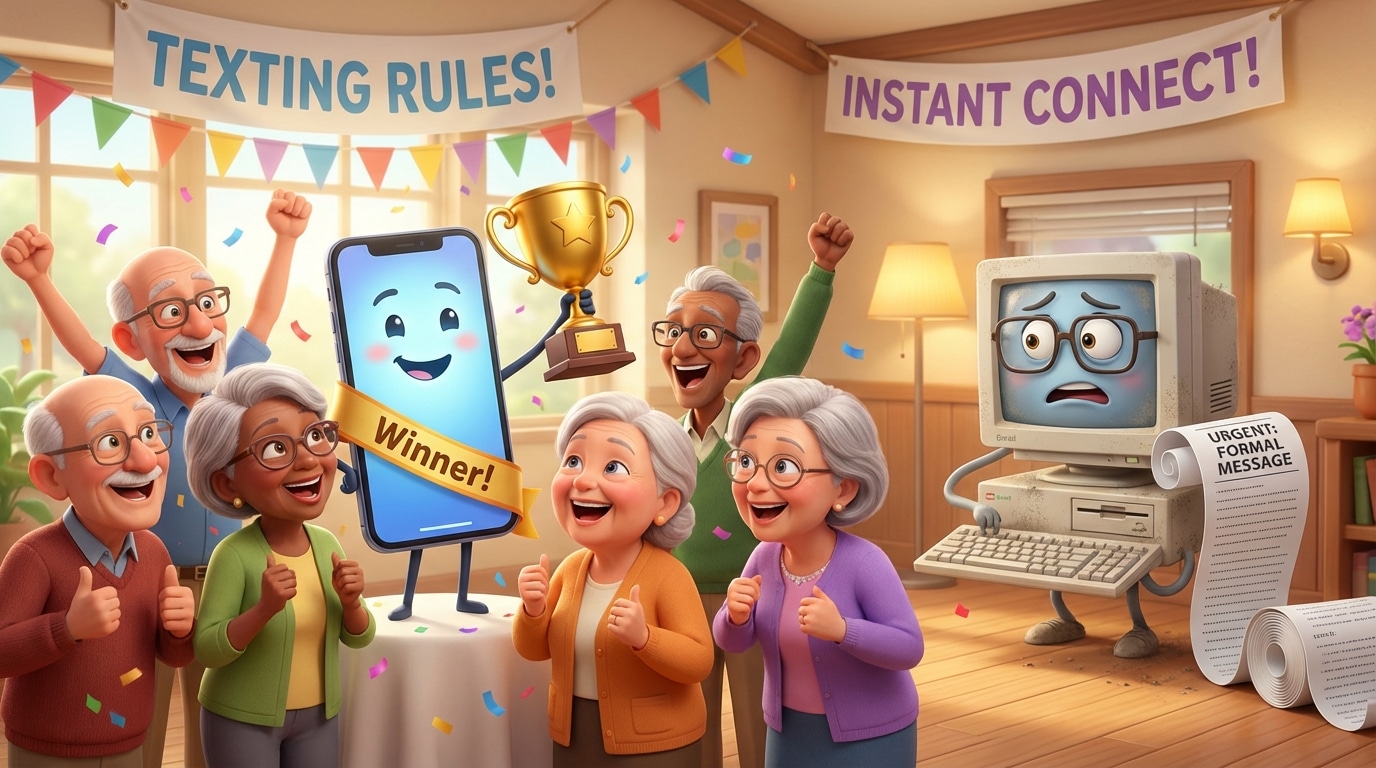
When I first heard that texting has officially overtaken email among the over-50s, I did a little victory dance. Not because I’m surprised that people our age can master technology (we absolutely can, thank you very much), but because it means we’ve collectively decided that life’s too short for “Dear Sir or Madam” followed by three paragraphs of unnecessary preamble.
The texting over 50s statistics from recent studies show something remarkable. We’re not just dabbling in text messages anymore, we’re choosing them as our primary digital communication method. And honestly? It makes perfect sense. We spent decades writing proper letters, then emails that looked suspiciously like those letters, and now we’ve finally embraced the joy of getting straight to the point. “Running late. See you at 3.” Done. Beautiful. No “I hope this message finds you well” required.
This shift in seniors texting vs email preferences isn’t just a fun statistic for tech journalists to write about. It represents something bigger. It shows how communication technology adapts to us, not the other way around. And it proves that when technology genuinely makes our lives easier, we’ll adopt it faster than you can say “smartphone.”
SOURCE: 2026 Tech Trends and Adults 50-Plus (PDF)
Why This Actually Matters (And I Mean Really Matters)
Here’s the thing about communication technology. It’s not just about sending words from point A to point B. It’s about connection. It’s about telling your daughter you’re thinking of her. It’s about coordinating Sunday lunch with the grandkids. It’s about letting your mate know you’ve arrived home safely after that concerning weather.
When over 50 communication preferences shift this dramatically, it tells us something important about what we value. Speed matters. Simplicity matters. Getting a response before we’ve forgotten why we asked the question matters. Email had its moment, and it was glorious, but texting fits our lives better now. It’s immediate without being intrusive. It’s casual without being careless. It’s perfect for “Can you grab milk?” and equally good for “Thinking of you today.”
The beauty of texting is that it meets us where we are. Literally. Whether we’re waiting for the bus, sitting in the garden, or pretending to watch that programme our partner chose, our phone’s right there. We don’t need to boot up a computer, log into an email account, or navigate through seventeen spam messages about cryptocurrency (whatever that is) to see that our friend wants to meet for coffee.
What We Used Before (A Trip Down Memory Lane)
Remember when “I’ll call you” actually meant something? Before texting, before email, we had the telephone. The landline. That beige or cream-coloured thing attached to the wall in the hallway, with a cord that never quite reached the chair you wanted to sit in.
If you needed to tell someone something, you rang them. If they weren’t home, you got nothing. No answering machine in the early days, just the endless ringing of a phone in an empty house. Later, we got answering machines (remember recording those messages, trying to sound casual and failing miserably?), then voicemail, but the principle remained the same. Communication was synchronous, you both had to be available at the same time.
Then came letters, of course. Proper letters. I’m not being nostalgic when I say there was something lovely about receiving a letter, but let’s be honest about the downsides. You wrote it, you posted it, and three days later it arrived. If you forgot to mention something, tough luck. Another letter, another stamp, another three days. Urgent communication it was not.
For work, we had memos. Remember those? Typed up, photocopied, distributed. The original group message, except it took all morning and involved significantly more paper cuts.
The fax machine arrived and we thought we were living in the future. Send a document down a phone line? Witchcraft! Except it was loud, unreliable, and the paper faded faster than our memories of what we sent.
The Journey from Email to Texting (How We Got Here)
Email arrived in our lives like a revelation. Suddenly, you could write a message and send it instantly to someone on the other side of the world. No postage, no waiting, no hoping they were home to answer the phone. The first emails in the 1990s were clunky affairs, you needed a computer, an internet connection (remember that screeching dial-up sound?), and the patience of a saint.
Early email was formal because we treated it like letters. We started with “Dear,” we signed off with “Yours sincerely,” and we agonised over every word. But it worked. By the early 2000s, most of us had email addresses, even if we only checked them once a week.
Then mobile phones got clever. The first text messages (SMS, or Short Message Service) appeared in the 1990s, but they were fiddly. You had to press the number keys multiple times to get each letter. Texting “hello” meant pressing 4 twice, 3 twice, 5 three times, 5 three times again, and 6 three times. It was like playing a very slow, very frustrating piano. Most of us stuck to phone calls.
T9 predictive text helped a bit. The phone guessed what word you wanted based on the number sequence. Sometimes it guessed right. Often it didn’t, leading to some genuinely baffling messages that we had to ring up to explain.
Everything changed with smartphones and touchscreen keyboards. Suddenly, texting was as easy as typing. The iPhone arrived in 2007, Android followed, and within a few years, most of us had little computers in our pockets with proper keyboards (well, virtual ones) that made texting actually pleasant.
Apps like WhatsApp (launched 2009) and later iMessage made texting even better. Now you could send photos, voice messages, even little animated cartoons if you were feeling fancy. The messages were free (using your internet data instead of SMS charges), and you could see when someone had read your message. No more wondering if it got lost in the ether.
By the 2020s, texting had evolved into something beautiful and simple. Voice-to-text meant you could dictate messages while driving (hands-free, obviously). Predictive text actually worked. And crucially, everyone else was doing it too, which meant the people you wanted to reach were reachable.
How Texting Actually Works (The Simple Version)
Right, let’s demystify this. When you send a text message, what actually happens?
Think of it like sending a letter, but instead of the Royal Mail, you’ve got invisible digital postmen working at the speed of light. You type your message on your phone. When you press send, your phone converts those words into digital data, essentially a series of ones and zeros that computers understand.
This data gets sent to your mobile network’s nearest tower. You know those tall masts you see around town that people complain about but everyone secretly relies on? Those. Your message zips to the tower, which passes it to your mobile network’s messaging centre. This is like a sorting office, but for texts.
The messaging centre checks where the message needs to go. It looks at the phone number you sent it to and works out which network that person uses. It then sends the message to their network’s messaging centre, which sends it to their nearest tower, which sends it to their phone. All of this happens in seconds.
If their phone’s off or out of signal, the messaging centre holds onto the message (like the sorting office holding a parcel when you’re out) and delivers it as soon as their phone’s back online.
With apps like WhatsApp, it’s slightly different but similar in principle. Your message goes through the internet instead of the SMS network. It travels from your phone, through your internet connection (either mobile data or WiFi), to WhatsApp’s servers (big computers that handle millions of messages), and then to your recipient’s phone via their internet connection. The benefit? You can send bigger files, photos, videos, and it’s all encrypted (scrambled so only you and the recipient can read it).
The really clever bit is how simple it all seems from your end. You type, you press send, they receive it. All that complexity hidden behind a button. That’s good design.
What’s Coming Next (The Future of Texting)
The future of texting looks remarkably like more of what we already have, just better. And honestly, that’s good news. We don’t need revolutionary changes. We need refinement.
Voice-to-text is getting scarily accurate. It understands accents better, picks up context, and even gets punctuation right most of the time. In a few years, typing might feel as old-fashioned as that multi-tap keyboard system.
Translation features are improving too. Imagine texting someone in Spain and having your English automatically converted to Spanish on their end, and vice versa. It’s already possible, but it’ll get smoother and more natural. Geography stops mattering quite so much.
Rich Communication Services (RCS) is replacing traditional SMS with something better. It’s essentially bringing all the features we love from WhatsApp into standard text messaging. Better photo quality, read receipts, typing indicators, all without needing a separate app. Android’s had it for a while, and Apple finally joined the party in 2024, meaning it’ll become the new normal.
What we probably won’t see is anything dramatically different. Texting works because it’s simple. The tech industry’s learned (finally) that we don’t want complicated. We want reliable, straightforward communication that doesn’t require a manual.
The Serious Bit: Security and Staying Safe
I wouldn’t be doing my job if I didn’t talk about safety. Texting’s generally secure, but like anything involving technology, there are things to watch out for.
Scam texts are the modern equivalent of dodgy phone calls. You’ll get messages claiming to be from your bank, the Royal Mail, the NHS, all asking you to click a link or share information. Here’s the rule: if it’s unexpected and asks for personal information or money, it’s probably a scam. Delete it. If you’re worried it might be real, contact the organisation directly using a number you’ve found yourself, not one in the message.
Your bank will never text asking for your PIN, password, or full account details. Neither will any legitimate organisation. If a text creates urgency (“Your account will be closed unless you act now!”), that’s a red flag. Scammers rely on panic.
Unknown numbers sending you links? Don’t click them. It’s that simple. Even if the message seems intriguing or alarming, resist. These links can install malicious software or take you to fake websites designed to steal your information.
Two-factor authentication (2FA) texts are the good guys. When you log into your bank or email, they send you a code via text to prove it’s really you. This is security working properly. But never share these codes with anyone who calls or texts asking for them. The whole point is that only you should see them.
WhatsApp and similar apps offer end-to-end encryption, which sounds technical but simply means your messages are scrambled during transmission so only you and your recipient can read them. Even WhatsApp itself can’t peek at your chats. This is good for privacy, but it also means you should be certain who you’re talking to. Check you’ve got the right contact before sharing anything sensitive.
Be careful with group chats. Once you send something to a group, you’ve lost control of it. Anyone in that group can screenshot and share it. Keep group messages light and assume they could potentially be seen by people outside the group.
If something feels off, trust your instincts. That message from someone claiming to be your grandchild stuck abroad needing money urgently? Ring your grandchild on their normal number. That text saying you’ve won a competition you don’t remember entering? You haven’t.
The good news is that with basic caution, texting is safe and secure. Don’t let security concerns put you off, just stay alert. Think before you click, verify before you share, and you’ll be fine.
Wrapping This Up
The texting over 50s statistics tell a story about us that I rather like. We’re not technophobic dinosaurs refusing to adapt. We’re selective. We waited until the technology actually worked properly, until it genuinely made our lives better, and then we embraced it wholeheartedly.
Email was revolutionary, and it still has its place. But for daily communication, for staying connected with the people we care about, for the hundreds of small interactions that make up our lives, texting just works better. It’s immediate without being demanding. It’s written without being formal. It’s there when we need it and quiet when we don’t.
The shift in over 50 communication preferences towards texting isn’t about following trends or trying to seem young. It’s about recognising that this technology, finally, fits our lives. We can check in with our children without interrupting their workday. We can make plans without playing phone tag. We can share moments without writing essays.
I’ve watched my own communication habits change over the past few years. I still email for work-related things, for anything that needs a paper trail, for messages that require formality. I still phone for proper catch-ups, for emotional conversations, for chats with my mum who prefers hearing voices. But for everything else? Texting. Quick questions, sharing photos, making plans, staying in touch. It’s become as natural as those phone calls used to be, but it fits modern life better.
The beauty of texting is that it’s evolved to be exactly what we need: simple enough that we don’t need instructions, powerful enough to handle photos and videos and voice messages, and ubiquitous enough that everyone we want to reach is reachable. It’s not perfect, nothing is, but it’s pretty damn good.
So yes, texting has overtaken email for us. Not because we’re trying to be trendy, but because we’re practical. We’ve found a tool that works, and we’re using it. And I think that’s rather wonderful. Now, if you’ll excuse me, I need to text my friend about lunch next week. No “Dear Margaret” required.
Walter
Leave a Reply