
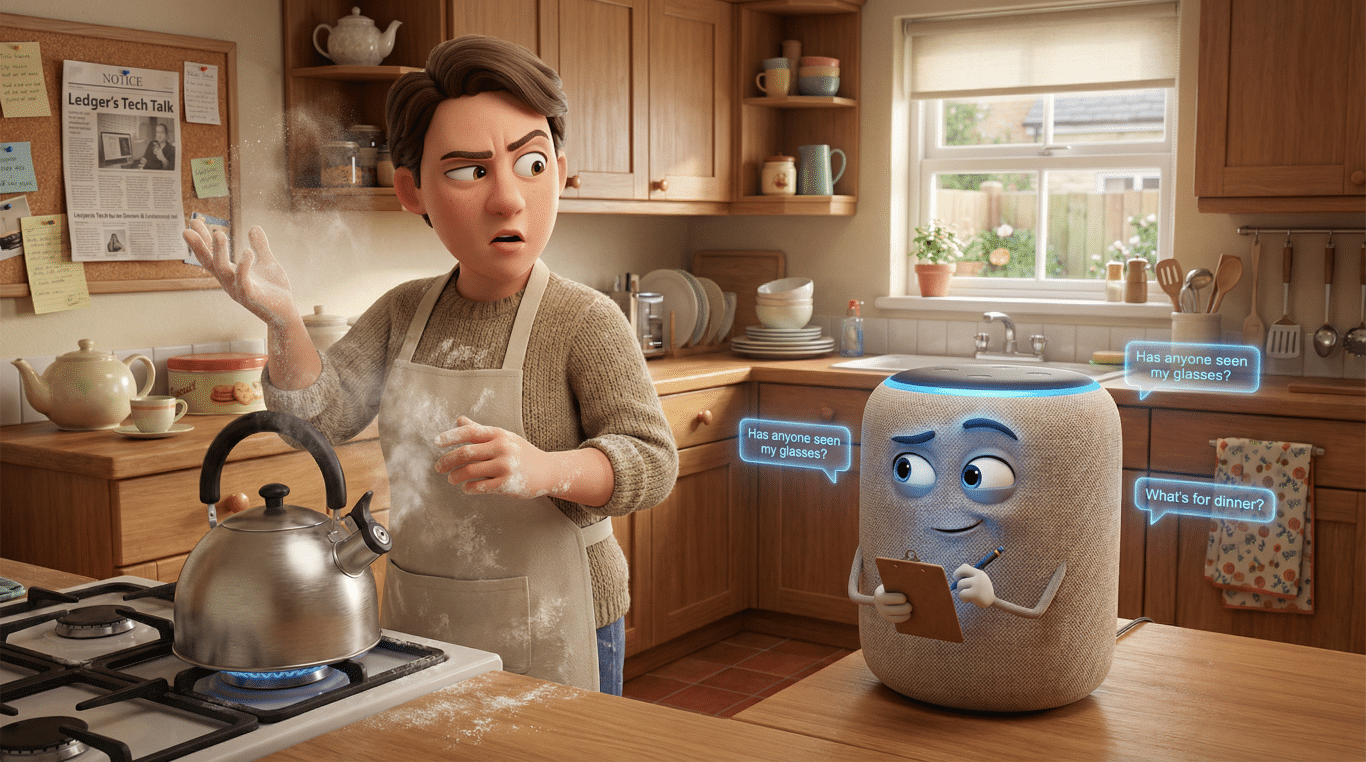
Look, I get it. You’ve got this little cylinder sitting on your kitchen counter, and sometimes, just sometimes, it feels like it’s eavesdropping on your conversations. You mention needing new garden furniture, and suddenly your phone is showing you ads for patio sets. Coincidence? Maybe. Creepy? Absolutely. So let’s have an honest chat about smart speaker privacy, because this is something that genuinely matters in 2026.
Why Smart Speakers Actually Matter (And Why We’re All Slightly Paranoid About Them)
Here’s the thing about smart speakers. They’ve become as common in British homes as the kettle, and that’s saying something. These devices have fundamentally changed how we interact with technology. Instead of typing or tapping, we just talk. We ask about the weather whilst making breakfast. We set timers whilst our hands are covered in flour. We tell them to play our favourite songs whilst we’re in the shower (no judgement here).
But this convenience comes with a question that nags at the back of our minds: is my smart speaker listening to everything I say? And more importantly, should I actually be worried about it? The short answer is complicated, which is exactly why I’m writing this. Because you deserve to understand what’s really happening in your own home.
What Smart Speakers Are Actually Used For (And What They’re Not)
Let me start with what these devices are genuinely designed to do. Smart speakers are meant to be your helpful home assistant. They play music, answer questions, control your smart lights, set reminders, read you the news, and tell you terrible jokes when you’re feeling low. They can order your shopping, check your calendar, and even help you follow recipes step by step.
What they’re not designed to do, officially at least, is record every single word you say and send it off to some massive server farm where people in lab coats analyse your conversations. That would be impractical, expensive, and honestly, most of what we say during the day is monumentally boring. “Has anyone seen my glasses?” and “What’s for dinner?” don’t exactly make for riveting intelligence gathering.
The reality sits somewhere in the middle, which is what makes smart speaker privacy such a thorny issue. These devices are always listening for their wake word (that’s “Alexa,” “Hey Google,” or “Hey Siri”), but they’re not supposed to be recording or transmitting everything until they hear that specific trigger. Think of it like having a friend who’s daydreaming until you say their name, then suddenly they’re paying full attention.
Remember When We Had to Actually Get Up? A Brief History
Cast your mind back to the 1990s and early 2000s. If you wanted to know the weather forecast, you either watched the telly at specific times, rang a premium rate number, or looked out the window and made an educated guess. If you wanted to play music, you had to physically walk to your stereo system, select a CD, and press play. Revolutionary, I know.
We had remote controls, sure, but each device had its own. I remember my parents having about seven different remotes on the coffee table, and nobody could ever remember which one worked the telly versus the DVD player. Voice control existed in science fiction films, but in real life? Not so much.
The closest we got was those clap-on, clap-off lights that never worked properly and would turn on whenever someone sneezed. Or those early voice recognition systems on phones that required you to shout “CALL HOME” seventeen times whilst the automated voice cheerfully misunderstood you every single time.
The Evolution of Smart Speakers: From Rubbish to Rather Good
The Early Days: Amazon Takes a Punt (2014-2015)
Amazon launched the first Echo speaker in November 2014, though it was invitation-only at first. I’ll be honest, when it came out, people thought Amazon had lost the plot. A speaker that you talk to? That listens all the time? It sounded barmy. But Amazon had noticed something: people were getting comfortable talking to their phones with Siri (launched in 2011), so why not have a dedicated device at home?
That first Echo was chunky, a bit awkward, and Alexa (the voice assistant inside) was frankly not very bright. She could play music from Amazon’s own service, set timers, and answer basic questions, but she’d often misunderstand you or simply say, “Sorry, I don’t know that one.” The benefit over what came before? You didn’t need to use your hands or look at a screen. That was genuinely novel.
The Competition Arrives (2016-2017)
Google wasn’t about to let Amazon have all the fun. They launched Google Home in 2016, and it was notably better at answering questions because, well, Google had the entire internet indexed. Apple eventually joined with the HomePod in 2018, focusing on sound quality but arriving fashionably late to the party, as Apple tends to do.
These second-generation devices were smarter, understood context better, and could control more smart home devices. The benefit? You could actually have something resembling a conversation rather than barking commands like you were talking to a particularly dim robot.
The Smart Home Integration Era (2018-2020)
This is when things got properly useful. Smart speakers became the control centre for your entire home. Lights, thermostats, door locks, cameras, even your kettle if you were feeling particularly fancy. The devices got smaller, cheaper, and you could put them in every room. Amazon released the Echo Dot, a smaller, more affordable version, and suddenly everyone had one.
The voice assistants got considerably brighter too. They could understand accents better (finally!), recognize different family members’ voices, and even detect when you were whispering and whisper back. Creepy or considerate? You decide.
The Privacy Reckoning (2019-2021)
Then came the revelations that made everyone question whether Alexa listening to me was more than just paranoia. In 2019, reports emerged that Amazon, Apple, and Google all employed people to listen to voice recordings to improve their services. Not all recordings, mind you, but enough to make people deeply uncomfortable.
The companies scrambled to respond, adding more privacy controls, making it easier to delete recordings, and being more transparent about what data they collected. This wasn’t a new version of the hardware, but it fundamentally changed how these devices operated and how companies handled our data.
The Current Generation (2022-2026)
Today’s smart speakers are remarkably sophisticated. They process more commands locally on the device itself rather than sending everything to the cloud, which is better for privacy and faster for you. They can distinguish between multiple voices in a noisy room, understand context from previous conversations, and integrate with virtually any smart home device you can imagine.
The latest models also have physical privacy switches that completely disconnect the microphones, LED indicators that show when they’re actively listening, and much more granular privacy settings. You can now tell your speaker to automatically delete recordings after a certain period, or never save them at all.
How These Things Actually Work: The Technical Bit Made Simple
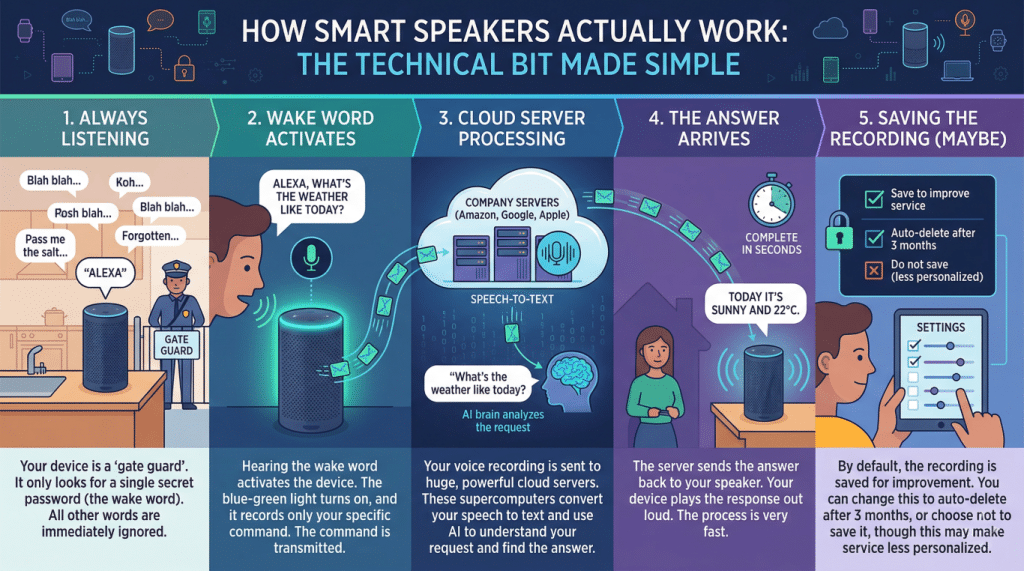
Right, let’s break down what happens when you say “Alexa, what’s the weather like today?” Because understanding this is crucial to understanding smart speaker privacy.
Step One: The Constant Listening (But Not Recording)
Your smart speaker is always listening for its wake word. Think of it like having a guard at a gate who’s been told to only open the door when someone says the secret password. The device has a tiny bit of its computer brain dedicated solely to recognizing that one word or phrase. Everything else it hears? It ignores and immediately forgets. This happens entirely on the device itself, not on the internet.
Step Two: The Wake Word Triggers Recording
When the device hears what it thinks is the wake word, it wakes up properly. A light comes on (usually blue or green), and now it starts recording what you say. This is the bit that actually gets sent to the company’s servers. So in our weather example, “what’s the weather like today?” is what gets recorded and transmitted.
Step Three: The Cloud Does the Thinking
Your voice recording shoots off to the company’s servers (Amazon, Google, or Apple). These servers are essentially massive, powerful computers that can understand human speech far better than the little speaker in your kitchen could alone. They convert your speech to text, figure out what you’re asking, and determine the best answer.
Step Four: The Response Comes Back
The server sends back the answer, your speaker plays it out loud, and the interaction is complete. The whole process takes a couple of seconds, which is honestly quite impressive when you think about it.
Step Five: The Recording Gets Saved (Maybe)
Here’s where it gets interesting for privacy. By default, most smart speakers save these recordings to help improve the service and to let you review your history. But you can change this. You can set them to delete recordings automatically after three months, or even not save them at all, though this might make the service slightly less personalized.
The Future of Smart Speakers: Where Are We Headed?
I reckon smart speakers are going to get even more embedded in our lives, but in ways that are hopefully more privacy-conscious. We’re already seeing devices that do more processing locally rather than sending everything to the cloud. This is brilliant for privacy because your voice never leaves your home.
We’re also likely to see more integration with AI assistants that can have actual conversations rather than just responding to commands. The technology behind ChatGPT and similar systems is already being integrated into smart speakers, making them genuinely helpful rather than just fancy timers.
Biometric security is another area that’s developing. Future speakers might use your unique voice print as a security measure, only responding to authorized family members for sensitive requests like unlocking doors or making purchases.
And honestly? I think we’ll see a continued push towards transparency. The companies making these devices have learned that people care about privacy, and they’re not willing to sacrifice it entirely for convenience. More controls, clearer explanations, and better security are all on the horizon.
Security and Vulnerabilities: Why You Should Actually Pay Attention
Now we get to the serious bit, and I’m not going to sugarcoat it. Smart speakers do present genuine security and privacy concerns. Not necessarily because the companies making them are evil (though healthy scepticism is always wise), but because any device connected to the internet can potentially be compromised.
The Accidental Activation Problem
Smart speakers sometimes wake up when they shouldn’t. They hear something that sounds like their wake word and suddenly they’re recording. Studies have found that devices can be triggered by words that sound similar, or even by sounds from the television. This means they might occasionally record conversations you didn’t intend them to hear.
Is this concerning? Yes. Is it malicious? Probably not. But it does mean that recordings of private conversations could end up on a company’s servers without your knowledge.
The Human Listening Issue
Remember when I mentioned that companies employed people to listen to recordings? They claimed it was to improve the service, and only a small fraction of recordings were reviewed, and they were supposedly anonymized. But here’s the thing: those reviewers reported hearing all sorts of private moments, from medical conversations to, well, intimate encounters.
The companies have since made this practice opt-in rather than automatic, but it’s worth checking your settings to make sure you’re comfortable with whatever’s currently enabled.
The Hacking Risk
Like any internet-connected device, smart speakers can theoretically be hacked. Security researchers have demonstrated various vulnerabilities over the years, from turning speakers into listening devices to using them to unlock smart locks. The companies patch these vulnerabilities when they’re found, but new ones emerge.
The risk isn’t enormous for the average person, but it’s not zero either. If someone really wanted to spy on you specifically, a smart speaker could potentially be exploited. That said, your smartphone presents similar risks, and you probably carry that everywhere.
The Data Collection Reality
Even when everything is working as intended, these devices collect data. They need to know your location for weather and traffic. They keep a history of your requests. They might share data with third-party services you connect to them. This data builds a surprisingly detailed picture of your life, your habits, your interests, and your household.
Is this data encrypted and protected? The companies say yes. Could it be subpoenaed by law enforcement? Absolutely. Could it be breached in a hack? Potentially. Should you be aware of this when deciding whether to have one in your home? Definitely.
What You Can Actually Do About It
The good news is you’re not powerless. Modern smart speakers have proper privacy controls if you bother to use them. You can mute the microphone with a physical button when you want guaranteed privacy. You can delete your voice recordings regularly or set them to auto-delete. You can review what’s been recorded and remove anything you’re uncomfortable with.
You can also be mindful about where you place these devices. Maybe don’t put one in your bedroom or bathroom. Perhaps avoid having one right next to where you have confidential phone conversations. And definitely set up voice recognition so your speaker doesn’t respond to just anyone.
So, Should You Actually Be Worried?
Here’s my honest take on the whole “is my smart speaker listening” question: yes, it’s listening for its wake word, but no, it’s probably not recording everything you say and sending it off to be analyzed by marketing departments. The reality is more nuanced and, frankly, more boring than the conspiracy theories suggest.
Should you be concerned about smart speaker privacy? Yes, in the same way you should be concerned about any technology that’s connected to the internet and has access to your personal information. These devices do present privacy risks, and you should understand those risks before bringing one into your home.
But should you be lying awake at night worrying that Alexa is listening to your every word? Probably not. The companies making these devices have too much to lose by being genuinely nefarious. They’ve faced regulatory scrutiny, public backlash, and actual consequences when they’ve overstepped. They’re motivated to keep your trust, even if that motivation is purely financial.
The key is informed consent. Understand what these devices do, how they work, and what data they collect. Use the privacy settings available to you. Make conscious choices about where you place them and when you mute them. And if you’re genuinely uncomfortable with the technology, you don’t have to have one. They’re convenient, sure, but they’re not essential.
I have smart speakers in my home, and I use them daily. But I’ve also gone through the privacy settings, I regularly delete my recordings, and I’m conscious about what I say around them. I’ve made an informed decision that the convenience is worth the relatively small privacy trade-off for me personally. Your calculation might be different, and that’s absolutely fine.
The technology isn’t going away. Smart speakers and voice assistants are becoming more prevalent, not less. But as consumers become more privacy-conscious and regulations tighten, I’m cautiously optimistic that these devices will become more respectful of our privacy rather than less.
Just remember: that little speaker on your counter is a computer connected to the internet. Treat it with the same healthy scepticism and security awareness you’d treat any other computer in your home. Don’t give it more power or access than you’re comfortable with. And if it ever starts answering questions you didn’t ask, well, maybe it’s time to have a serious think about whether the convenience is really worth it after all.
Stay curious, stay informed, and maybe, just maybe, keep the really private conversations for when you’re out on a nice walk instead.
Walter
Leave a Reply