
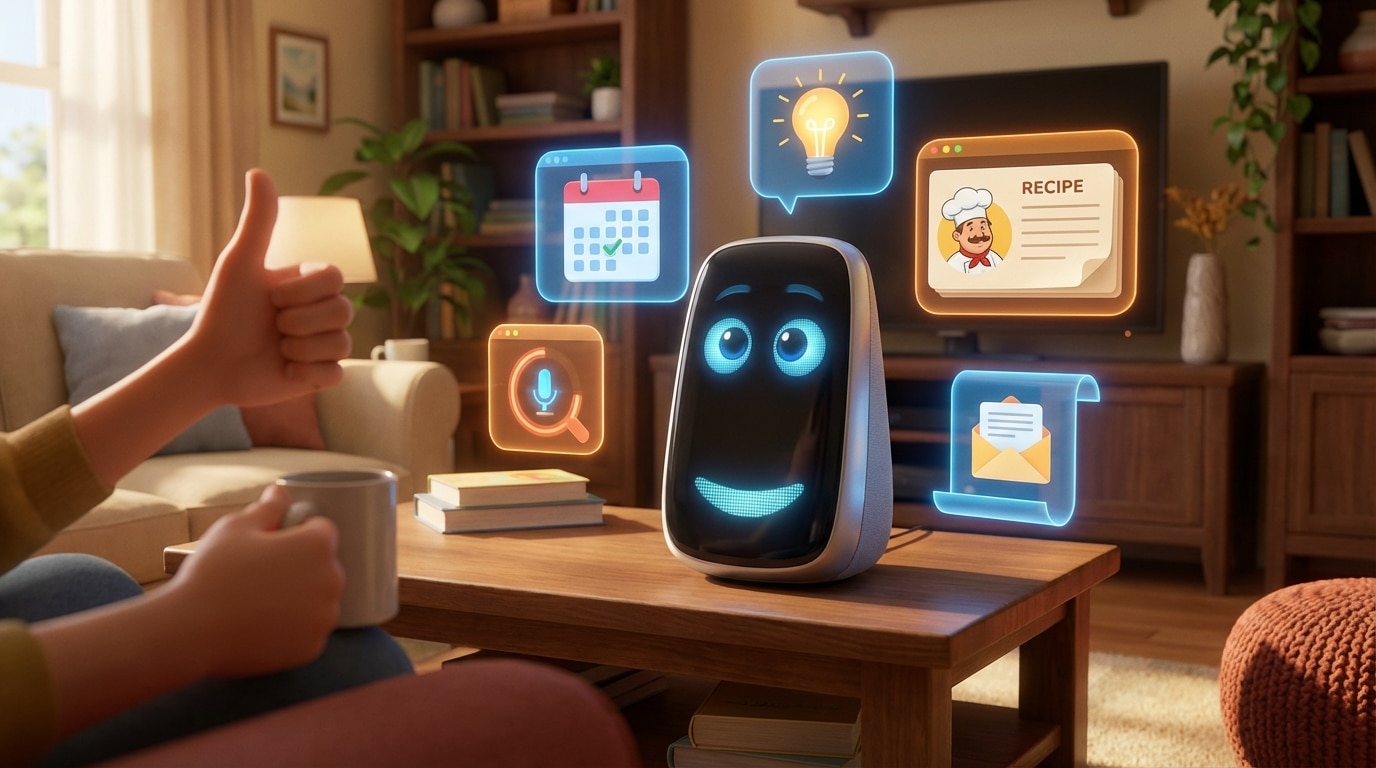
The Little Cylinder That Could (And Now Really, Really Can)
Remember when you first got a smart speaker and thought it was absolute magic? You’d ask it to play your favourite song or set a timer for the pasta, and you’d feel like you were living in a science fiction film. Then, about five minutes later, you’d ask it something slightly complicated — like “What’s the best route to the garden centre that avoids the motorway?” — and it would stare back at you with the blank expression of a confused golden retriever.
Well, those days are largely behind us.
The humble smart speaker — that little tube or puck next to your kettle — has quietly been getting a brain transplant. A proper one. This isn’t “a bit better than before” new. We’re talking about the difference between a pocket calculator and a laptop. The technology has fundamentally changed, and if you haven’t noticed yet, you’re in for a pleasant surprise.
What Is This Actually For? (And What It’s Not)
There’s a lot of marketing fluff floating around about AI assistants. So let me cut through it.
These devices are brilliant for managing the flow of your daily life. Think of them as an incredibly patient personal assistant who never takes a lunch break. They can hold proper conversations, remember what you said earlier in the chat, book appointments, control your heating and lights, read out recipes while you cook, summarise your emails, and remind you about medications.
Amazon Alexa+ can handle multi-step tasks on your behalf — booking a restaurant, adding it to your calendar, and texting a family member about the plans, all from a single spoken request. Google Gemini for Home links your speaker to your Google account so it can draw on your calendar, contacts, and preferences to give you genuinely personalised responses.
What they’re NOT for is replacing your doctor, your solicitor, or your financial adviser. They can give you general information, but they can also get things wrong, and when it comes to your health, your legal situation, or your money, “generally right” isn’t good enough. Use them as a starting point, not the final word.
A Brief History of Talking to Machines
To appreciate where we are, you need to know where we came from.
If you’re over 50, you might remember Dragon NaturallySpeaking — the voice recognition software from the late 1990s. You’d spend 45 minutes training it to recognise your voice by reading passages aloud, and it would still type “weather” when you said “whether.” It was, to put it kindly, a work in progress. Before that, the science fiction of our youth gave us HAL 9000 from 2001: A Space Odyssey and the computer from Star Trek that you could just… talk to. Those felt impossibly futuristic. Surely that was centuries away.
Then Apple introduced Siri in 2011 and the world briefly lost its mind. You could ask your phone a question! With your voice! And it would sometimes answer correctly! Google Now followed shortly after, and Microsoft introduced Cortana. Genuinely exciting at the time, though looking back, these were quite limited — essentially very clever search engines with a voice interface bolted on.
The smart speaker era began in 2014 when Amazon launched the original Echo with Alexa. Google Home followed in 2016. Both sold in enormous numbers and were genuinely useful for simple tasks — setting timers, playing music, checking the weather. But they had a fundamental limitation: they were essentially very fast lookup tables. You asked a question, they searched for an answer, they read it back. They couldn’t hold a conversation. Each interaction started completely fresh, like talking to someone with no short-term memory whatsoever.
The AI Revolution: From Lookup Table to Actual Intelligence
The success of ChatGPT in late 2022 sent shockwaves through the technology industry. Both Amazon and Google realised that the future of voice assistants lay in large language models — AI trained on an enormous amount of text that can understand and generate language in a far more flexible, human way.
Think of it this way. The old system was like having a very organised filing cabinet. You could find things quickly, but only if they were filed exactly where you expected. The new system is more like having a genuinely well-read friend who can reason through problems and give you a thoughtful answer even when your question is a bit muddled.
The changes didn’t happen overnight. From 2019 to 2022, both Amazon and Google started incorporating more sophisticated language processing — Alexa got “hunches” based on your habits, and Google Assistant got better at follow-up questions. If you asked “Who is the Prime Minister?” and then said “How old is he?” it would correctly understand that “he” referred to the Prime Minister. Sounds simple, but at the time it was a meaningful step forward.
From 2023 onwards, Google began integrating Gemini — its most advanced AI model — into its assistant products. Amazon was simultaneously rebuilding Alexa from the ground up. Both were chasing the same goal: a voice assistant that could genuinely reason, hold a conversation, and get things done in the real world on your behalf.
Where Things Stand Right Now: Alexa+ and Gemini for Home
This is where the original story needs some updating, because quite a bit has happened.
Amazon Alexa+
Amazon announced Alexa+ in February 2025, but the actual rollout was considerably slower than the fanfare suggested. Early access began mid-2025, starting with Echo Show models 8, 10, 15, and 21. It wasn’t until February 2026 that Amazon made Alexa+ available to all US users — launched, somewhat theatrically, via a Super Bowl ad fronted by Chris Hemsworth. By then, Amazon was reporting tens of millions of users engaging in twice as many conversations and making three times as many purchases compared to the old Alexa.
For UK readers specifically: Alexa+ arrived here on 19 March 2026, making the UK the first European country to receive it. And it hasn’t just been translated — it’s been properly localised. Amazon’s team at its Cambridge Tech Hub trained the system on 40 regional dialects, so it can handle the considerable variation in how we speak across this country. It connects to UK-specific services and British news sources including the BBC and the Guardian.
Pricing is simple: £19.99 per month, or free with an Amazon Prime membership. The good news on hardware is that Amazon has confirmed 97% of shipped Alexa devices are compatible, so you almost certainly won’t need to buy anything new. If you want early access now, you can register at amazon.co.uk/newalexa.
As for what it can actually do: Alexa+ holds extended contextual conversations — it remembers what you said five minutes ago, not just five seconds ago. It handles genuinely complex requests without you having to break everything into separate commands. In a single sentence you can ask it to find a local restaurant with vegetarian options, book a table, add it to your calendar, and send a message to whoever’s joining you. It’ll do the lot. It can also arrange home repairs, manage your smart home, and order groceries or takeaway through integrations with Uber Eats and Amazon Fresh.
Amazon has expanded Alexa+ beyond the Echo too. Alexa.com launched in late 2025 as a web portal, letting you continue voice conversations from your living room on a desktop browser — handy if you’re mid-task and switch devices.
Google Gemini for Home
Google’s approach has been somewhat different. Rather than launching a new paid service, Gemini for Home started rolling out as a free upgrade to existing Nest speakers and displays in late October 2025, beginning in the US. The UK and most of Europe followed in early 2026.
The basic Gemini voice assistant replaces the old Google Assistant on compatible devices at no cost. The more capable version — including Gemini Live for extended, free-flowing conversation and advanced camera features on Nest devices — requires a Google Home Premium subscription starting at £10 per month.
Google is also launching a brand-new physical speaker. The Google Home Speaker is priced at £99, built around Gemini from the ground up, and announced for spring 2026. It offers 360-degree audio and comes in four colours: Porcelain, Hazel, Berry, and Jade. As of publication it hasn’t appeared on shelves yet, but purchases will include a six-month Google Home Premium trial. If you already have a Nest speaker, the free Gemini upgrade will land on your device without you needing to do anything.
The Future: Where Is All This Heading?
These devices are going to become genuinely proactive rather than purely reactive. Instead of waiting for you to ask, they’ll start anticipating your needs. Amazon demonstrated exactly this kind of “ambient AI” at CES 2026 — technology that’s there when you need it and fades into the background when you don’t.
We’re also going to see much better integration with health monitoring. Alexa+ already connects with Oura Ring, letting you track health data through your speaker. The next step — your speaker noticing from your voice that you sound more tired than usual, or gently reminding you that you haven’t mentioned taking your afternoon medication — is already in development.
Alexa+ is also heading beyond the home. Amazon announced at CES 2026 that it’s adding Alexa+ to select BMW models this year, and Samsung is building it into their smart televisions. The line between your kitchen counter, your living room TV, and your car is starting to blur.
Confidence note: These observations are based on confirmed CES 2026 announcements and publicly reported development roadmaps. They represent informed extrapolation rather than confirmed shipping features.
Security and Privacy: The Bit You Really Need to Read
I’ve been enthusiastic throughout this piece, and genuinely so. But I’d be doing you a disservice if I skipped this part.
The fundamental trade-off is this: the more personal data you share with these devices, the more useful they become. But that data is valuable, and it’s worth being thoughtful about what you share and with whom.
The “always listening” aspect makes many people uneasy, and that’s entirely reasonable. The companies involved insist audio is only recorded after the wake word is detected, and independent testing has broadly supported this. However, there have been documented cases of wake words triggered accidentally — by similar-sounding words on television — leading to snippets of private conversation being captured unintentionally. It happens, and it’s worth knowing about.
There’s also the question of data breaches. These companies now store your voice recordings, preferences, shopping habits, calendar data, and more. If that data were ever stolen, it would be a significant invasion of your privacy. It’s worth regularly reviewing what they hold and deleting recordings you’re not comfortable with. Both Amazon and Google provide tools to do this in their apps — it takes five minutes and is absolutely worth doing.
Be particularly careful about voice purchasing. Both Amazon and Google allow you to buy things by voice, which is convenient but also a vulnerability. Set up a voice PIN if you use this feature, and consider whether you need it enabled at all. And be aware of “vishing” — voice phishing — where fraudsters try to trick you into giving personal information verbally. Your smart speaker isn’t the risk; the habit of becoming comfortable giving out information by voice is something to stay alert to.
The bottom line: these devices are safe for most everyday uses, but treat them with the same thoughtfulness you’d apply to any technology that connects to the internet and knows a lot about you.
Wrapping Up: Your Kitchen Counter Just Got a Lot Smarter
We’ve come a long way from shouting at Dragon NaturallySpeaking and watching it type gibberish.
Amazon Alexa+ is available in the UK — free for Prime members, localised for how we actually speak, and genuinely capable of things its predecessor could only dream about. Google Gemini for Home is rolling out as a free upgrade to existing Nest speakers, with a new dedicated device arriving imminently. Neither is perfect. They still get things wrong, still occasionally misunderstand you, and they’re still not a replacement for professional advice. But for the first time, they’re useful in a broad, flexible way that earlier versions simply weren’t.
For anyone over 50, I’d particularly encourage you to give these a proper go if you haven’t already. If reading small text is getting harder, if typing is becoming less comfortable, if you just want to ask a question without fumbling for your phone — these devices are genuinely brilliant. Patient, available at three in the morning, and they won’t judge you for asking the same question four times.
Just go in with your eyes open. Understand what data you’re sharing, review your privacy settings periodically, and don’t ask it to replace your GP. Do all that, and you’ve got one of the most useful bits of technology to come along in years, sitting right there next to your kettle.
Walter
Leave a Reply