
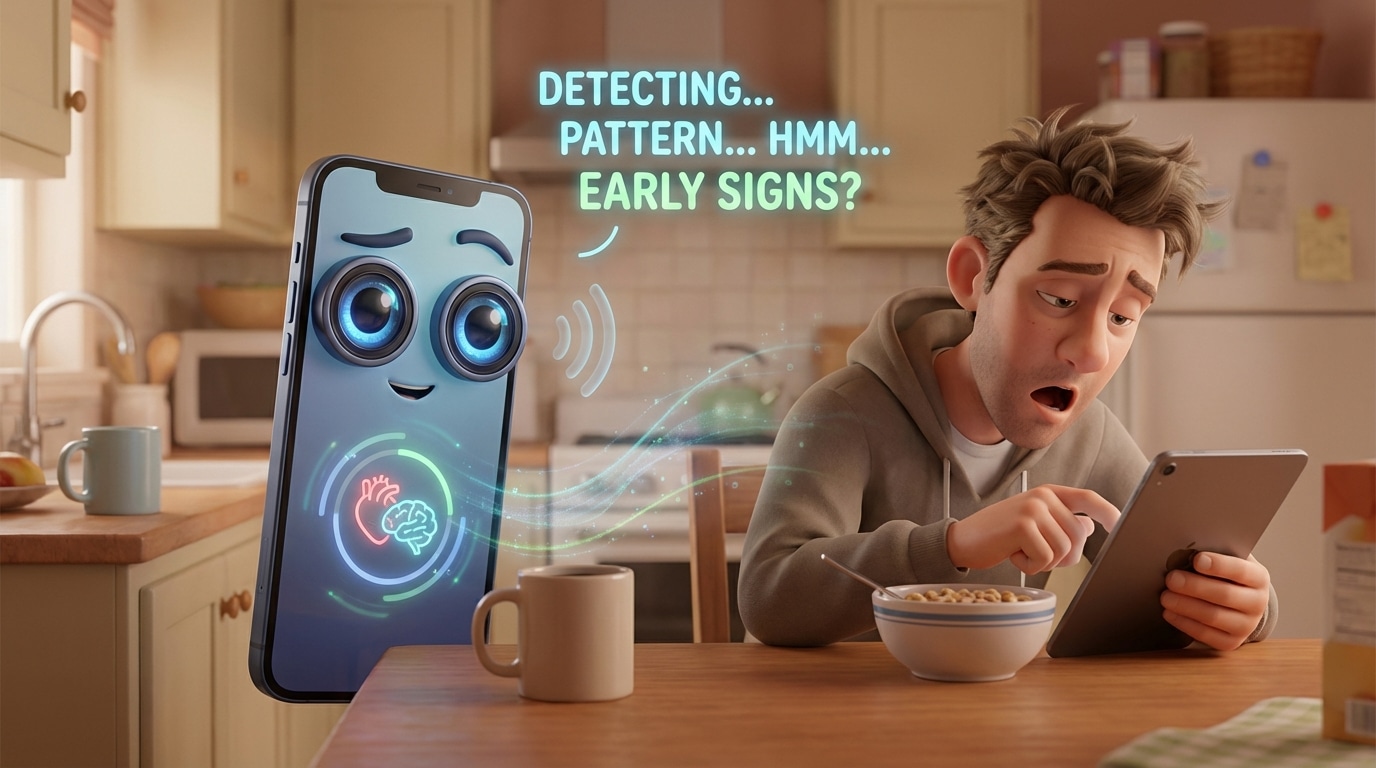
Your phone knows you’re getting sick. That’s both brilliant and slightly terrifying.
Let me paint you a picture. It’s a Tuesday morning. You feel fine, more or less. Maybe a little tired, but who isn’t? You grab your phone off the nightstand, scroll through your emails, check the weather. Normal stuff. What you don’t realise is that your phone has been quietly watching you all night. Not in a creepy stalker way, well, not entirely, but in a way that might genuinely save your life.
Smartphone health monitoring has moved so far beyond counting your steps that it’s almost unrecognisable from what it was even five years ago. We’re talking about technology that can detect early signs of conditions like atrial fibrillation, depression, Parkinson’s disease, and even COVID-19, sometimes days before you’d ever book a GP appointment. The phone sitting in your pocket right now is, in many ways, a medical device. It just doesn’t look like one.
This matters enormously, especially as we get older. The truth is, many serious health conditions are far more treatable when caught early. A heart condition spotted at stage one is a very different beast from one discovered at stage four. And if your phone can be the thing that catches it early, while you’re just going about your life, then that’s not just clever technology. That’s genuinely life-changing stuff.
So let’s dig into this properly. What exactly is happening inside your phone, how did we get here, and should you be excited or nervous? Probably both, as it turns out.
What This Technology Is Actually For (And What It Isn’t)
Before we get carried away imagining our phones diagnosing us with rare tropical diseases, let’s be clear about what passive smartphone sensing health technology actually does and doesn’t do.
What it is for is pattern recognition. Your phone collects data about how you move, how you speak, how often you pick it up, how fast you type, how long you sleep, and dozens of other behaviours. Over time, it builds a picture of your personal baseline. When something changes significantly from that baseline, it flags it. Think of it like your phone learning your normal and then noticing when things go a bit off.
Researchers have used this approach to monitor symptoms of depression by tracking reduced social activity and changes in movement patterns. They’ve detected early signs of Parkinson’s disease through subtle changes in how people type or hold their phones. Studies published in journals like npj Digital Medicine have shown that passive smartphone sensing health data can predict flu-like illness onset before people report feeling unwell.
What it is not for, at least not yet, is replacing your doctor. Your phone cannot take a blood test. It cannot examine your throat. It cannot feel your lymph nodes or look into your eyes with a light. It is a very sophisticated early warning system, not a diagnosis machine. Think of it like the oil warning light on your car. It tells you something needs attention. It doesn’t fix the engine.
There’s also a lot it simply isn’t designed to do. It won’t monitor your cholesterol or detect cancer cells. It can’t replace specialist equipment. And any app claiming to diagnose serious conditions definitively from your phone alone should be treated with the same scepticism you’d give a bloke at a car boot sale selling “genuine” Rolex watches.
The Evolution of Phone-Based Health Monitoring
The First Generation: Counting Steps and Not Much Else (2007 to 2013)
The earliest smartphones had accelerometers, little sensors that detected movement and orientation. This was mostly so your screen could rotate when you turned the phone sideways. Clever developers quickly realised these could also count steps, and so the first wave of health apps was born. They were basic. Really basic. But the seed was planted.
The Second Generation: Adding a Heartbeat (2013 to 2016)
This is where things got genuinely interesting. Samsung introduced a heart rate sensor in the Galaxy S5 in 2014, one of the first mainstream smartphones to include one. You’d press your finger against a small sensor on the back of the phone and it would read your pulse. It worked by shining a tiny light through your skin and measuring how the light changed as blood pulsed through your capillaries. Simple, elegant, and a genuine step towards smartphone health monitoring as we know it today.
Around the same time, Apple launched HealthKit in 2014, creating a centralised place where all your health data could live. This was important because it meant different apps and devices could share information and build a more complete picture.
The Third Generation: The Wearable Revolution Feeds Back Into Phones (2016 to 2019)
The Apple Watch arrived in 2015 and changed everything, though it took a couple of years to really hit its stride. By 2018, the Apple Watch Series 4 had an FDA-cleared electrocardiogram (ECG) feature built in, meaning it could detect atrial fibrillation, a type of irregular heartbeat that significantly raises stroke risk.
Crucially, this wearable data fed back into the phone ecosystem. Your phone became the hub, the brain that collected data from the watch, from apps, from its own sensors, and started making sense of it all together. The phone itself wasn’t just a passive receiver anymore. It was actively learning.
The Fourth Generation: Passive Sensing Goes Mainstream (2019 to 2022)
This is where the concept of phone sensors detect illness really took off in research circles. Academics and tech companies started realising that you didn’t need people to actively use a health app to gather useful data. The phone was already collecting information constantly, how you moved, how often you used it, how your voice sounded in calls, how your hands trembled or didn’t when you typed. If you could make sense of all that passive data, you had something remarkable.
Studies during the COVID-19 pandemic accelerated this dramatically. Researchers found that changes in phone usage patterns, things like reduced movement, more frequent charging because people were home more, and changes in call duration, correlated with infection.
The Fifth Generation: AI Comes to the Party (2022 to Present)
We are now firmly in the era where artificial intelligence sits at the heart of smartphone health monitoring. Modern phones don’t just collect data. They run sophisticated machine learning models that can identify patterns invisible to the human eye.
Apple’s iPhone 15 and 16 series, along with high-end Android devices from Samsung and Google, now include features that use AI to analyse gait (how you walk), detect falls, monitor respiratory rate during sleep, and flag anomalies in heart rhythm data. Google’s Pixel phones have featured a feature called Car Crash Detection since 2021, which uses the accelerometer and microphone together to detect accidents.
The passive smartphone sensing health capabilities in 2025 and 2026 are genuinely astonishing. Research published in recent years has shown that phone microphones can detect early signs of respiratory conditions from the sound of your breathing or coughing. Camera-based photoplethysmography, which is just a fancy way of saying the camera reads your pulse by looking at tiny colour changes in your skin, can now measure blood oxygen levels on some devices without any additional hardware.
How It Actually Works, Step by Step
Right, let’s get into the mechanics. I promise this won’t require a degree in engineering.
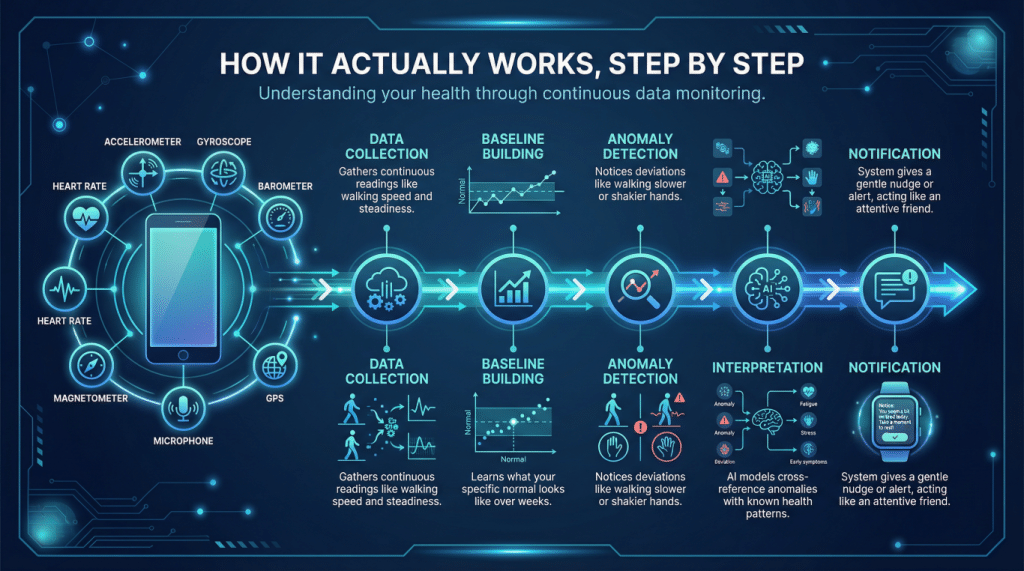
Your phone is packed with sensors. There’s the accelerometer we mentioned, which measures movement and acceleration. There’s a gyroscope, which measures rotation and orientation. There’s a barometer, which measures air pressure and can tell your phone what floor of a building you’re on. There’s a GPS chip, a microphone, a camera, a proximity sensor near the earpiece, and an ambient light sensor. Most phones also have a magnetometer, essentially a compass. High-end phones add dedicated health sensors like heart rate monitors and blood oxygen sensors.
All of these sensors are running essentially all the time, even when your screen is off. They’re doing this quietly, in the background, using very little power.
The first step is data collection. Your phone gathers readings from all these sensors continuously. How fast you’re walking, how often you pick the phone up, how long you spend on it at 3am, how your voice sounds, how steadily you hold the device.
The second step is baseline building. Over days and weeks, your phone’s software learns what normal looks like for you specifically. Not for an average person. For you. This is crucial, because everyone’s normal is different.
The third step is anomaly detection. When something deviates significantly from your personal baseline, the system notices. Maybe you’re walking more slowly than usual. Maybe your hands are shakier. Maybe you’ve barely picked up your phone for two days, which might suggest you’re feeling poorly and spending more time in bed.
The fourth step is interpretation. This is where AI earns its keep. Raw anomalies don’t mean much on their own. The AI models look at combinations of changes, cross-reference them with known health patterns, and determine whether the deviation is meaningful or just because you had a late night watching a film.
The fifth step is notification. If the system is confident enough, it alerts you. “Your heart rhythm looks unusual. Consider speaking to a healthcare provider.” Not “you’re having a heart attack.” Just a nudge. A prompt to pay attention.
It’s less like having a doctor in your pocket and more like having a very attentive friend who notices you seem a bit off and suggests you might want to get checked out.
What’s Coming Next
The next five years in this space are going to be extraordinary, and I say that as someone who’s seen a lot of “extraordinary” technology promises turn out to be slightly less than advertised.
Non-invasive blood glucose monitoring through phone cameras or wearables is the holy grail right now. For the hundreds of millions of people with diabetes, being able to check blood sugar without finger-prick tests would be genuinely transformative. Several companies are close, though “close” in medical technology terms can still mean years away.
Mental health monitoring is another frontier. Research is already showing that passive smartphone sensing health data, things like typing speed, social media usage patterns, and movement data, can correlate with depressive episodes and anxiety. The ethical questions here are enormous, and rightly so, but the potential to catch a mental health crisis before it becomes acute is genuinely compelling.
Continuous blood pressure monitoring without a cuff is also in development, with some wearable devices already offering limited versions of this. As this technology matures, it will likely integrate more deeply with phone systems.
And then there’s the integration with healthcare systems. Right now, most of this data lives on your phone or in a tech company’s cloud. The future involves this data flowing, with your permission, directly to your GP’s system, giving doctors a continuous picture of your health between appointments rather than a snapshot taken during a ten-minute consultation.
Security, Vulnerabilities, and Why You Should Genuinely Care
Now, I need to be straight with you here, because this is the bit people often skip and really shouldn’t.
Your health data is extraordinarily valuable. Not just to you, but to insurance companies, employers, advertisers, and criminals. A dataset showing that you have an irregular heartbeat or that your movement patterns suggest early cognitive decline is the kind of information that could affect your insurance premiums, your employment, or worse.
The companies holding this data, Apple, Google, Samsung, and the various app developers, have varying levels of commitment to protecting it. Apple has been notably strong on health data privacy, keeping much of it encrypted on-device and being explicit about what is and isn’t shared. Google’s approach has historically been more data-permissive, though they’ve tightened their policies significantly in recent years.
Third-party health apps are where things get genuinely murky. An app you downloaded for free to track your sleep might be selling your data to data brokers. This isn’t paranoia. It’s been documented repeatedly. A 2020 study found that many popular health apps shared data with third parties in ways that weren’t clearly disclosed to users.
What should you actually do? First, check your phone’s health data privacy settings. On iPhone, go to Settings, then Privacy and Security, then Health. On Android, look in your Google account settings under Data and Privacy. Second, be selective about which apps you grant health data access to. Third, read the privacy policy of any health app before you use it, I know, I know, nobody does this, but for health apps it genuinely matters.
The other vulnerability worth mentioning is the accuracy of the data itself. These systems are impressive but not infallible. False positives, being told something might be wrong when it isn’t, can cause unnecessary anxiety. False negatives, missing something that is wrong, can create false reassurance. Use this technology as a supplement to proper medical care, not a replacement for it.
Bringing It All Together
Here’s where we’ve landed. The phone in your pocket is no longer just a communication device. It’s a continuous, passive health monitor that’s getting smarter every single year. Smartphone health monitoring has gone from counting steps on a glorified pedometer to detecting heart arrhythmias, flagging potential illness before symptoms appear, and monitoring mental health through behavioural patterns.
The journey from that glass thermometer on your parents’ bathroom shelf to a device that can detect atrial fibrillation while you’re watching television is, when you stop and think about it, genuinely remarkable. We’ve gone through generations of increasingly sophisticated technology, each building on the last, until we’ve arrived at a point where phone sensors detect illness with a level of accuracy that would have seemed like science fiction twenty years ago.
The future is going to push this even further, into blood glucose monitoring, mental health support, and seamless integration with healthcare. It’s exciting. It’s also a little daunting.
But here’s my honest take. Used thoughtfully, with an awareness of the privacy implications and a clear understanding of what it can and can’t do, this technology is one of the most genuinely useful things to happen to personal health in a generation. It’s not a replacement for your GP. It’s not a diagnostic oracle. But as an early warning system, as a way of noticing that something might be worth paying attention to, it’s remarkable.
A quick note: tech doesn’t stand still. Some of what I’ve described here, particularly anything future-facing may have moved on by the time you read this. I’d always encourage you to check current status before making any decisions based on it.
Walter
Leave a Reply