
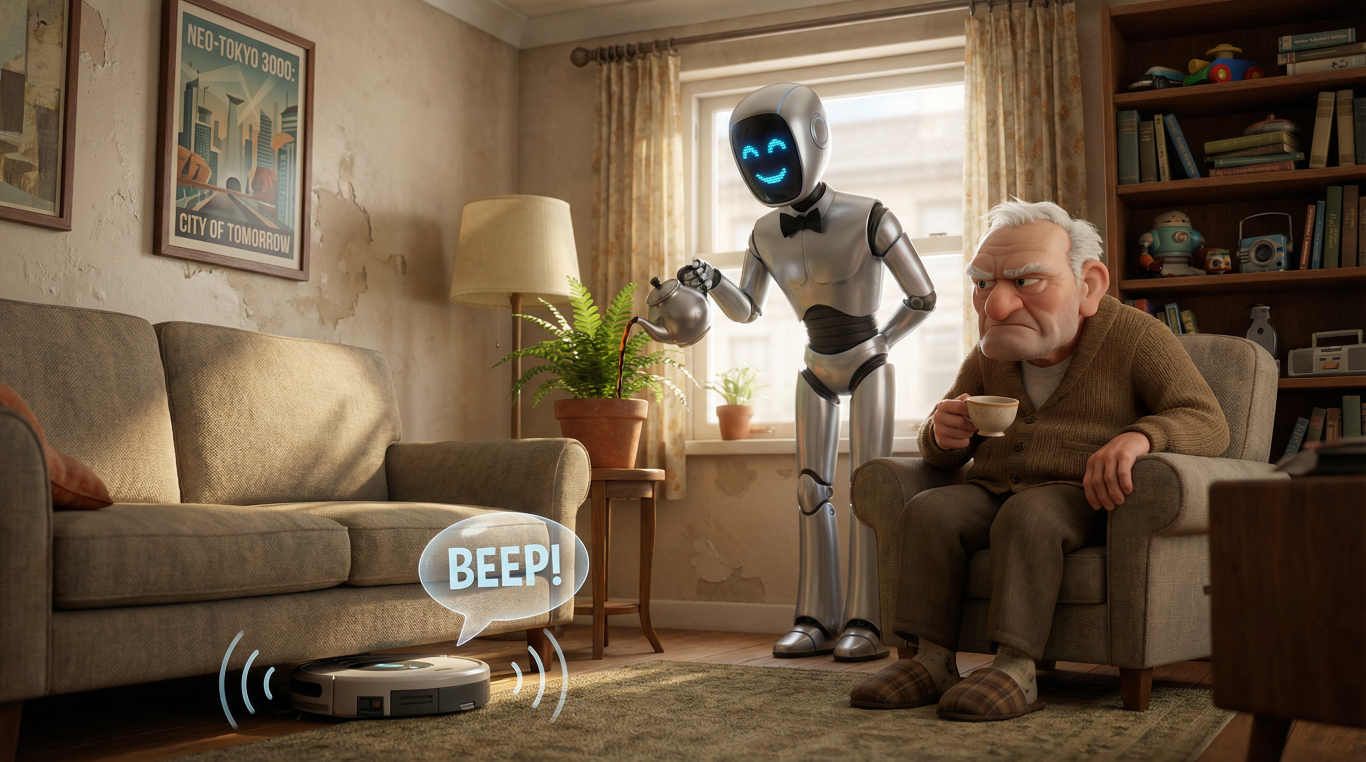
When I watched “I, Robot” when it came out in 2004, I genuinely thought we’d have humanoid robots doing our housework by now. Will Smith made it look so inevitable, didn’t he? Twenty years later, I’m still doing my own washing up, and the most advanced robot in my house is a vacuum cleaner that occasionally gets stuck under the sofa and beeps pathetically until I rescue it.
But here’s the thing. We’re actually closer than you might think to having proper humanoid robots walking amongst us, and simultaneously, we’re decades away from the intelligent, thinking machines that populated that film. It’s a bit like asking when we’ll have flying cars. The flying bit? We’ve had that since the Wright brothers. The car bit? Sorted. But combining them safely and affordably for everyone? That’s where it gets complicated.
Why This Technology Matters More Than You Think
The development of AI robots and humanoid robots isn’t just about having a mechanical butler to bring you tea (though I won’t pretend that doesn’t sound lovely). This technology represents something far more profound. It’s about creating machines that can work alongside us in environments designed for humans, doing tasks that are either too dangerous, too repetitive, or too physically demanding for people.
Think about it this way. Our entire world, every building, every doorway, every staircase, every tool, has been designed for creatures with two arms, two legs, and roughly the same height and capabilities. If we want robots to truly integrate into our society without rebuilding everything from scratch, they need to have a similar form. A wheeled robot, no matter how clever, can’t climb the stairs to check on an elderly person who’s fallen. A robot arm in a factory can’t walk over to fetch a different tool when needed.
But beyond the practical stuff, there’s something deeper here. The quest to build humanoid robots with artificial general intelligence, machines that can think and reason like we do, forces us to understand ourselves better. It’s like trying to teach someone to ride a bicycle. You never really understand all the tiny adjustments and balance corrections until you try to explain it to someone else. Building thinking machines makes us confront what thinking actually is.
What These Robots Are Used For (And What They’re Not)
Right now, humanoid robots are being used in research laboratories, some manufacturing settings, and increasingly in customer service roles. I’ve seen them demonstrated at tech shows, doing impressive things like opening doors, climbing stairs, and even doing backflips (which, frankly, is more than I can manage these days).
What they’re not being used for, despite what science fiction promised us, is anything requiring genuine understanding, creativity, or complex decision-making in unpredictable environments. They can’t have a proper conversation with you about your day. They can’t look at your overgrown garden and decide the best way to landscape it. They certainly can’t override their programming because they’ve decided they know better, which is probably for the best.
The reason comes down to one crucial limitation. We’ve become remarkably good at building the body, the mechanical bit. The challenge is the brain. Current AI robots can follow instructions brilliantly, recognize patterns wonderfully, and even learn from experience to some degree. But they don’t understand what they’re doing. They’re like someone who’s memorized a phrase book for a foreign language. They can say the words, but they don’t grasp the meaning behind them.
Before We Had Robots: A Quick Trip Down Memory Lane
Before we had anything resembling humanoid robots, we had automation, and we’ve had that for longer than you might think. The Jacquard loom from 1804 used punch cards to automatically weave complex patterns. Those punch cards, by the way, would later inspire early computers. Everything connects eventually.
In factories throughout the 20th century, we had increasingly sophisticated machines doing repetitive tasks. Car manufacturing became famous for this. But these weren’t robots as we think of them. They were fixed machines, bolted to the floor, doing one job over and over. Brilliant at that one job, mind you, but utterly hopeless at anything else.
The word “robot” itself comes from a 1920 Czech play, derived from “robota” meaning forced labour. Rather ominous when you think about it. But the concept of artificial servants or helpers goes back much further. Myths and stories from ancient Greece featured mechanical servants built by the god Hephaestus. We’ve been dreaming about this for millennia.
The Journey From Clunky Machines to Almost-Human Robots
The first industrial robot, called Unimate, started work in 1961 at a General Motors plant. It was essentially a giant mechanical arm that moved die castings from an assembly line and welded them onto car bodies. Revolutionary for its time, but about as humanoid as a desk lamp.
The 1970s and 80s saw robots become more common in manufacturing, but they were still firmly in the “mechanical arm bolted to the floor” category. The real shift towards humanoid robots began in the 1990s and early 2000s, when researchers started seriously asking, “What if we gave these things legs?”
Honda’s ASIMO, unveiled in 2000, was a watershed moment. Here was a robot that looked vaguely like a person in a spacesuit, and it could walk. Actually walk, with a proper gait, not shuffle or roll. It could navigate stairs, recognize faces, and even conduct an orchestra. ASIMO represented years of research into balance, movement, and coordination. The benefit over previous robots was enormous. Suddenly, we had a machine that could potentially go anywhere a human could go.
Then came Boston Dynamics with their various robots throughout the 2000s and 2010s. Their Atlas robot, first shown in 2013, took things to another level. This thing could do parkour, recover from being pushed, and navigate rough terrain. Each generation became more stable, more capable, more eerily lifelike in its movements. The benefit here was resilience and adaptability. Earlier humanoid robots would fall over if you breathed on them too hard. Atlas could stumble, correct itself, and keep going.
More recently, we’ve seen companies like Tesla enter the space with their Optimus robot, designed specifically for practical tasks rather than research. The benefit of this newer generation is cost and practicality. They’re being designed from the ground up to be manufactured at scale and to do useful work, not just demonstrate what’s possible.
How These Remarkable Machines Actually Work
Let me walk you through how a modern humanoid robot functions, and I promise to keep the jargon to a minimum.
Imagine the robot as three interconnected systems working together, rather like how your body works with your brain, nervous system, and muscles all coordinating.
First, there’s the perception system. This is how the robot senses the world around it. It uses cameras (its eyes), sometimes multiple ones to create depth perception like we have. It might use LIDAR, which is basically echolocation using lasers instead of sound, giving it a 3D map of its surroundings. Touch sensors in the hands and feet tell it when it’s making contact with something. All this information floods in constantly, just like your senses are constantly feeding information to your brain.
Second, there’s the processing system, the brain if you will. Modern humanoid robots use powerful computers, often similar to the ones that power your laptop but optimized for specific tasks. This is where artificial intelligence comes in. The robot runs software that interprets all that sensory information and decides what to do. When you tell it to pick up a box, the AI figures out where the box is, plans a path for the arm to reach it, calculates how much grip force is needed, and coordinates all the movements needed.
The AI uses something called machine learning, which is a bit like how you learned to catch a ball. Remember the first time you tried? You probably missed. But your brain noticed what went wrong, adjusted, and you tried again. Eventually, you could catch without thinking about it. Machine learning works similarly. The robot practices tasks thousands of times, sometimes in simulation, learning from mistakes until it gets good at them.
Third, there’s the mechanical system, the body. This includes electric motors (like super-precise versions of what’s in your power drill) that move the joints, gears that provide the right amount of force, and the structural frame that holds everything together. Modern humanoid robots have dozens of these motors, each controlled independently but coordinated together. When the robot walks, it’s constantly making tiny adjustments to maintain balance, just like you do without realizing it.
The clever bit is how these three systems work together in real-time. The robot sees an obstacle, the AI processes that information and plans a new path, and the mechanical system executes that plan, all in fractions of a second. It’s happening continuously, thousands of calculations per second, which is why these robots need such powerful computers.
What the Future Holds for Humanoid Robots and Artificial General Intelligence
Here’s where I need to be careful, because predicting the future of technology is notoriously tricky. People in the 1950s thought we’d have moon bases by now. We don’t. But they also didn’t predict smartphones, and now we can’t live without them.
For the mechanical side of humanoid robots, the physical body, I’m quite optimistic. We’ll see them become more capable, more robust, and crucially, cheaper within the next decade. I wouldn’t be surprised if by 2030, you could buy a humanoid robot for household tasks for the price of a decent car. They’ll be able to do laundry, tidy up, maybe help with gardening. Basic physical tasks in structured environments.
The real question mark hangs over artificial general intelligence, the kind of thinking that the robots in “I, Robot” displayed. This is the ability to understand, learn, and apply knowledge across different domains, the way humans do. Current AI is narrow. It’s brilliant at specific tasks but can’t transfer that knowledge. A chess-playing AI can’t suddenly decide to write poetry.
Some researchers think we’ll achieve artificial general intelligence within 20 years. Others think it’s 50 years away. Some think it might be impossible with our current approach. I honestly don’t know, and neither does anyone else, despite what they might tell you at dinner parties.
What I do think is that we’ll see a gradual progression. Robots will get better at understanding context, at handling unexpected situations, at learning new tasks quickly. They won’t suddenly wake up one day and be fully conscious (probably), but they’ll become increasingly capable partners in specific domains. A care robot might become genuinely good at understanding when an elderly person needs help, even if it doesn’t truly “understand” ageing in the way we do.
The Serious Stuff: Security and Why You Should Pay Attention
Now, I don’t want to sound like a doom-monger, but we need to talk about the risks, because they’re real and they’re important.
Physical security is the obvious one. A humanoid robot is essentially a very strong, very fast machine. If someone hacks into it or it malfunctions, it could cause serious harm. Imagine if someone took control of your household robot and used it maliciously. It’s not science fiction. Any device connected to the internet can potentially be hacked, and robots are no exception.
Manufacturers are working on safety features, things like force limits that prevent the robot from applying dangerous pressure, emergency stop mechanisms, and secure communication protocols. But nothing is ever 100% secure. You’ll need to think about robots the way you think about any powerful tool. Keep the software updated, use strong passwords, be aware of the risks.
Privacy is another concern. A humanoid robot in your home will have cameras and microphones, constantly sensing its environment to do its job. That’s a lot of data about your private life. Who has access to that data? How long is it stored? Could it be used for other purposes? These are questions you need to ask before welcoming one of these machines into your home.
Then there’s the economic impact. If humanoid robots become good enough and cheap enough to replace human workers in significant numbers, what happens to those workers? History suggests that automation creates new jobs even as it eliminates old ones, but the transition can be brutal for individuals caught in the middle. This isn’t a reason to stop progress, but it is a reason to think carefully about how we manage it.
Finally, there’s the long-term question of artificial general intelligence. If we do eventually create machines that can think and reason like humans, what rights do they have? How do we ensure they remain aligned with human values? These sound like philosophical questions, and they are, but they’re also practical ones that we need to start thinking about now, before the technology forces our hand.
Bringing It All Together
So, when will we have full AI robots like those in “I, Robot”? The honest answer is that we’re both closer and further away than you might think.
The physical robots, the humanoid bodies that can move through our world and manipulate objects, those are coming along nicely. Within ten to twenty years, I expect humanoid robots will be relatively common in certain settings. Warehouses, hospitals, maybe even some homes. They’ll be useful, capable machines that can do practical work.
But the thinking, reasoning, genuinely intelligent artificial general intelligence that made the robots in that film so compelling? That’s the harder problem, and nobody knows for sure when we’ll solve it. It might be twenty years. It might be fifty. It might require fundamental breakthroughs we haven’t even imagined yet.
What I do know is that the journey is fascinating. Every advance in humanoid robots and AI robots teaches us something new, not just about technology but about ourselves. What does it mean to think? What makes us human? These aren’t just academic questions anymore.
And here’s my final thought. When these advanced robots do arrive, whether that’s in 2040 or 2080, the world will change in ways we can’t fully predict. Some changes will be wonderful. Some will be challenging. The key is to stay informed, ask questions, and engage with the technology rather than fear it.
Because ready or not, the future is coming. And it’s going to be interesting.
Just hopefully without the whole robots-taking-over-the-world bit from the end of the film. That part we can skip.
Walter
Leave a Reply