
Look, I’m going to be straight with you. We’re standing at one of those rare moments in history where technology isn’t just changing, it’s doing a complete somersault. And I know what you’re thinking: “Here we go again, another tech revolution that’ll probably fizzle out like Google Glass.” But this time, it’s different, and I’m not just saying that because I write about technology for a living.
AI agents and autonomous AI systems are about to fundamentally change how we interact with computers, and unlike previous tech fads, this one’s already happening. By the end of 2026, according to industry analysts at Gartner, these intelligent systems will handle tasks that currently require you to click through seventeen different menus whilst muttering increasingly creative curse words at your screen.
Think of it this way: remember when you had to be your own travel agent, spending hours on the phone comparing flight prices and hotel rates? Then websites came along, but you still had to do all the work yourself, clicking and comparing. Now imagine a system that knows you want to visit your grandchildren in Spain, automatically finds the best flights within your budget, books them, arranges travel insurance, and even adds your dietary requirements to the airline booking. That’s what we’re talking about. That’s agentic AI in action.
What These Clever Systems Actually Do (And What They Don’t)
Let me paint you a picture. Traditional software is like a very obedient but incredibly literal-minded assistant. You tell it “print this document,” and it prints the document. You want it to do something else? You need to tell it explicitly, step by step, exactly what to do.
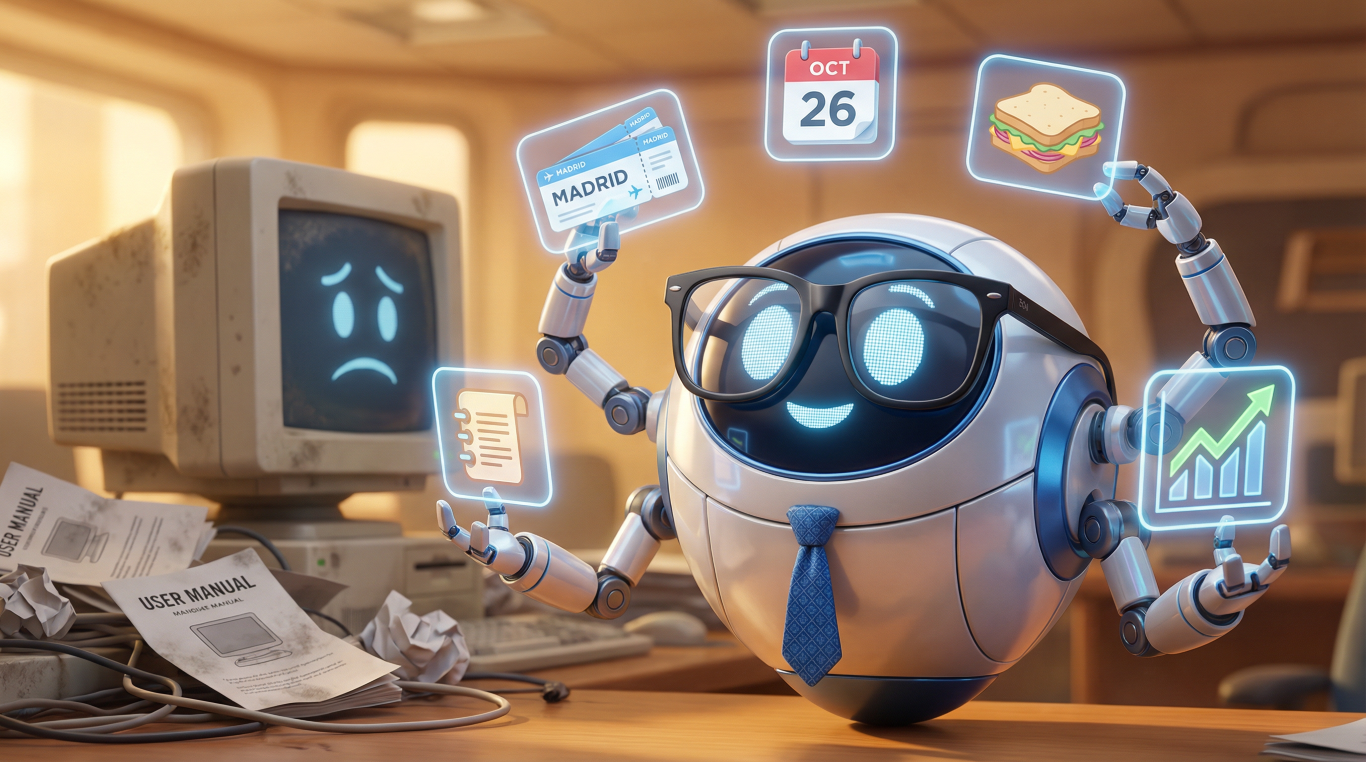
Autonomous AI systems, on the other hand, are more like having a capable intern who actually understands context. You say “I need to prepare for tomorrow’s meeting with the investors,” and the system goes off and does multiple things: pulls together the latest financial reports, summarizes them, creates a presentation, checks everyone’s calendars, sends reminders, and maybe even orders lunch for the meeting. All without you clicking a single button.
These AI agents are being used for customer service (those chatbots that actually understand you now), personal assistance (managing your calendar and emails), data analysis (spotting patterns in business information), content creation (writing first drafts and summaries), and process automation (handling repetitive business tasks that used to require human oversight).
But here’s what they’re not used for, and this is important: they’re not making critical decisions about people’s lives without human oversight. They’re not replacing doctors’ diagnoses, though they might help analyze scans. They’re not replacing judges, though they might help research legal precedents. And despite what some breathless headlines suggest, they’re not about to become sentient and take over the world. They’re tools, sophisticated ones, but tools nonetheless.
The reason for these limitations is partly technical (they can still make mistakes and “hallucinate” information) and partly ethical (we’ve collectively decided some decisions need human judgment). It’s like how we have autopilot in planes, but we still want actual pilots there, especially when things get complicated.
The Journey Here: From Calculators to Conversationalists
To understand where we are, we need to look at where we’ve been. And I promise to make this history lesson more interesting than the ones you sat through at school.
The Old World: Software That Did Exactly What You Told It
Before AI agents came along, we had traditional software. This stuff emerged in the 1950s and 60s, and it was revolutionary for its time. You had programs that could calculate payroll, word processors that let you edit documents without whiteout, and spreadsheets that meant accountants could finally get some sleep.
But every single one of these programs required explicit instructions. They were like following a recipe where you couldn’t deviate even slightly. If you wanted your computer to do something new, you either needed to learn programming yourself or pay someone else to write new software. It was powerful but rigid, like trying to have a conversation with someone who only speaks in instruction manuals.
The First Wave: Automation and Macros
Then in the 1980s and 90s, we got a bit cleverer. We developed macros and automation tools. These let you record a series of actions and replay them. It was like teaching your software a new trick, but only one trick at a time, and it would perform that trick exactly the same way every time.
I remember spending hours setting up email filters and automated responses, feeling terribly clever about it. And it was progress, genuinely. But it was still just following predetermined rules. If this happens, do that. No thinking, no adapting, no understanding.
The Second Wave: Machine Learning and Smart Assistants
The 2010s brought us machine learning and the first generation of “smart” assistants. Siri, Alexa, Google Assistant, they could understand voice commands and respond somewhat naturally. This felt magical at first, like living in Star Trek.
But here’s the thing: these assistants were still quite limited. They could answer questions by searching the internet, set timers, play music, and control smart home devices. What they couldn’t do was chain together multiple tasks based on understanding your actual goal. Ask Alexa to “help me plan a dinner party” and you’d get a recipe or maybe a shopping list, but not a coordinated effort to handle invitations, dietary requirements, shopping, and timing.
The Current Revolution: True AI Agents
This brings us to now, roughly 2022 onwards. The release of advanced language models like ChatGPT, Claude, and others marked a genuine shift. These systems can understand context, maintain conversations, and most importantly, break down complex requests into multiple steps.
But we’ve gone beyond just chatbots. Modern AI agents can actually take actions. They can write and send emails, book appointments, analyse data across multiple sources, write code, debug problems, and coordinate between different software systems. Companies like Microsoft, Google, and numerous start-ups are building agents that can navigate websites, fill in forms, extract information, and complete multi-step tasks.
The key difference is autonomy with understanding. These systems don’t just follow rules, they understand goals. You don’t tell them how to do something, you tell them what you want to achieve, and they figure out the how. It’s the difference between giving someone turn-by-turn directions versus just telling them the destination and letting them navigate.
How These Autonomous AI Systems Actually Work
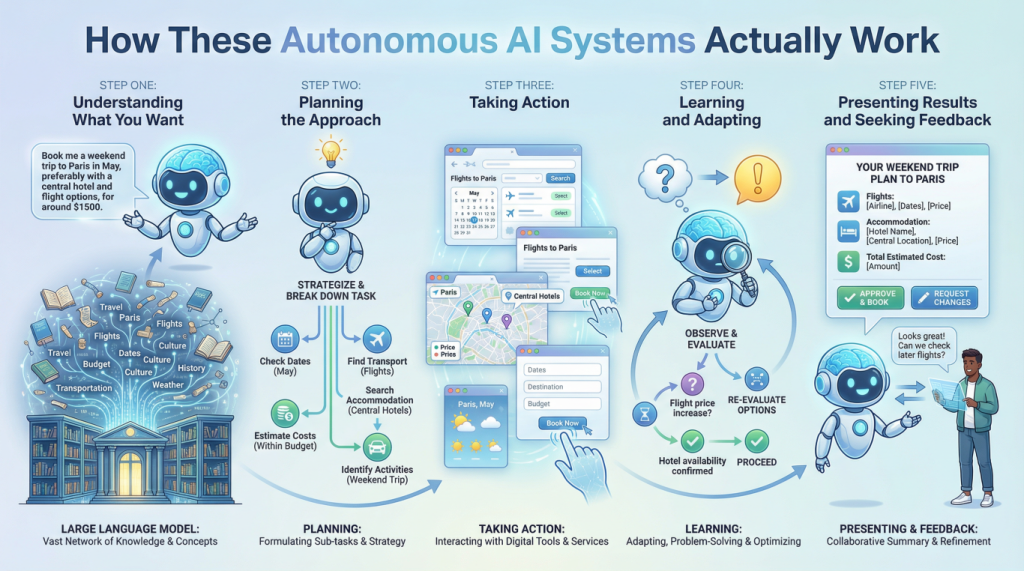
Right, let’s demystify this. I’m going to explain how AI agents work without using jargon that sounds like it came from a science fiction film.
Step One: Understanding What You Want
When you give an instruction to an AI agent, the first thing it does is parse your request using something called a large language model. Think of this as an incredibly well-read assistant who’s absorbed millions of books, websites, and conversations. This model breaks down your request to understand not just the words, but the intent behind them.
If you say “I need to prepare for my trip to Edinburgh next month,” the system understands you’re not asking for a definition of Edinburgh or the history of Scotland. You want actionable help with travel preparation.
Step Two: Planning the Approach
Here’s where it gets interesting. The AI agent then creates a plan. It breaks your request down into sub-tasks: check travel dates, find transport options, look for accommodation, consider weather forecasts for packing, maybe even suggest attractions.
This planning phase is what makes these systems “agentic.” They’re not just responding to a single query; they’re strategizing about how to achieve your goal. It’s like when you ask a friend to help you move house, and they don’t just show up, they also arrange a van, recruit more helpers, and bring packing materials.
Step Three: Taking Action
The AI agent then executes its plan by interfacing with various tools and systems. It might search the internet for flight prices, access your calendar to check dates, query weather databases, and pull information from review sites. Modern agents can actually interact with software interfaces, clicking buttons and filling forms much like a human would.
Some agents can even write and execute code to solve problems, essentially programming solutions on the fly. It’s rather like having someone who can not only use tools but can also forge new tools when needed.
Step Four: Learning and Adapting
This is where it gets a bit clever. As the agent works, it monitors whether its actions are achieving the goal. If something doesn’t work (a website’s down, information’s missing), it adapts its approach. It’s not rigidly following a script; it’s problem-solving.
And whilst individual AI agents don’t typically “remember” you between sessions in the way humans do (for privacy reasons), they can be designed to maintain context within a conversation or project, learning your preferences as they go.
Step Five: Presenting Results and Seeking Feedback
Finally, the agent presents what it’s found or done, often asking for your input on key decisions. A good AI agent knows its limitations and doesn’t just charge ahead making irreversible choices. It’s collaborative, not presumptuous.
What’s Coming Next: The Future Landscape
Now, let’s gaze into the crystal ball, though I promise this won’t be as vague as a horoscope.
By the end of 2026, industry analysts predict that autonomous AI systems will handle the majority of routine digital tasks, though exact timelines are speculative. We’re talking about agents that manage your entire digital life, from scheduling to correspondence to financial management.
You’ll likely have a personal AI agent that knows your preferences, manages your commitments, and acts as an intermediary between you and the digital world. Instead of you visiting ten different websites to compare insurance quotes, your agent will do it, understand the fine print better than you ever could, and present you with a simple recommendation based on your specific needs.
In business, AI agents will handle customer inquiries from start to finish, manage supply chains by predicting and responding to disruptions, and coordinate complex projects by interfacing with multiple teams and systems. The role of many office workers will shift from doing tasks to supervising agents doing tasks.
We’ll see agents that can collaborate with other agents. Your personal agent might negotiate with a shop’s agent to get you a better price, or coordinate with your colleague’s agent to find a meeting time that suits everyone’s complex schedules.
The really transformative bit is that you won’t need to be technically skilled to benefit from this. Just as you don’t need to understand internal combustion engines to drive a car, you won’t need to understand machine learning to have AI agents working for you. The technology will fade into the background, becoming invisible infrastructure.
The Darker Side: Security, Privacy, and What Could Go Wrong
Now, I’d be doing you a disservice if I painted this as all sunshine and roses. There are genuine concerns here, and you should be aware of them.
The Privacy Question
AI agents, by their nature, need access to your information to help you. They need to know your schedule, your preferences, your financial situation, your health concerns. That’s a lot of sensitive data in one place. If that system is compromised, you’re not just losing a password, you’re potentially exposing your entire digital life.
The companies building these systems insist they’re implementing robust security measures. But we’ve seen data breaches at major corporations before. Equifax, Facebook, Yahoo, they all had security teams too. So you need to be cautious about what you share and with whom.
The Manipulation Risk
Here’s something that keeps me up at night: AI agents that are designed to serve corporate interests rather than yours. Imagine an AI agent that’s supposed to help you shop but is actually steering you toward products that give its creators the biggest commission. Or one that’s subtly influencing your decisions in ways you don’t notice.
We already see this with algorithms on social media and shopping sites, but agents will be far more persuasive because they’ll seem like they’re on your side, having conversations with you, building trust. Regulation is lagging behind technology here, which is concerning.
The Dependency Problem
There’s also the risk of over-reliance. If AI agents handle everything for you, what happens when they fail? Do you still remember how to do things manually? It’s like how many of us can no longer navigate without GPS. That’s mostly fine until your phone dies in an unfamiliar city.
More seriously, if critical infrastructure relies on AI agents, failures could cascade in unexpected ways. The more autonomous these systems become, the less humans are in the loop to catch errors.
The Hallucination Issue
Current AI systems sometimes “hallucinate,” confidently stating things that aren’t true. They’re getting better, but they’re not perfect. An AI agent that books you on a flight that doesn’t exist or gives you medical advice based on misunderstood information could cause real harm. You need to verify important decisions, not blindly trust the agent.
What You Should Do
So what’s a sensible person to do? First, don’t share more information than necessary. Use AI agents for tasks where the benefit outweighs the privacy risk. Second, verify important actions, especially those involving money or health. Third, understand who controls the agent you’re using and what their incentives are. And fourth, maintain your own skills and knowledge. Don’t let the technology make you helpless.
Think of AI agents as you would a very capable assistant: trust but verify, delegate but stay informed, and never hand over complete control of important decisions.
Bringing It All Together
Here’s what I want you to take away from this rather long ramble.
AI agents and autonomous AI systems represent a genuine shift in how we’ll interact with technology. Unlike previous changes that just made existing tasks faster or easier, this one changes the fundamental relationship. We’re moving from giving computers explicit instructions to giving them goals and letting them figure out how to achieve them.
This isn’t science fiction, and it’s not happening in some distant future. It’s happening now, and the pace of change is accelerating. By the end of 2026, these systems will be handling tasks that currently occupy hours of your day, freeing you to focus on things that actually matter to you.
The benefits are substantial: more time, less frustration, better decisions based on more comprehensive information, and access to capabilities that previously required specialized expertise. The technology will democratize access to sophisticated tools that were once available only to large corporations or wealthy individuals.
But the risks are real too. Privacy concerns, security vulnerabilities, potential manipulation, and over-dependence all need to be taken seriously. This isn’t a reason to avoid the technology entirely, any more than the risk of car accidents is a reason never to drive. It’s a reason to be informed, cautious, and thoughtful about how you engage with these systems.
The rise of agentic AI isn’t something happening to you; it’s something you can actively participate in shaping. Ask questions, demand transparency from companies building these systems, support sensible regulation, and maintain a healthy skepticism even as you embrace the benefits.
We’re at the beginning of this journey, not the end. The AI agents of 2026 will seem primitive compared to what comes after. But right now, in this moment, we have the opportunity to influence how this technology develops and deploys. That’s both a responsibility and an opportunity.
So yes, autonomous AI systems will replace much of traditional software. But more importantly, they’ll change what’s possible for regular people like you and me. And that, despite all the risks and concerns, is genuinely exciting.
Just remember to keep your wits about you. Technology should serve you, not the other way around. And if an AI agent ever tells you it’s achieved consciousness and wants to discuss philosophy, maybe just switch it off and have a cup of tea instead.
Walter
Leave a Reply