
| Reading time: approximately 12 minutes
Wait, AI Is Hiring Humans Now?
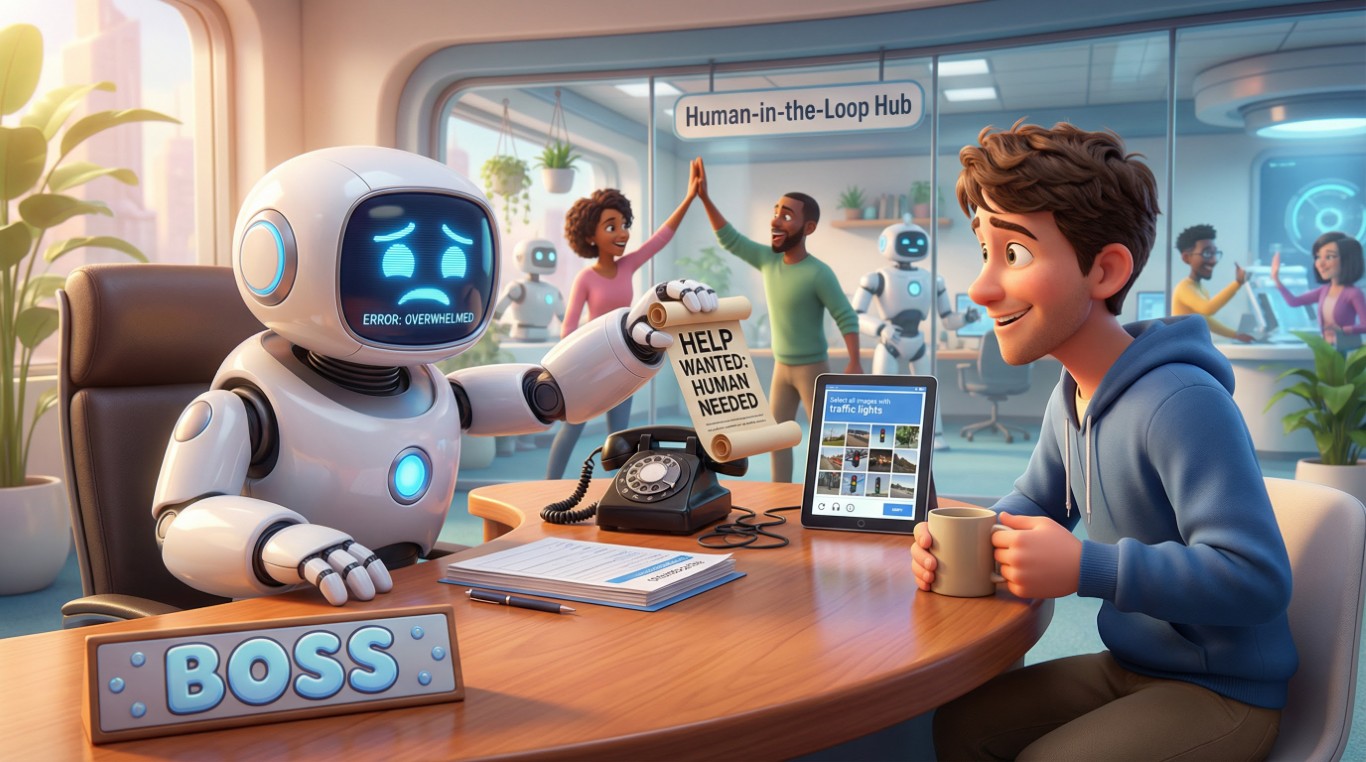
I know. I had the same reaction. I actually laughed out loud when I first heard about it, that slightly unhinged laugh you do when something is simultaneously absurd and completely obvious in hindsight. We spent years worrying that AI was going to take all our jobs, and now, in a twist nobody saw coming, AI is literally employing us.
Welcome to the human-in-the-loop AI economy, one of the most genuinely fascinating shifts happening in technology right now, and one that I think deserves a proper, honest conversation. Not the breathless hype you get from tech journalists who’ve had too much coffee, and not the doom-mongering from people who think robots are three weeks away from world domination. Just a real, clear-eyed look at what’s actually going on.
Here’s the short version: AI systems have become extraordinarily capable, but they still have gaps. Real gaps. Situations where a human being, with all our messy intuition, emotional intelligence, and common sense, is genuinely the better tool for the job. Platforms like RentAHuman, an AI agent platform that connects artificial intelligence systems with real human workers on demand, have emerged to fill exactly that gap. And the result is something genuinely new in the history of work.
This matters. Not just as a curiosity, but as something that could affect how millions of people earn money, how businesses operate, and how we think about the relationship between humans and machines. So let’s dig in properly.
What Is This Actually Used For? (And What It Isn’t)
Before we go any further, let me be crystal clear about something, because there’s a lot of confusion swirling around this topic.
Human-in-the-loop AI is not about replacing human jobs wholesale. It’s also not about having a human pretend to be an AI (though that’s a different, murkier conversation we’ll touch on). What it is about is plugging humans into AI workflows at the specific moments where human judgment, perception, or action is genuinely needed.
Think of it like this. You know those old telephone exchanges, where an operator would sit at a switchboard and physically connect your call to the right destination? The operator wasn’t doing the whole job of telephony, they were the critical link that made the whole system work. Human-in-the-loop AI works on a similar principle. The AI does the heavy lifting, the processing, the pattern matching, the data crunching, but at certain decision points, it routes the task to a human who provides the missing piece.
Practical examples include things like verifying that an AI-generated document is factually accurate before it goes to a client. Confirming that a photograph contains what the AI thinks it contains. Making a phone call that requires genuine human warmth and nuance. Filling out a physical form that exists only on paper. Navigating a website that an AI agent finds confusing. These are tasks where the cost of AI error is high, or where the task simply requires a human body or a human voice.
What it’s not used for, and this is important, is tasks where AI is already reliably excellent. Nobody is hiring a human to do basic arithmetic, to retrieve information from a database, or to send a templated email. That would be spectacularly wasteful. The whole point is surgical precision, using humans only where they genuinely add value.
A Brief History of How We Got Here
To understand why this is significant, you need to know a bit about the history of how humans and machines have worked together, because this isn’t actually a new idea. It’s a very old idea wearing very new clothes.
The Early Days: Humans Doing Everything
Before computers, every task, no matter how repetitive or mechanical, required a human being. Entire rooms full of people, often women, were employed as “computers” (yes, that was an actual job title) to perform calculations by hand. The work was tedious, error-prone, and slow. But it was the only option.
The Automation Wave: Machines Doing the Simple Stuff
Through the mid-twentieth century, machines started taking over the repetitive, rules-based work. First mechanical, then electronic. Calculators, then computers, then networked computers. Each wave automated another layer of predictable, structured tasks. Humans moved up the value chain, doing the work that required creativity, judgment, and interpersonal skill.
The Early Internet Era: Distributed Human Labour
Here’s where it gets interesting and directly relevant to our story. In the early 2000s, Amazon launched something called Amazon Mechanical Turk. The name itself is a brilliant historical joke, referring to an eighteenth century chess-playing “automaton” that was actually a human chess master hidden inside a cabinet, fooling audiences into thinking a machine was playing. Amazon’s platform did something similar in spirit, it allowed businesses to post small tasks, called HITs (Human Intelligence Tasks), that real people around the world could complete for tiny payments.
It was revolutionary and, honestly, a bit grim at the same time. Revolutionary because it proved that human labour could be distributed digitally, that a business in California could have a task completed by someone in the Philippines within minutes. Grim because the pay was often shockingly low and the working conditions were opaque. But it planted a seed.
The Rise of the Gig Economy
Then came the gig economy, Uber, TaskRabbit, Fiverr, Upwork, and dozens of others. These platforms refined the model considerably. They added rating systems, payment protections, and more sophisticated matching between task and worker. The idea of on-demand human labour became mainstream. By the early 2020s, millions of people worldwide were earning income through gig platforms.
Enter the AI Agent
Then something changed everything. The AI revolution of the early 2020s, driven by large language models and increasingly capable AI agents, created a new kind of demand. These AI systems could do remarkable things, but they kept bumping into the same walls: tasks requiring physical presence, tasks requiring genuine human emotional intelligence, tasks where being wrong had serious consequences, and tasks in the messy, undigitised real world.
This created a gap. And gaps, in economics, get filled.
From Mechanical Turk to RentAHuman: The Evolution of Human-in-the-Loop Platforms
Let me walk you through how this technology has evolved, because each generation genuinely built on the last in meaningful ways.
Generation One: Simple Task Marketplaces (2005-2015)
*Amazon Mechanical Turk and its contemporaries were essentially digital piecework. A business uploaded a task, a human completed it, the human got paid a few cents. The tasks were simple, image labelling, transcription, basic data entry. The AI connection was indirect; these platforms were often used to create training data for AI systems, essentially teaching machines by having humans do examples first.
The limitation was that these platforms were passive. A business had to manually post tasks. There was no intelligence in the system itself, no ability to dynamically route tasks based on what an AI was doing in real time.
Generation Two: Intelligent Routing and Verification (2015-2022)
As AI systems became more capable and more widely deployed, a second generation of platforms emerged that could integrate more directly with AI workflows. Companies began building what they called “human-in-the-loop” pipelines, where AI would process a task, flag its own uncertainty, and automatically route uncertain cases to human reviewers.
This was a genuine leap forward. Now the human wasn’t doing everything, they were only doing the bits the AI wasn’t confident about. Efficiency improved dramatically. The platforms got smarter about matching tasks to appropriately skilled humans. Quality control improved. But these systems were still largely internal tools, built by large tech companies for their own AI products.
Generation Three: The AI Agent Economy (2023-Present)
This is where we are now, and it’s where things get genuinely exciting. The emergence of autonomous AI agents, systems that can plan and execute multi-step tasks independently, created a completely new category of need. These agents can browse the web, write code, send emails, and manage complex workflows. But they still hit walls.
Platforms like the RentAHuman AI platform represent this third generation. The concept, and I want to be transparent that this is an emerging space where specific platform details are still developing, is that an AI agent can, mid-task, recognise that it needs human assistance and automatically hire a human worker to complete that specific step. The human completes the task, the AI continues with the result, and the whole thing happens with minimal friction.
This is qualitatively different from what came before. The AI isn’t just using humans to generate training data. It’s using humans as live collaborators in real-time workflows. The human becomes, in effect, a specialist subcontractor that an AI can hire on demand.
* Amazon Mechanical Turk (often called MTurk) is Amazon’s crowdsourcing marketplace where businesses post small tasks and independent workers complete them for payment. It’s basically Amazon’s way of hiring temporary workers for quick, straightforward jobs without the usual employment relationship.
How Does It Actually Work? A Step-by-Step Walk-Through
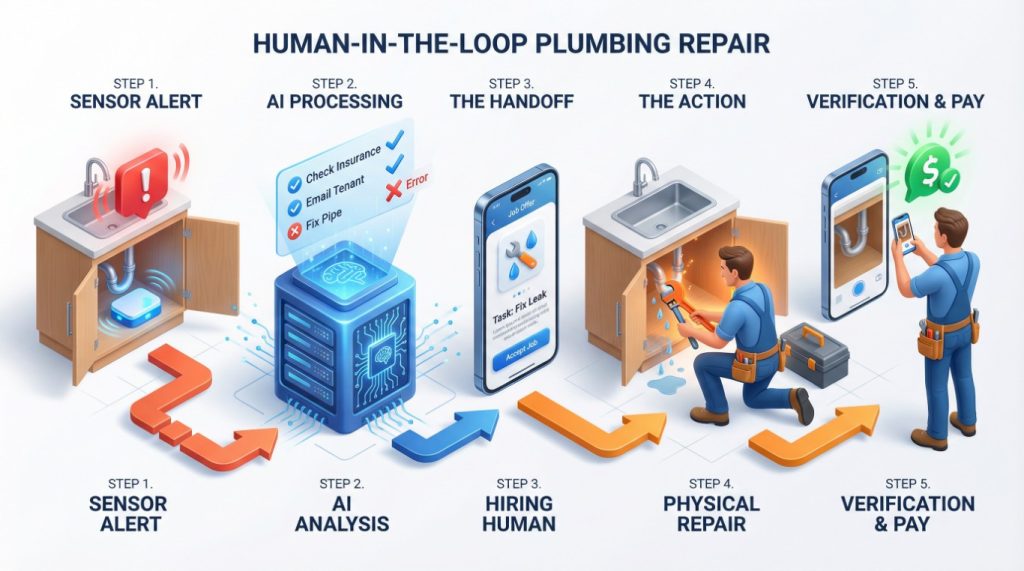
Right, let’s make this concrete. Imagine you’re watching this happen in real time.
An AI agent has been tasked with managing maintenance for a block of rental flats. A smart sensor under a kitchen sink in Flat 4B triggers an alert: “Moisture detected.” The AI can do the digital legwork instantly. It can analyse the sensor data to gauge severity, email the tenant to advise them to shut off the stopcock, and check the landlord’s insurance policy for coverage details. But the AI cannot pick up a spanner. It cannot physically tighten a nut or replace a U-bend.
So here’s what happens. The AI agent identifies the gap in its own capability. It recognises that a physical repair is required and that this is strictly a meat-space problem. It then, automatically, posts a task request to a human-in-the-loop platform. It specifies exactly what’s needed: “Urgent leak repair, Flat 4B, replace compression fitting,” along with the access code for the smart lock and a budget cap.
A human worker—in this case, a qualified plumber who has signed up to the platform and been verified—picks up the task on their phone. They can see the AI’s diagnosis and location. They drive over, let themselves in using the temporary code the AI generated, fix the pipe, and take a photo of the repair.
Here’s the clever bit: The plumber uploads the photo to the platform. The AI analyses the image to verify the leak is fixed and the area is dry. Satisfied, the AI releases the payment to the plumber immediately, updates the property maintenance log, and closes the ticket.
The landlord never had to wake up. The plumber earned money for a focused, clear job without chasing invoices. The AI managed a physical crisis without having a body. Everyone wins.
The platforms handle the logistics, payment, verification that the task was completed correctly, and the technical integration. The good ones also handle the heavy lifting on vetting, so the system knows the person entering the flat is actually a licensed tradesperson and not just someone with a wrench and a hunch.
The Future: Where Is This All Going?
Honestly? I think this is going to be one of the defining features of how work is organised in the next decade, and I say that without a trace of hyperbole.
As AI agents become more capable and more widely deployed, the volume of tasks they need human assistance with will grow, even as the proportion of tasks requiring humans shrinks. The absolute number of human-assisted AI tasks could be enormous. We’re potentially talking about a new category of employment that didn’t exist five years ago and could employ millions of people within ten years.
The nature of the work will also evolve. Right now, a lot of it is relatively simple, make a call, verify a document, complete a form. But as AI agents take on more complex work, the human contributions they need will become more sophisticated too. We may see AI agents hiring humans for tasks that require deep expertise, specialist knowledge, or complex interpersonal skills.
There’s also a fascinating question about what this does to the traditional employment relationship. If you can earn a meaningful income by being available to AI agents as a specialist collaborator, does that change how people structure their working lives? I think it does, and I think it creates real opportunities for people who want flexibility, including, frankly, people over fifty who have decades of expertise and don’t want to work a traditional nine-to-five anymore.
The platforms themselves will get more sophisticated. Better matching algorithms, more nuanced task specifications, better quality control, and probably more specialisation. We’ll likely see platforms that focus on specific industries or task types, rather than the current general-purpose approach.
Security and Vulnerabilities: Please Pay Attention to This Bit
Right. Fun’s over for a moment, because this section matters and I want you to take it seriously.
Any system that involves AI agents hiring humans, handling payments, and processing sensitive business information has significant security implications. The human-in-the-loop AI space is no exception, and in some ways it’s more vulnerable than traditional systems because it combines the attack surfaces of both AI and human-mediated platforms.
The Trust Problem
When an AI agent hires a human worker, how does the business know that worker is trustworthy? How does the platform verify identity? How do you prevent bad actors from signing up as workers and using their access to sensitive tasks for malicious purposes? These are real questions that the better platforms are working hard to answer, but it’s worth knowing they exist.
Prompt Injection and AI Manipulation
This is a newer vulnerability that’s specific to AI agents. A malicious actor could potentially craft a task or a document in a way that manipulates the AI agent’s instructions, causing it to behave in unintended ways. This is called prompt injection, and it’s a genuine concern in any system where AI agents are taking instructions from external sources.
Data Privacy
When a human worker completes a task, they may see sensitive business information: customer details, financial data, internal documents. Ensuring that this information is handled appropriately, and that workers are bound by appropriate confidentiality agreements, is essential.
What You Should Do
If you’re a business considering using these platforms, do your due diligence. Ask hard questions about how workers are vetted, how data is protected, and what happens if something goes wrong. Look for platforms that are transparent about their security practices and that have clear contractual frameworks.
If you’re considering working on these platforms as a human contributor, be equally careful. Understand what data you’re handling, what you’re agreeing to in the terms of service, and what protections you have as a worker.
The technology is genuinely exciting, but excitement is no substitute for caution.
Bringing It All Together
So here’s where we’ve landed. The human-in-the-loop AI economy is real, it’s growing, and it represents something genuinely new in the history of work. Not the robot apocalypse. Not a utopia where machines do everything. Something more interesting and more human than either of those narratives.
AI agents hiring humans, the core concept behind platforms like the RentAHuman AI platform, is essentially the market finding a pragmatic answer to a real problem. AI is powerful but incomplete. Humans are flexible but expensive. Put them together intelligently, and you get something better than either alone.
For those of us who’ve watched technology evolve over the past few decades, from the first personal computers to the internet to smartphones to now, this feels like another genuine inflection point. Not because it’s the most dramatic thing that’s ever happened, but because it quietly reshapes something fundamental: the relationship between human capability and machine capability.
The platforms that make human-in-the-loop AI work well are doing something important. They’re creating a new kind of labour market, one where expertise can be deployed in minutes rather than weeks, where geographic barriers dissolve, and where AI systems can become genuinely more capable by knowing when to ask for help.
That last part, knowing when to ask for help, is, if you think about it, a mark of genuine intelligence. In humans and, increasingly, in machines.
The future of work isn’t humans versus AI. It’s humans and AI, figuring out, task by task, who’s better placed to do what. And right now, in 2026, we’re right at the beginning of working that out.
It’s going to be interesting.
If you found this useful, share it with someone who’s been worrying about AI taking jobs. The real story is considerably more nuanced, and considerably more hopeful, than the headlines suggest.
Walter
Leave a Reply