
I’ll be honest with you. When I first started hearing about artificial intelligence taking over jobs, I pictured a scene from The Terminator. Robots everywhere, humans queuing at the Job Centre, and a general sense of technological doom. But here’s the thing that’s been keeping me up at night, and I promise it’s not just the coffee: the AI job market is doing something completely bonkers. Companies are actually hiring more people, not fewer, even as they roll out AI systems across their businesses.
I know, I know. It sounds like I’ve lost the plot. But stick with me here, because this paradox is one of the most important things happening in our working world right now, and understanding it might just change how you think about technology and your career (or your children’s and grandchildren’s careers).
Why This Matters More Than You Think
Remember when everyone thought the internet would destroy traditional businesses? Well, some did disappear, but mostly it created entire industries we’d never even imagined. The relationship between AI and employment is turning out to be similarly complex, and frankly, far more interesting than the doom-and-gloom headlines suggest.
Here’s why you should care: whether you’re still working, thinking about a career change, or simply want to understand the world your grandchildren are inheriting, this shift affects everyone. The future of work AI is creating isn’t about robots replacing humans. It’s about something far more nuanced, and dare I say it, hopeful.
What AI Actually Does (And What It Doesn’t)
Let me clear something up straight away. When we talk about AI in the workplace, we’re not talking about a sentient computer that thinks like a human. That’s science fiction, and we’re nowhere near it. What we’re actually dealing with is more like a very sophisticated pattern-matching system, think of it as a really clever filing clerk who never gets tired and can work through mountains of paperwork at lightning speed.
AI today is brilliant at specific, repetitive tasks. It can scan thousands of CVs in seconds, spot patterns in sales data, transcribe meetings, answer basic customer questions, and even write simple reports. It’s like having an incredibly efficient assistant who never needs a tea break.
But here’s what it can’t do, and this is crucial: it can’t understand context the way humans do. It can’t read the room. It can’t tell when a customer is upset but trying to be polite. It can’t come up with genuinely creative solutions to problems it’s never seen before. It can’t navigate office politics (thank goodness). And it absolutely cannot replace the human touch that so many jobs require.
I learned this the hard way when I tried using an AI writing assistant for a sympathy card. The result was technically correct but emotionally tone-deaf. It suggested “Sorry for your loss. Have you considered our grief counselling services?” Needless to say, I wrote my own message.
Before AI: How We Used to Work
Cast your mind back to the 1980s and 1990s. I remember my first office job, everything was done manually or with very basic computers. Want to find a customer’s file? Walk to the filing cabinet. Need to analyse sales trends? Get out your calculator and a big sheet of paper. Want to schedule a meeting? Play telephone tag for three days.
We had secretaries who spent their days typing letters, filing clerks who organised physical documents, and entire departments dedicated to tasks that now take minutes. It wasn’t better or worse, it was just different. And here’s the important bit: when computers came along, we didn’t sack everyone. We gave them different work to do.
I remember when my office got its first proper computer system in 1995. Everyone panicked. Margaret, who’d been filing documents for twenty years, was convinced she’d be out of a job by Christmas. But you know what happened? She became the office expert on the new system, trained everyone else, and ended up with a promotion. The work changed, but the need for human workers didn’t disappear.
The Evolution of AI: From Calculator to Colleague
Let’s walk through how we got here, and I promise to keep the technical jargon to a minimum.
The Early Days (1950s-1990s): AI as Science Fiction
The first attempts at AI were essentially very complicated calculators. Scientists programmed computers with strict rules: if this happens, do that. These systems could play chess or solve mathematical problems, but they couldn’t learn or adapt. It was like teaching someone a recipe they could only follow exactly, with no room for improvisation if you were missing an ingredient.
The Learning Phase (1990s-2010s): AI Gets Smarter
Then something clever happened. Instead of programming every single rule, researchers figured out how to let computers learn from examples. This is called machine learning, and it’s a bit like how you learned to recognise a cat. Nobody gave you a rulebook saying “four legs, fur, pointy ears equals cat.” You just saw lots of cats, and your brain figured out the pattern.
These systems got quite good at specific tasks. Your email spam filter learned to spot dodgy messages. Netflix learned what films you might like. Amazon learned what products to suggest. But they were still narrow specialists, each one good at exactly one thing.
The Modern Era (2010s-Now): AI Gets Conversational
This is where things got interesting, and where the AI job market started getting really confusing. Systems like ChatGPT and similar tools can now handle language in ways that feel almost human. They can write emails, summarise documents, answer questions, and even crack jokes (though they’re not always funny, bless them).
These modern AI systems are trained on vast amounts of text from the internet, learning patterns in how humans communicate. It’s like they’ve read every book in the library and can now have a decent conversation about most topics, even if they don’t truly understand what they’re saying in the way you and I do.
The benefit over previous versions? Flexibility. Instead of needing a different program for every task, one AI system can help with writing, analysis, coding, and creative work. It’s like having a Swiss Army knife instead of a drawer full of single-purpose tools.
How AI Actually Works: The Simple Version
Right, let me explain this without making your eyes glaze over. Think of AI like teaching a very literal-minded but incredibly fast student.
First, you show it thousands, sometimes millions, of examples. Want it to recognise cats in photos? Show it a million cat pictures and a million non-cat pictures. Want it to write business emails? Feed it thousands of business emails.
The AI system looks for patterns in all this data. It notices that cats usually have pointy ears and whiskers. It learns that business emails often start with “Dear” and end with “Kind regards.” It’s not understanding these things the way we do, it’s just spotting patterns, like noticing that dark clouds usually mean rain.
Then, when you give it a new task, it applies those patterns. Show it a new photo, and it compares it to the patterns it learned. Ask it to write an email, and it strings together words in patterns that match the emails it studied.
The clever bit is that it can combine patterns in new ways. It’s never seen your specific photo or been asked to write your exact email before, but it can generalise from what it’s learned. Think of it like how you can recognise your neighbour’s new car even though you’ve never seen that exact model before, you recognise the patterns that make it a car.
The Paradox Explained: Why We’re Hiring More, Not Less
Here’s where it gets fascinating, and where the AI job market stops making sense until you dig deeper.
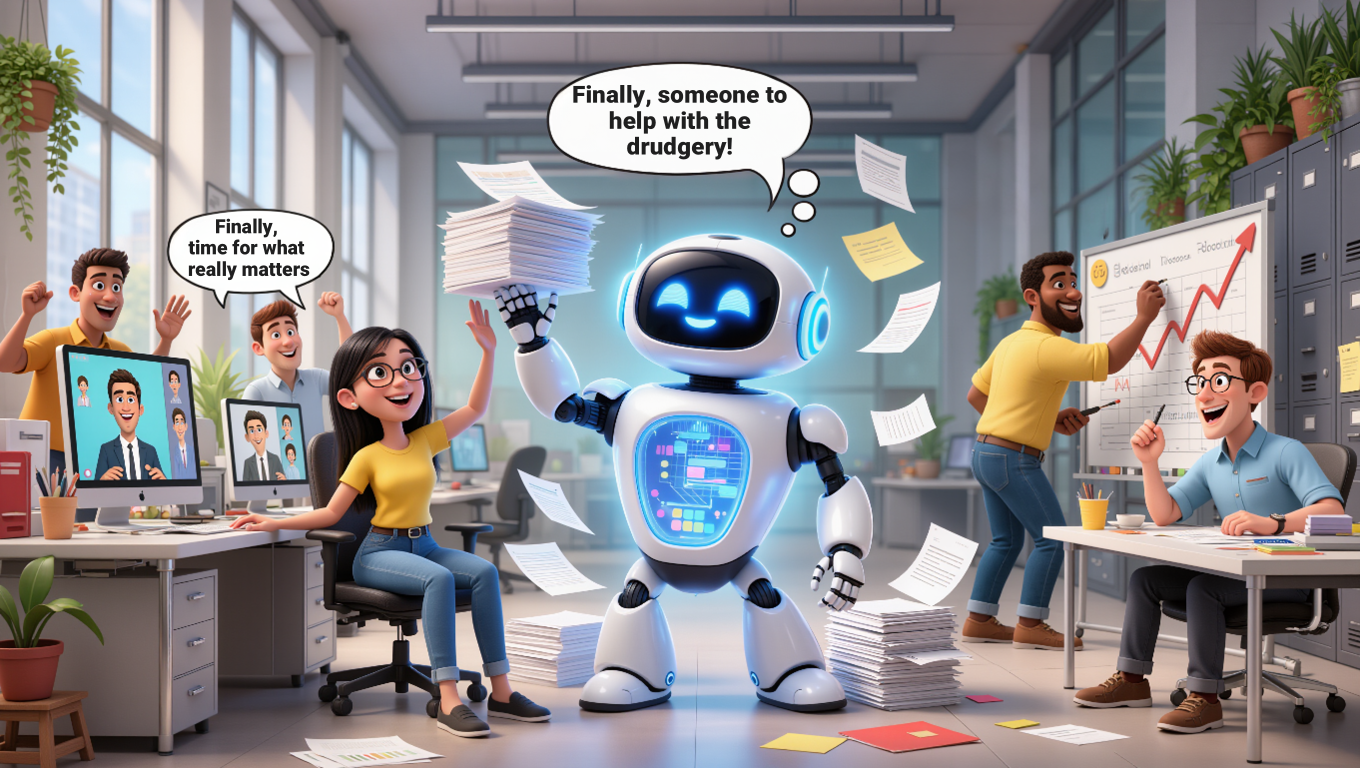
When companies bring in AI, they typically automate the boring, repetitive bits of jobs. The data entry. The initial customer enquiry responses. The scheduling. The first-pass document review. You’d think this means fewer workers needed, right?
Wrong. And I find this absolutely brilliant.
What actually happens is this: when the tedious stuff gets automated, workers suddenly have time for the valuable stuff. The stuff that actually grows the business. The creative problem-solving. The relationship building. The strategic thinking. The human touch.
I spoke to a friend who works in recruitment. Her company brought in AI to scan CVs. She was terrified. But instead of replacing her, it freed her up to actually talk to candidates, build relationships with clients, and work on the tricky placements that need human judgement. Her company ended up hiring three more recruiters because they could handle more clients.
There’s another factor at play too. When AI makes a company more efficient, that company often grows. And growing companies need more people, not fewer. It’s like when supermarkets introduced self-checkout. Everyone predicted job losses. But supermarkets used the efficiency gains to open more stores, stock more products, and offer more services. They ended up employing more people overall, just in different roles.
What the Future Holds
Looking ahead, and I’m trying not to sound like a fortune teller here, the future of work AI is shaping is going to be about collaboration, not replacement.
We’re heading towards a world where AI handles the routine, and humans handle the exceptional. Think of it like driving a car with power steering. The power steering doesn’t replace you as the driver, it just makes the mechanical bit easier so you can focus on navigation, awareness, and decision-making.
I reckon we’ll see new job categories emerge that we can’t even imagine yet. Twenty years ago, “social media manager” wasn’t a job because social media didn’t exist. In twenty years, we’ll have jobs like “AI trainer” (teaching AI systems about specific industries), “AI ethics consultant” (making sure AI behaves properly), and “human-AI collaboration specialist” (helping teams work effectively with AI tools).
The jobs that will thrive are those that require uniquely human skills. Empathy. Creativity. Strategic thinking. Negotiation. Teaching. Caring. All the things that make us human, basically. AI might help with these jobs, but it won’t replace them.
There’s also a growing recognition that some jobs shouldn’t be fully automated even if they could be. Do you really want an AI making decisions about your medical treatment without human oversight? Do you want a robot caring for your elderly parents? Some things need the human touch, and society is starting to value that more, not less.
The Security Side: Why You Should Care
Now, I need to put on my serious hat for a moment because this matters.
As companies use AI more, they’re feeding these systems enormous amounts of data. Customer information. Business secrets. Personal details. And here’s the uncomfortable truth: AI systems can be hacked, tricked, or misused just like any other technology.
I’m not trying to scare you, but you should know that AI can be fooled. Researchers have shown that adding certain patterns to images can make AI see things that aren’t there. AI chatbots can sometimes be tricked into revealing information they shouldn’t. And if someone gains access to an AI system, they potentially gain access to all the data it was trained on.
There’s also the issue of bias. AI learns from human-created data, and humans have biases. If an AI hiring system is trained on historical data from a company that, let’s be honest, mostly hired white men in the past, it might learn to favour white male candidates. This isn’t the AI being malicious, it’s just pattern-matching, but the result is still discrimination.
Companies need to be careful about what data they feed to AI, how they secure these systems, and how they check for bias. As workers and consumers, we need to ask questions about how AI is being used and what safeguards are in place.
Think of it like this: you wouldn’t leave your filing cabinets unlocked and open to the street. The same principle applies to AI systems, except the filing cabinets are digital and potentially accessible from anywhere in the world.
Wrapping This Up
So here we are, at the end of this journey through the weird and wonderful world of AI and employment. If you take nothing else away from this, remember this: the relationship between AI and jobs isn’t a simple story of robots replacing humans.
It’s more nuanced, more interesting, and frankly more hopeful than that. Yes, AI will change how we work. Yes, some specific tasks will be automated. But the overall effect seems to be creating more opportunities, not fewer, just different ones.
The AI job market isn’t shrinking, it’s transforming. Companies are hiring more people to do more valuable work, while AI handles the drudgery. It’s like when washing machines were invented. They didn’t put everyone out of work, they just freed people up to do other things (and made laundry day a lot less miserable).
The key is adaptability. The jobs of the future will require different skills, more human skills, actually. Creativity, empathy, strategic thinking, relationship building. The things that make us uniquely human are becoming more valuable, not less.
I find that rather beautiful, actually. In trying to build machines that think like humans, we’re discovering that the most valuable thing about humans is precisely the bits that machines can’t replicate. Our humanity.
So if you’re worried about AI taking over the job market, take a breath. Yes, things are changing. Yes, we need to be thoughtful about security and ethics. But the future isn’t humans versus machines. It’s humans and machines, working together, each doing what they do best.
And honestly? I think that’s a future worth getting excited about.
Walter
Leave a Reply