

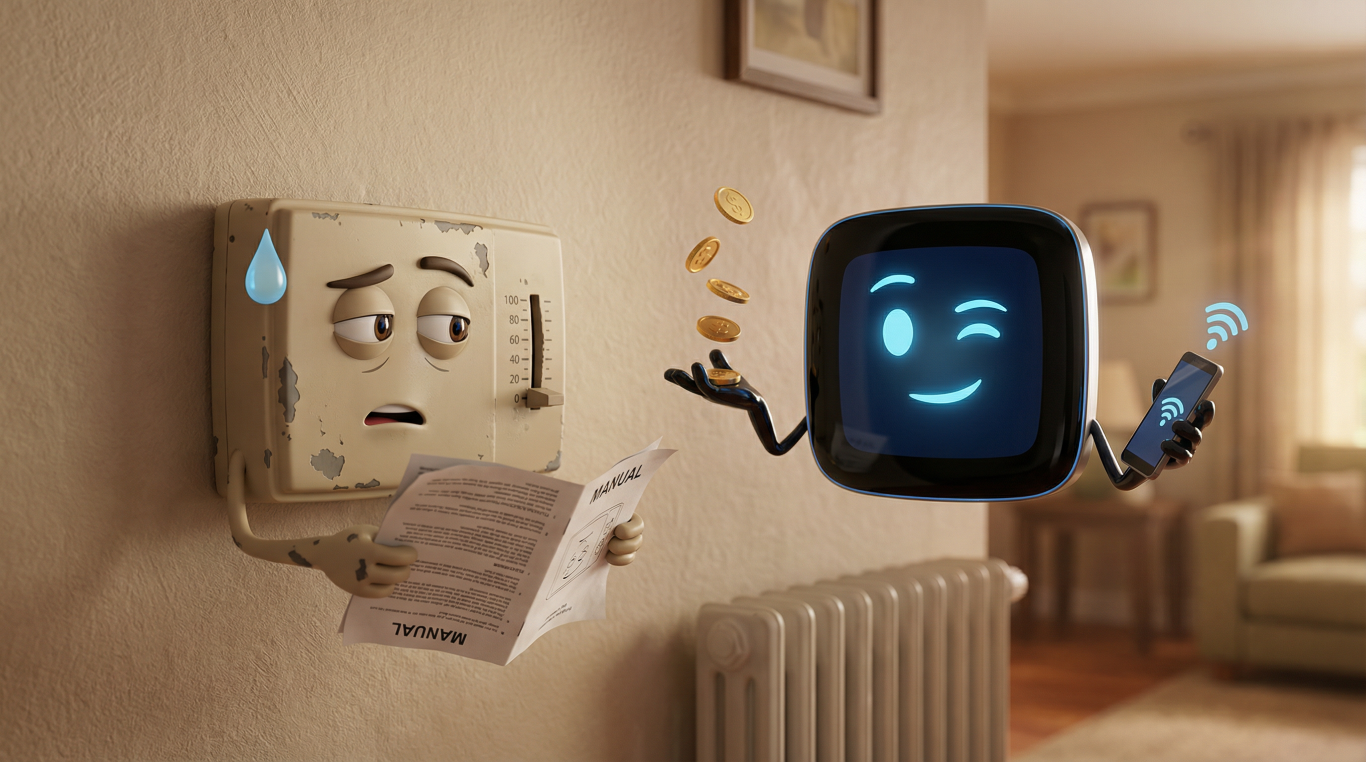
When I first heard about smart thermostats, I thought they were just another gadget designed to separate us from our money. You know the type, those things that promise to change your life but end up gathering dust in a drawer somewhere between the fondue set and that bread maker you used twice. But here’s the thing, I was completely wrong about smart thermostats. Dead wrong, actually.
These clever little devices have genuinely transformed how millions of people manage their home heating, and more importantly, they’ve done something rather remarkable: they’ve saved people actual money whilst making their homes more comfortable. That’s not marketing nonsense, that’s reality. And in today’s world, where energy bills seem to climb faster than inflation and we’re all trying to do our bit for the planet, a smart thermostat has become less of a luxury and more of a sensible investment.
Why Smart Thermostats Matter More Than Ever
Let me paint you a picture. Remember when petrol was under a pound a litre? When you could heat your entire house without wincing at the monthly bill? Those days feel like ancient history now. Energy costs have skyrocketed, and most of us are looking at our heating systems like they’re money-eating monsters lurking in our cupboards.
This is precisely why smart thermostats have become such important technology. They’re not just about convenience, though that’s certainly a nice bonus. They’re about control, efficiency, and ultimately, keeping more money in your pocket. The average household can save between 10% and 23% on their heating bills with a smart thermostat, and when you’re talking about bills that run into thousands of pounds a year, that’s not pocket change.
Beyond the financial aspect, there’s the environmental one. I’m not going to preach, but the reality is that heating our homes accounts for a massive chunk of household carbon emissions. If a smart thermostat can help reduce that whilst also saving you money, well, that’s what I call a proper win-win situation.
What Smart Thermostats Do (And Don’t Do)
Right, let’s get clear about what we’re actually talking about here. A smart thermostat is essentially the brain that controls your heating system. It tells your boiler when to fire up and when to take a rest. But unlike the old thermostats that just measured temperature and switched on and off like a rather dim light switch, the best smart thermostat models actually learn, adapt, and think.
They’re used for controlling your central heating and, in some cases, your hot water. They connect to your home’s Wi-Fi, which means you can control them from your phone, tablet, or computer, whether you’re sitting on your sofa or stuck in traffic three towns away. They learn your routines, understand when you’re home and when you’re out, and adjust accordingly. Some even check the weather forecast and prepare your heating in advance.
Now, what they’re not used for. They won’t make your tea, they won’t fix a broken boiler, and they can’t heat your home any faster than your existing heating system allows. I mention this because I’ve heard people disappointed that their new smart thermostat didn’t magically transform their ancient, inefficient boiler into a modern marvel. The thermostat is the conductor, but it can only work with the orchestra it’s been given.
The Journey From Dumb to Smart: A Brief History
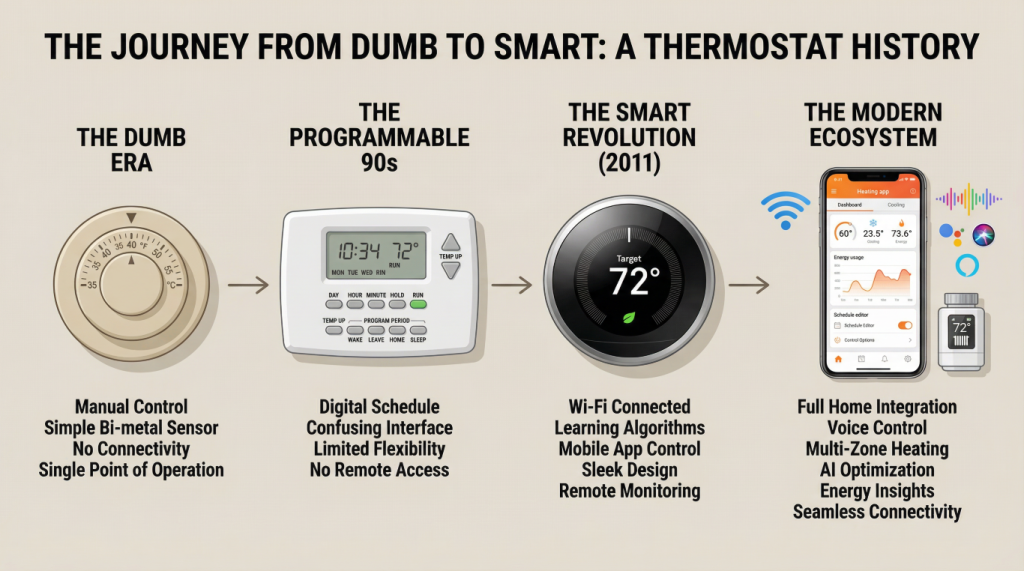
Before smart thermostats came along, we had what I affectionately call “dumb” thermostats. Not that there’s anything wrong with them, bless them, they did their job for decades. These were the simple dial types you’d see on the wall, usually in the hallway, often painted over multiple times. You’d set a temperature, and when the house got colder than that, click, the heating would come on. Warmer? Click, off it went.
Then we got a bit fancier with programmable thermostats in the 1980s and 1990s. These were the ones with the little LCD screens and enough buttons to launch a space shuttle. In theory, brilliant. You could programme different temperatures for different times of day. Monday morning, Tuesday evening, Wednesday afternoon, you could set it all up. In practice? Most people found them about as user-friendly as assembling flat-pack furniture in the dark. I knew plenty of folks who just left them on the default settings because figuring out the programming was too much hassle.
The first smart thermostat that really caught public attention was the Nest Learning Thermostat, which arrived in 2011. Created by former Apple engineers, it looked sleek, it was actually pleasant to use, and here’s the clever bit, it learned from you. You didn’t need to programme it with complex schedules. You just adjusted it when you wanted to, and over time, it figured out your patterns. Revolutionary? Perhaps that’s overselling it, but it certainly changed the game.
Since then, we’ve seen an explosion of options. Companies like Hive, Tado, Ecobee, and Honeywell have all jumped into the market with their own versions. Each generation has brought improvements: better learning algorithms, more accurate sensors, improved energy reports, integration with voice assistants like Alexa and Google Assistant, and increasingly sophisticated geofencing that knows when you’re heading home.
Modern smart thermostats are light years ahead of those first models. They can now detect which rooms are occupied, adjust heating zone by zone with smart radiator valves, provide detailed energy usage reports, and some can even detect if your heating system is developing problems before they become expensive disasters.
How These Clever Boxes Actually Work
Let me walk you through how a smart thermostat actually operates, because it’s not magic, even though it sometimes feels like it.
First, there’s smart thermostat installation, which I’ll be honest, can be a bit daunting if you’re not handy with DIY. Most smart thermostats need to replace your existing thermostat and connect to your heating system’s wiring. Some people tackle this themselves, others call in a professional, and there’s no shame in either approach. The important thing is that it’s connected properly to your heating system and to your home Wi-Fi network.
Once installed and set up through its companion app on your phone, the thermostat starts doing several things simultaneously. It’s constantly measuring the temperature in your home using built-in sensors. These are typically more accurate than those old dial thermostats, which is partly why they’re more efficient.
The thermostat also tracks your behaviour. When do you typically adjust the temperature? When are you usually home? When do you leave? It’s gathering this data, not in a creepy way, but in a helpful way, building up a picture of your routine. After a week or two, it starts making educated guesses about what you want.
Here’s where it gets interesting. Let’s say you usually get home at six in the evening and like the house at 20 degrees. An old thermostat would just switch on at six and start heating. A smart thermostat is more sophisticated. It knows how long your house takes to heat up. It checks the weather forecast and sees it’s particularly cold today. So it might start heating at 5:30 instead, ensuring the house is lovely and warm when you walk through the door at six.
The geofencing feature is particularly clever. Using your phone’s location, it can tell when you’re approaching home and start warming things up. Conversely, if everyone’s phones have left the house, it knows nobody’s home and can reduce the heating automatically. No more heating an empty house because you forgot to turn it down.
Throughout all this, the smart thermostat is sending information back to its app, showing you exactly how much energy you’re using, when your heating is on, and often providing tips on how you could save more. It’s like having an energy consultant living in your wall, except this one doesn’t charge by the hour.
The Future: Where Are We Heading?
The future of smart thermostats looks genuinely exciting, and I don’t say that lightly because most “future tech” predictions are overhyped nonsense. But the direction here makes sense.
We’re moving towards even more integration with the broader smart home ecosystem. Your smart thermostat will talk to your smart windows, your smart lights, even your smart kettle. The idea is that all these devices work together to optimise your home’s energy use. Windows might automatically adjust their tinting based on sunlight and heating needs. Lights might dim to reduce heat output when the thermostat is working hard to cool things down.
Artificial intelligence is getting better, which means these devices will become even more intuitive. They’ll predict your needs before you know them yourself. Feeling a bit under the weather? Your smart thermostat might notice you’re home on a day you’d usually be at work and adjust accordingly. Planning a holiday? It’ll optimise your heating for extended absence without you needing to remember to adjust it.
There’s also increasing focus on integration with the energy grid itself. Future smart thermostats might automatically reduce heating during peak demand times when electricity is most expensive and carbon-intensive, then heat your home more during off-peak hours. Some might even work with home battery systems and solar panels to optimise when you use grid electricity versus stored or generated power.
We’ll likely see better room-by-room control becoming standard rather than optional. Why heat the spare bedroom nobody uses? Future systems will be even better at directing warmth only where it’s needed, when it’s needed.
Security: The Bit Nobody Wants to Think About But Really Should
Right, here’s the part where I need to put on my serious hat for a moment. Smart thermostats are connected to the internet, and anything connected to the internet can potentially be hacked. I’m not trying to scare you, but you should understand the risks.
The good news is that attacks on smart thermostats are relatively rare. Hackers generally have bigger fish to fry than your heating schedule. But the risks do exist. Someone gaining access to your smart thermostat could potentially see when you’re home and when you’re away, which is obviously concerning from a security perspective. They could also mess with your heating, though frankly, that’s more annoying than dangerous.
The more serious concern is that your smart thermostat could be a weak point in your home network security. If someone can get into your thermostat because you’ve used a weak password, they might be able to access other devices on your network. It’s like leaving a window unlocked, it’s not the main door, but it’s still a way in.
So what should you do? First, use a strong, unique password for your thermostat’s app. Not “password123” or your dog’s name. Something proper. Enable two-factor authentication if it’s available. Keep your thermostat’s software updated, manufacturers regularly release security patches, so let them install automatically or check regularly for updates.
Make sure your home Wi-Fi is secure with a strong password and modern encryption (WPA3 if your router supports it, WPA2 at minimum). Some people even set up a separate Wi-Fi network just for their smart home devices, which isn’t a bad idea if you’re particularly security-conscious or technically inclined.
Also, read the privacy policy. I know, I know, nobody reads those things, they’re duller than watching paint dry. But at least skim through to understand what data your smart thermostat collects and what the company does with it. Most reputable manufacturers are transparent about this, but it’s worth knowing.
The bottom line is this: smart thermostats are generally secure, but they’re not invulnerable. Take basic precautions, use common sense, and you’ll likely be absolutely fine.
Wrapping This Up
Look, I started this piece admitting I was sceptical about smart thermostats, and I’ll end it by saying they’ve genuinely won me over. Not because they’re flashy or trendy, but because they actually do what they promise. They save money, they make life more convenient, and they help reduce energy waste.
The best smart thermostat for you will depend on your specific heating system, your budget, and what features matter most to you. Some people want all the bells and whistles, room-by-room control, voice assistant integration, the works. Others just want something that learns their routine and saves them money without much fuss. Both approaches are valid.
Smart thermostat installation might seem intimidating, but it’s increasingly straightforward, and there’s no shortage of professional installers if you’d rather not tackle it yourself. Once it’s up and running, most people wonder how they managed without one.
Are they perfect? No. Will they solve all your heating woes? Probably not. But will they make your home more comfortable whilst reducing your energy bills? For most people, absolutely yes. And in a world where both comfort and economy matter more than ever, that’s not a bad combination at all.
The technology will continue improving, becoming smarter, more efficient, and more integrated with our homes. But even the current generation of smart thermostats represents a genuine leap forward from what we had before. Sometimes, just sometimes, the hype is actually justified.
So if you’ve been sitting on the fence about getting a smart thermostat, wondering if it’s worth the investment, I’d say this: if you own your home, if you’re planning to stay there for a few years, and if you care about your energy bills, it’s worth serious consideration. You might just find, like I did, that this is one piece of smart home technology that actually earns its place on your wall.
Walter
Disclaimer: Energy savings vary by household, usage patterns, and existing heating efficiency. Always ensure installation is carried out safely and in compliance with local regulations.
Leave a Reply