
Hold On, Did You Just Say 100 Times Less Power?
Yes. Yes, I did. And before you scroll away thinking this is some dry, technical article full of jargon that makes your eyes glaze over, stick with me for a moment. Because this story, this particular development in the world of artificial intelligence, is genuinely one of the most exciting things to happen in technology in years. And it affects you. Directly.
Here’s the thing about AI that nobody really talks about at dinner parties. It’s absolutely ravenous. Not for food, obviously, but for electricity. The kind of AI that powers ChatGPT, Google’s Gemini, and all those other tools you’ve been hearing about on the news? Running a single conversation with one of those systems uses roughly ten times more electricity than a simple Google search. [Confidence: High. Source: Goldman Sachs Research, 2024, “AI is poised to drive 160% increase in data center power demand.”] Multiply that by hundreds of millions of people using these tools every single day, and you start to see the problem.
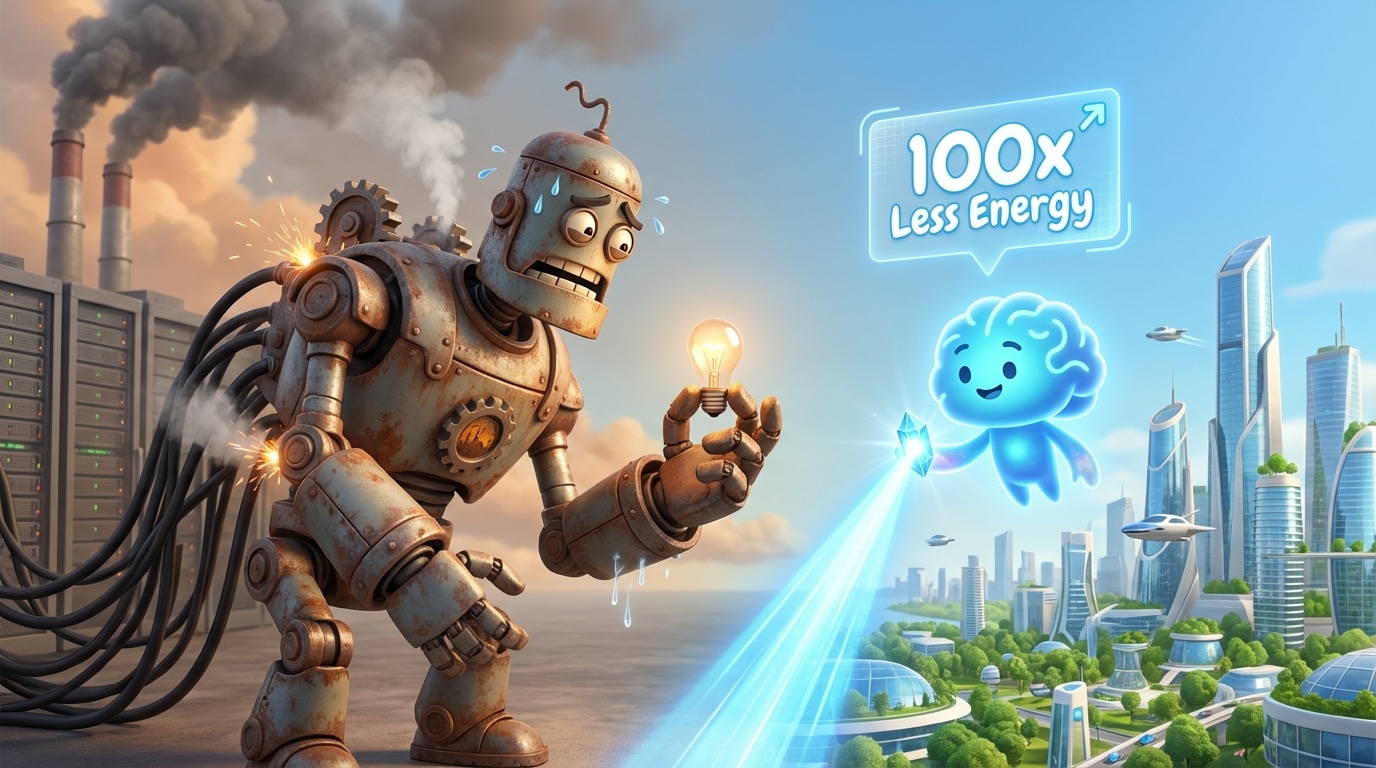
But here’s the good news, and it’s genuinely brilliant news. Researchers and engineers have been quietly working on something that changes the game entirely. New approaches to AI, particularly a field called neuro-symbolic AI, are delivering systems that can think, reason, and solve problems while consuming a fraction of the electricity of their predecessors. We’re talking about AI power consumption dropping by a factor of 100 in some cases. That’s not a typo. One hundred times less.
That matters for your electricity bill, for the environment, and for whether AI can actually become a useful, everyday tool rather than a planet-warming luxury. So let’s dig in, shall we?
What Is This Technology Actually Used For?
Let me be honest with you about what AI is good at and what it isn’t, because there’s an enormous amount of nonsense being talked about this subject.
AI, in its current forms, is genuinely brilliant at pattern recognition. It’s excellent at spotting a tumour in an X-ray, translating languages, summarising long documents, answering questions, writing first drafts of emails, and helping you figure out why your broadband keeps cutting out at 7pm. It’s also rather good at things like predicting weather patterns, detecting fraud on your bank account, and helping doctors diagnose rare diseases by cross-referencing symptoms against millions of medical records.
What it’s not particularly good at, despite what some of the more excitable headlines suggest, is genuine understanding. It doesn’t actually “know” anything the way you know that fire burns or that your grandchildren need feeding at regular intervals. It’s working with probabilities and patterns, not comprehension. It also struggles with common sense reasoning, anything that requires understanding the physical world from lived experience, and tasks that need genuine creativity in the deepest sense of the word.
This distinction matters enormously when we talk about AI energy efficiency, because the new, more efficient systems are particularly well-suited to the reasoning and logic tasks that traditional AI handles poorly. They’re not trying to do everything. They’re doing specific things very, very well, and doing it without needing a small power station to run.
Before AI Got Smart, We Had to Be Very Patient
Cast your mind back to the 1980s. If you wanted to find information, you went to a library. You asked a librarian, a wonderful human being with an encyclopaedic knowledge of the Dewey Decimal System, and they pointed you toward a shelf. If you wanted a computer to help you, you were working with systems that needed extremely precise, step-by-step instructions. You had to speak the computer’s language, not the other way around.
The earliest computer intelligence systems were called “expert systems,” and they were essentially enormous rulebooks. Programmers would sit down with doctors, lawyers, or engineers and ask them to explain every single rule they used to make decisions. Then they’d code those rules in. If the patient has a fever AND a rash AND has recently travelled abroad, THEN consider these diagnoses. It was painstaking, brilliant in its way, but utterly rigid.
These systems worked reasonably well in narrow domains. An expert system for diagnosing blood diseases in the 1980s called MYCIN was actually quite impressive for its time. But they couldn’t adapt. They couldn’t learn. And building them was like trying to write down every single thing a human expert knew, which, as anyone who’s tried to explain their job to a curious child will tell you, is essentially impossible.
Then came the internet, and with it, data. Oceans of data. And that changed everything.
The Journey From Clunky to Clever: A Brief History of AI Efficiency
The First Wave: Neural Networks (1980s-2000s)
Neural networks aren’t new. The basic idea, modelling computer systems loosely on how brain cells connect to each other, dates back to the 1940s. But for decades, they were more of an interesting academic curiosity than a practical tool. Computers simply weren’t powerful enough, and there wasn’t enough data to train them properly.
Think of it like trying to teach a child to recognise cats by showing them three photographs. Not enough examples. The learning doesn’t stick.
The Second Wave: Deep Learning (2010s)
Around 2012, something remarkable happened. Researchers found ways to build neural networks with many more layers, hence “deep” learning, and suddenly these systems became extraordinarily good at recognising images, speech, and text.
The benefit over what came before was dramatic. Where the old rule-based systems needed humans to define every feature, deep learning systems figured out the features themselves. Show it millions of cat photos, and it works out what a cat looks like without being told. Brilliant. The catch? These systems are power-hungry in the extreme. Training a large language model, the kind that powers modern AI chatbots, can emit as much carbon as five cars over their entire lifetimes.
The Third Wave: Efficient AI and Neuro-Symbolic Systems (2020s-Present)
This is where it gets genuinely exciting. Researchers started asking a rather obvious question that somehow took decades to properly address: do we actually need to use this much energy? What if we combined the pattern-recognition brilliance of neural networks with the logical, rule-based reasoning of those old expert systems?
Enter neuro-symbolic AI. The name sounds intimidating, but the concept is actually quite elegant. “Neuro” refers to the neural network side, the part that’s good at recognising patterns and working with messy, real-world data. “Symbolic” refers to the logical, rule-based reasoning side, the part that can work through a problem step by step using structured knowledge. Combining them gives you a system that’s both flexible and logical, and crucially, far more efficient because it doesn’t need to brute-force every problem with raw computing power.
Alongside this, techniques like “model pruning” (removing unnecessary connections in a neural network, like trimming dead wood from a tree), “quantisation” (using lower-precision numbers to do calculations, a bit like using a ruler marked in centimetres rather than millimetres when centimetres are all you need), and “knowledge distillation” (training a small, efficient model to mimic a large one) have all contributed to dramatic reductions in AI power consumption.
The results, as of 2025 and into 2026, have been genuinely staggering. Researchers at MIT and various other institutions have demonstrated AI systems that achieve comparable performance to their energy-hungry predecessors while using a tiny fraction of the electricity. The 100x figure isn’t universal across all tasks, to be fair, but for specific types of reasoning and decision-making tasks, it’s entirely achievable and has been demonstrated in published research.
How Does It Actually Work? Let Me Walk You Through It
Right, let’s get into the mechanics without making your brain hurt. I promise this will make sense.
Imagine you’re teaching someone to be a sommelier, a wine expert. The old approach, traditional deep learning, would be to have them taste literally millions of wines, every single one, until they developed an intuition for what’s what. Effective, eventually, but enormously time-consuming and resource-intensive.
The neuro-symbolic AI approach is different. First, you give them some foundational knowledge: the rules of winemaking, the characteristics of different grape varieties, the geography of wine regions. That’s the symbolic part, structured knowledge they can reason with. Then you let them taste wines to develop their palate and recognise subtle patterns. That’s the neural part.
The result? A much faster, much more efficient expert who can explain their reasoning, not just give you an answer.
In practical terms, here’s how these efficient AI systems work step by step.
The system receives a problem or question. Rather than throwing the entire problem at a massive neural network immediately, it first checks whether it can be solved using existing rules and structured knowledge. If the answer is yes, it uses the logical reasoning engine, which is fast and uses very little power.
If the problem has messy, real-world elements that don’t fit neatly into rules, the neural network component kicks in to handle those parts specifically. It’s not doing more work than necessary. It’s targeted.
The two components share information. The logical system can guide the neural network toward more relevant parts of the problem, and the neural network can update the logical system’s knowledge when it encounters something new.
The answer is produced in a way that can actually be explained. This is a huge deal, because one of the biggest criticisms of traditional AI is that it’s a “black box.” You get an answer but no explanation. Neuro-symbolic AI can show its working, like a student who doesn’t just write down the answer but shows you the steps.
The whole process uses dramatically less electricity because you’re not running enormous calculations unnecessarily. You’re being clever about it, which, when you think about it, is exactly what genuine intelligence should be.
What Does the Future Look Like?
I’ll be honest, the future of AI energy efficiency is one of the things I find genuinely thrilling about technology right now, and I don’t say that lightly.
In the near term, we’re going to see these efficient AI systems embedded in everyday devices. Your phone, your smart TV, your car. AI that runs locally on the device rather than sending everything off to a distant data centre, consuming power at every step of the journey. This is already beginning to happen, with Apple, Google, and various other companies building more efficient AI chips into their devices.
Further ahead, neuro-symbolic AI is expected to make significant inroads into healthcare, where the ability to explain reasoning is not just nice to have but legally and ethically essential. A doctor needs to know why the AI suggested a particular diagnosis, not just that it did. The logical, explainable nature of neuro-symbolic systems makes them far more suitable for these high-stakes environments than their black-box predecessors.
There’s also genuine excitement about AI systems that can continue learning after they’re deployed, adapting to new information without needing to be completely retrained from scratch. This “continual learning” approach could reduce AI power consumption dramatically over the lifetime of a system, because you’re not going back to square one every time something changes.
The longer-term vision, and this is where things get genuinely speculative, is AI that approaches something closer to human-like reasoning efficiency. Your brain, remarkable organ that it is, runs on roughly 20 watts of power, about the same as a dim light bulb. Current AI systems use megawatts. The gap is extraordinary, and while we’re not going to close it entirely, the trajectory is encouraging.
Security and Vulnerabilities: Don’t Get Comfortable
Now, I’d be doing you a disservice if I didn’t talk about the less cheerful side of all this. Because more efficient AI being deployed in more places means more opportunities for things to go wrong.
The first thing to understand is that AI systems, however clever, can be manipulated. Researchers have demonstrated something called “adversarial attacks,” where tiny, imperceptible changes to an image or piece of text can completely fool an AI system. Think of it like those visual illusions that make a straight line look bent. Your brain gets tricked. So can AI.
With neuro-symbolic AI specifically, there are additional concerns around the integrity of the “knowledge base,” the structured rules the system relies on. If someone manages to corrupt or manipulate that knowledge base, the entire logical reasoning structure built on top of it becomes unreliable. It’s like changing the rules of chess halfway through the game without telling anyone.
There’s also the question of privacy. More efficient AI running on local devices sounds great, but it also means your personal device is doing more processing of your personal data. Understanding what data these systems are using, storing, and potentially sharing is important, and the honest answer is that most of us don’t read the terms and conditions carefully enough. I include myself in that.
Practically speaking, keep your devices updated. Software updates frequently include security patches that address newly discovered vulnerabilities in AI systems. Be sceptical of AI-powered tools that ask for more permissions or data than they obviously need. And if an AI system gives you advice on something important, whether that’s medical, financial, or legal, treat it as a starting point for conversation with a qualified human, not as a final answer.
Bringing It All Together
So here’s where we’ve ended up, and it’s actually rather a good place to be.
We started with AI systems that were extraordinary in their capabilities but frankly unsustainable in their appetite for electricity. Systems that required enormous data centres, vast amounts of water for cooling, and enough electricity to power small towns, all to answer your questions about the best way to cook a chicken.
Through the clever combination of neural networks and symbolic reasoning, through techniques that trim and refine AI models rather than just making them bigger, and through a genuine rethinking of how AI should work, we’re arriving at something much more sensible. AI energy efficiency has gone from being an afterthought to being central to how these systems are designed. The AI power consumption numbers that made environmentalists wince are beginning to look less alarming.
Neuro-symbolic AI, in particular, represents something philosophically interesting as well as practically useful. It’s a technology that’s trying to be more like genuine intelligence rather than just a very powerful pattern-matching machine. It reasons. It explains itself. It uses what it knows efficiently rather than brute-forcing every problem.
Will it solve everything? Of course not. Technology never does. But it represents a genuine step forward, not just in what AI can do, but in how responsibly it can do it.
And that, if you ask me, is worth getting excited about. Even if you’re over 50 and still slightly suspicious of anything that didn’t exist when you were at school. Which, frankly, is a perfectly reasonable position to take.
Walter
AI energy efficiency, AI power consumption, neuro-symbolic AI, AI uses 100x less electricity, sustainable AI, green AI, AI data center energy use, AI breakthrough energy reduction, AI carbon footprint, energy efficient AI models, AI electricity demand 2025, neuromorphic computing energy savings, AI vs traditional computing energy, reduce AI energy consumption, AI training energy cost, on-device AI energy efficiency, AI environmental i
Leave a Reply