

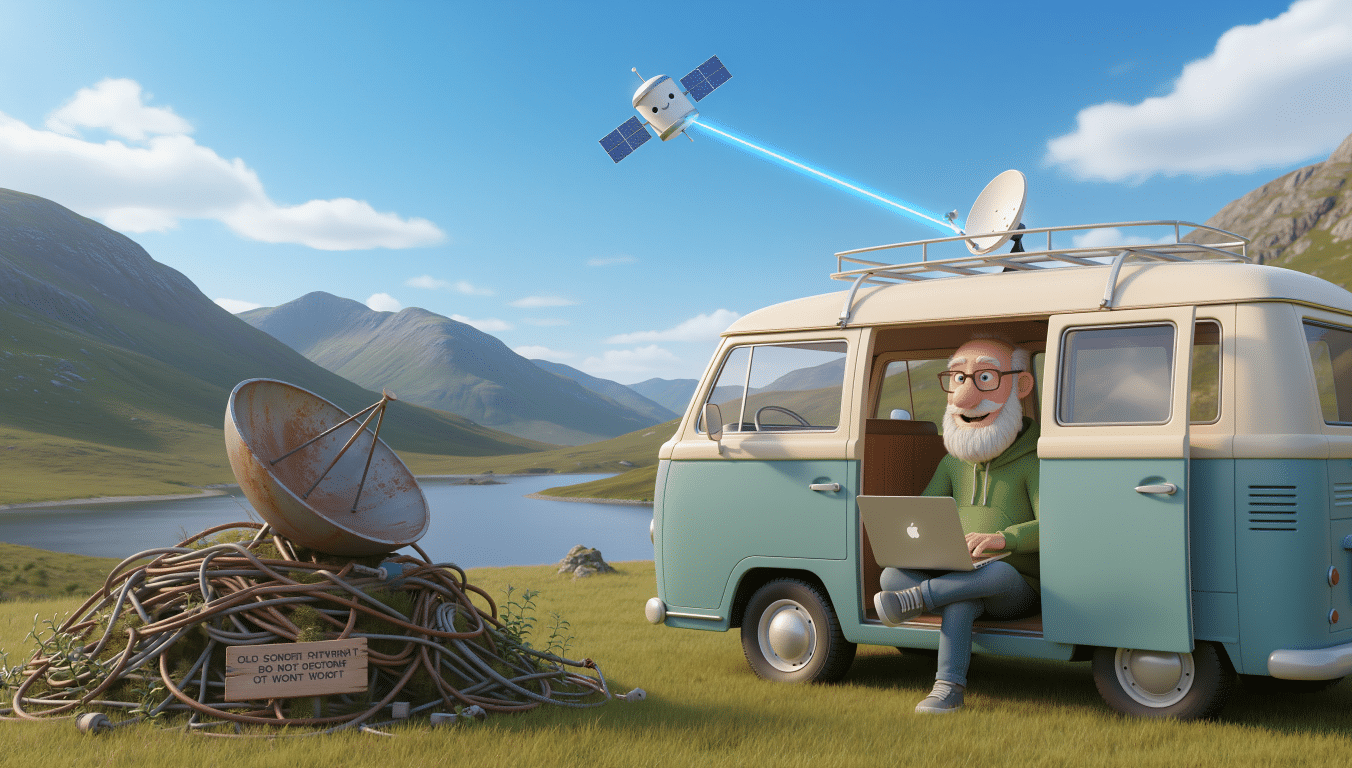
Five years ago, if someone told me I’d be writing about getting my internet from satellites whizzing around in space, I’d have laughed them out of the room. But here we are, and this technology is genuinely changing how people work and live.
Here’s the thing that gets me excited about satellite internet: for the first time in human history, you can have proper, fast internet literally anywhere on Earth. That cottage in the Scottish Highlands? Covered. That beach house in Cornwall where the only previous connection was a dodgy phone signal? Sorted. Your mate’s farm in rural Wales where broadband was just a distant dream? Done and dusted.
This matters because the world changed. We learned during the pandemic that many of us don’t actually need to be in an office. We learned that “remote work” doesn’t mean sitting in your spare bedroom in Croydon, it can mean working from anywhere. And that’s where space-based internet comes in, utterly transforming what’s possible.
What Satellite Internet Is Actually For (And What It Isn’t)
Let me paint you a picture. Digital nomad internet used to be an absolute nightmare. You’d rock up to some beautiful remote location, ready to work with a view, only to discover the WiFi barely loads your emails. I’ve been there, watching a video call freeze mid-sentence, looking like a complete muppet to my colleagues.
Satellite internet solves this specific problem brilliantly. It’s designed for people and places where traditional internet infrastructure either doesn’t exist or is absolutely rubbish. We’re talking about rural homes, boats in the middle of the ocean, RVs touring the continent, research stations, disaster relief areas, and yes, digital nomads working from that converted van they won’t shut up about on Instagram.
But here’s what it’s not great for, and I need to be straight with you about this. If you live in central London with access to gigabit fiber, satellite internet isn’t going to be better. It’s more expensive, and whilst it’s getting remarkably good, fiber still has lower latency (that’s the delay in sending and receiving data). You wouldn’t swap out a perfectly good broadband connection for it. That would be daft.
It’s also not ideal if you’re in a flat with no view of the sky, or if you’re surrounded by tall buildings or dense tree cover. The system needs a clear view upwards, which makes sense when you think about it. Can’t get signals from space if you can’t see space.
The Old Days: When Internet Meant Being Tied Down
Remember dial-up? That screaming, screeching noise that announced you were about to wait five minutes for a single webpage to load? God, those were dark times. You couldn’t use the phone and the internet simultaneously. Your mum would pick up the phone downstairs and boot you offline right when you were winning at whatever game you were playing.
Then came broadband through phone lines, ADSL they called it. Suddenly we had “always on” internet. Revolutionary. No more of that banshee screaming every time you wanted to check your email. But here’s the catch: you needed to be physically connected to a phone line, which meant you needed to be near infrastructure. If British Telecom hadn’t run cables to your area, you were stuffed.
Cable internet came along, offering faster speeds through the same cables that brought you Sky Sports. Then fiber optic cables, which use light instead of electricity to transmit data. Fiber is brilliant, genuinely fast, but it requires someone to physically dig up roads and lay cables to your house. In cities, this happened. In rural areas? Not so much. The economics didn’t work out. Why spend millions laying cable for a village of 200 people?
This is where the divide happened. City folks got faster and faster internet. Rural folks got forgotten. I’ve got friends in the countryside still struggling with speeds that would make a 1990s modem blush. It’s not right, but it’s the reality of infrastructure that requires physical cables.
The Evolution: From Rubbish Space Internet to Starlink
Now, satellite internet isn’t actually new. We’ve had satellite internet since the late 1990s, but it was absolutely terrible. I’m talking about speeds slower than many mobile connections, delays that made video calls impossible, and prices that would make your eyes water.
The old satellite internet systems used what we call geostationary satellites. These massive things sat about 35,000 kilometers above Earth, staying in one fixed position relative to the ground below. Sounds clever, right? Here’s the problem: that signal had to travel 35,000 kilometers up, then 35,000 kilometers back down. That’s 70,000 kilometers for every single bit of data. The speed of light is fast, but it’s not instantaneous. You’d click something and wait. And wait. It was usable for emails, barely, but forget about anything else.
These systems also required massive satellite dishes. I’m talking about those huge things you’d see on houses that looked like you were trying to communicate with aliens. They were expensive to install, expensive to run, and the service was mediocre at best. Companies like HughesNet and Viasat offered these services, and to be fair to them, they were the only option for some people. But nobody was excited about it.
Then everything changed. A company called SpaceX, run by that bloke Elon Musk (who you’ve probably heard of), had a different idea. Instead of a few massive satellites far away, what if you launched thousands of smaller satellites much closer to Earth? What if instead of 35,000 kilometers away, they were only about 550 kilometers up?
This is Low Earth Orbit, or LEO for short. The difference is staggering. That signal now travels maybe 1,000 kilometers total instead of 70,000. Suddenly, the delays drop from half a second to about 20-50 milliseconds. That might not sound like much, but it’s the difference between a video call that feels like talking to someone on the moon and one that feels almost normal.
Starlink launched their first satellites in 2019. I remember thinking it was a bit mad, honestly. They were talking about launching tens of thousands of satellites. The first beta users got access in 2020, and the reports started coming in. People in the middle of nowhere were getting 100+ Mbps download speeds. Farmers were crying with joy. Remote workers were suddenly able to do their jobs from places they’d only dreamed about.
The system evolved quickly. The first Starlink dishes were nicknamed “Dishy McFlatface” by users (because the internet loves a silly name), and they were quite large, round things that needed to be professionally installed. Then came version two, which was rectangular and easier to set up. Then portable versions for RVs and boats. Each iteration got better, smaller, more efficient.
Other companies took notice. Amazon announced Project Kuiper, their own LEO satellite constellation. OneWeb started launching their satellites. The race for space-based internet was on, and competition, as always, drives innovation and hopefully brings prices down.
How This Space Magic Actually Works
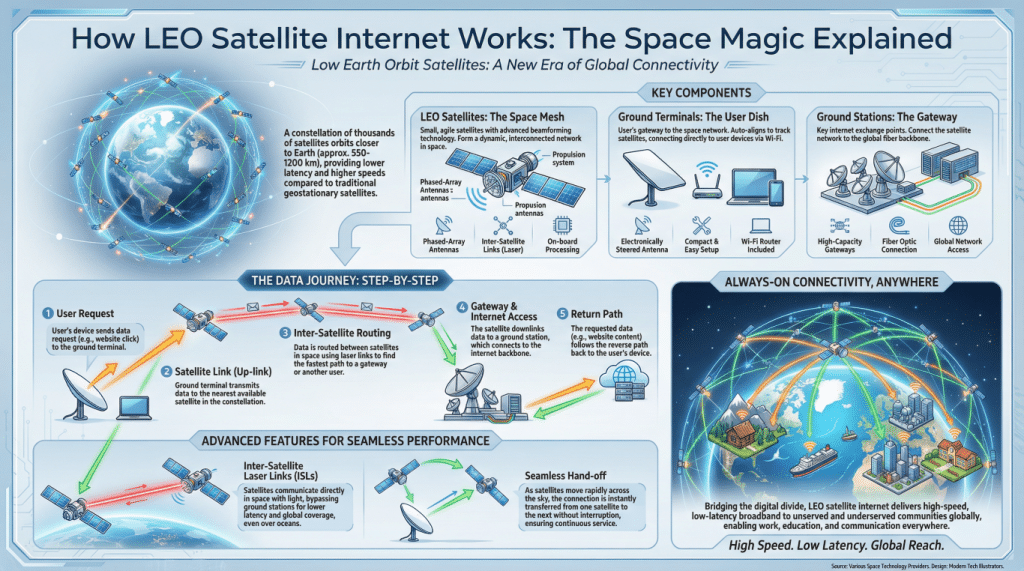
Right, let me walk you through this step by step, because it’s actually quite fascinating once you understand it.
First, you need the satellites themselves. Starlink has launched over 5,000 of these things as of late 2024 (and they’re still launching more every few weeks). They’re orbiting Earth at about 550 kilometers up, traveling at roughly 27,000 kilometers per hour. At that speed, they zoom around the entire planet in about 90 minutes. Mental, isn’t it?
Each satellite is about the size of a table and weighs around 260 kilograms. They’re covered in solar panels for power and have antennas to communicate with Earth. They’re also fitted with ion thrusters, which are small engines that use electricity to shoot out ions (charged particles) to adjust their position. This keeps them from crashing into each other, which would be rather unfortunate.
Now, on the ground, you’ve got your terminal, that dish thing that sits outside your house or on your van. This is actually a sophisticated piece of kit, though it looks simple enough. Inside are thousands of tiny antennas that work together (they call this a phased array antenna, but you don’t need to remember that). The clever bit is that it can electronically steer its signal without physically moving. Well, the newer ones don’t move. The original Dishy did a little dance when it first started up, which was oddly endearing.
Here’s how a typical internet request works: You click on a website. That request goes from your computer to the dish via a cable. The dish beams that request up to whichever Starlink satellite is currently overhead. Remember, these satellites are moving fast, so the one serving you now won’t be the same one serving you in ten minutes. The satellite receives your request and sends it down to a ground station, which is connected to the regular internet infrastructure. The ground station fetches the website data, sends it back up to a satellite (possibly a different one), which beams it back down to your dish, which sends it to your computer. All of this happens in milliseconds.
The satellites also talk to each other using lasers. Yes, lasers in space, like something from Star Wars. This means data can hop between satellites without having to go down to a ground station first, which is especially useful over oceans where there are no ground stations.
The system constantly manages which satellite your dish is talking to, seamlessly handing you off from one to the next as they zip overhead. You don’t notice this happening. It just works, which is rather the point.
What’s Coming Next: The Future Gets Interesting
The future of digital nomad internet from space looks genuinely exciting, and I don’t say that lightly. We’re talking about several developments that could change everything again.
First, direct-to-mobile connectivity. Several companies are working on satellites that can communicate directly with your regular mobile phone, no special equipment needed. Imagine being in the middle of a forest with full signal. That’s coming, probably within the next few years.
Second, speeds are going to get faster. The next generation of satellites will have more bandwidth, better antennas, and more sophisticated technology. We’re talking about gigabit speeds becoming standard, even from space. That’s faster than many people get from fiber today.
Third, global coverage will become truly global. Right now, there are still gaps, particularly over the poles and some ocean regions. As more satellites launch and the constellations fill out, you’ll be able to get high-speed internet literally anywhere on the planet’s surface. Antarctica? Covered. Middle of the Pacific? No problem.
The prices will likely come down too. As more competitors enter the market and the technology matures, the cost of both equipment and monthly service should decrease. It’s already happened to some extent. The first Starlink kits cost £500 for the hardware, and whilst that’s not cheap, it’s a fraction of what old satellite internet systems cost.
We might also see specialized services. Satellite internet optimized for boats, for aircraft (proper WiFi on planes that actually works), for emergency services, for military applications. The technology is flexible enough to adapt to different needs.
The Dark Side: Security and What Could Go Wrong
Now, I need to have a serious word with you about security, because this is important and people often don’t think about it.
When your internet is beaming through space, it’s potentially vulnerable in ways that fiber isn’t. Your data is being broadcast into the air, up to satellites, and back down again. In theory, someone with the right equipment could intercept those signals. Now, before you panic, the data is encrypted, which means it’s scrambled into gibberish that only your dish and the satellite can understand. But encryption can be broken, given enough time and computing power.
There’s also the question of who operates these satellites. With Starlink, you’re trusting SpaceX and, by extension, whatever government regulations they operate under. Your internet traffic is passing through their systems. They could, theoretically, monitor what you’re doing. Most reputable companies don’t, and there are laws against it, but it’s worth being aware of.
My advice? Use a VPN (Virtual Private Network) when doing anything sensitive over satellite internet, just as you would on public WiFi. A VPN adds an extra layer of encryption and routes your traffic through secure servers. It’s like putting your data in a locked box before sending it through the post.
There’s also physical security. That dish sitting outside your house or on your van is expensive kit. It could be stolen. It could be damaged. Insurance is worth considering if you’re relying on this for your livelihood.
Then there’s the vulnerability of the satellites themselves. They’re up in space, relatively exposed. Space debris is a real problem, with thousands of pieces of junk whizzing around up there. A collision could take out satellites. Solar storms can disrupt communications. These are rare events, but they happen.
There’s also a concern I have about over-reliance. If everyone starts depending on a single satellite network for their internet, what happens if it goes down? We’ve seen how fragile centralized systems can be. Diversification is important. Don’t put all your eggs in one basket, as your parents probably told you.
Wrapping This Up: The Revolution Is Here
Here’s what I’ve learned after diving deep into this technology: we’re living through a genuine revolution in connectivity, and most people haven’t quite realized it yet.
For decades, fast internet meant being tethered to cities and infrastructure. It meant choosing between a career that required connectivity and a life in the countryside. It meant digital nomads having to carefully plan their travels around WiFi availability. Those constraints are evaporating.
Satellite internet, particularly these new LEO systems like Starlink, has changed the equation entirely. It’s not perfect. It’s still more expensive than fiber if you have access to fiber. It still needs a clear view of the sky. The equipment isn’t cheap. But for millions of people who previously had no good options, it’s transformative.
I’ve seen the impact firsthand. Friends who moved to rural areas during the pandemic and can now actually work from home. Digital nomads who’ve expanded their possible destinations from “places with good WiFi” to “literally anywhere.” Small businesses in remote areas that can finally compete online. Kids in rural schools who can access the same educational resources as city kids.
The technology will keep improving. Speeds will increase, prices will drop, coverage will expand. Competition from Project Kuiper and others will drive innovation. Within five years, I reckon space-based internet will be as normal as getting TV from satellites is today.
Should you get it? That depends entirely on your situation. If you’re stuck with rubbish rural broadband, absolutely worth investigating. If you’re planning the digital nomad lifestyle, it’s genuinely a game-changer. If you’ve already got good fiber, probably not necessary unless you’re planning to move somewhere remote.
But here’s what excites me most: this technology represents freedom. Freedom to live where you want. Freedom to work from places that inspire you. Freedom from the tyranny of infrastructure that decided where you could and couldn’t have modern connectivity.
We’re beaming internet from space, people. From actual space. That’s remarkable, and it’s available right now, not in some distant future. The world just got a whole lot bigger and a whole lot more accessible.
And honestly? That’s bloody brilliant.
Walter
Note: Specific pricing, exact satellite counts, and service availability may vary by region and change over time. Always check current specifications before purchasing.
Leave a Reply