

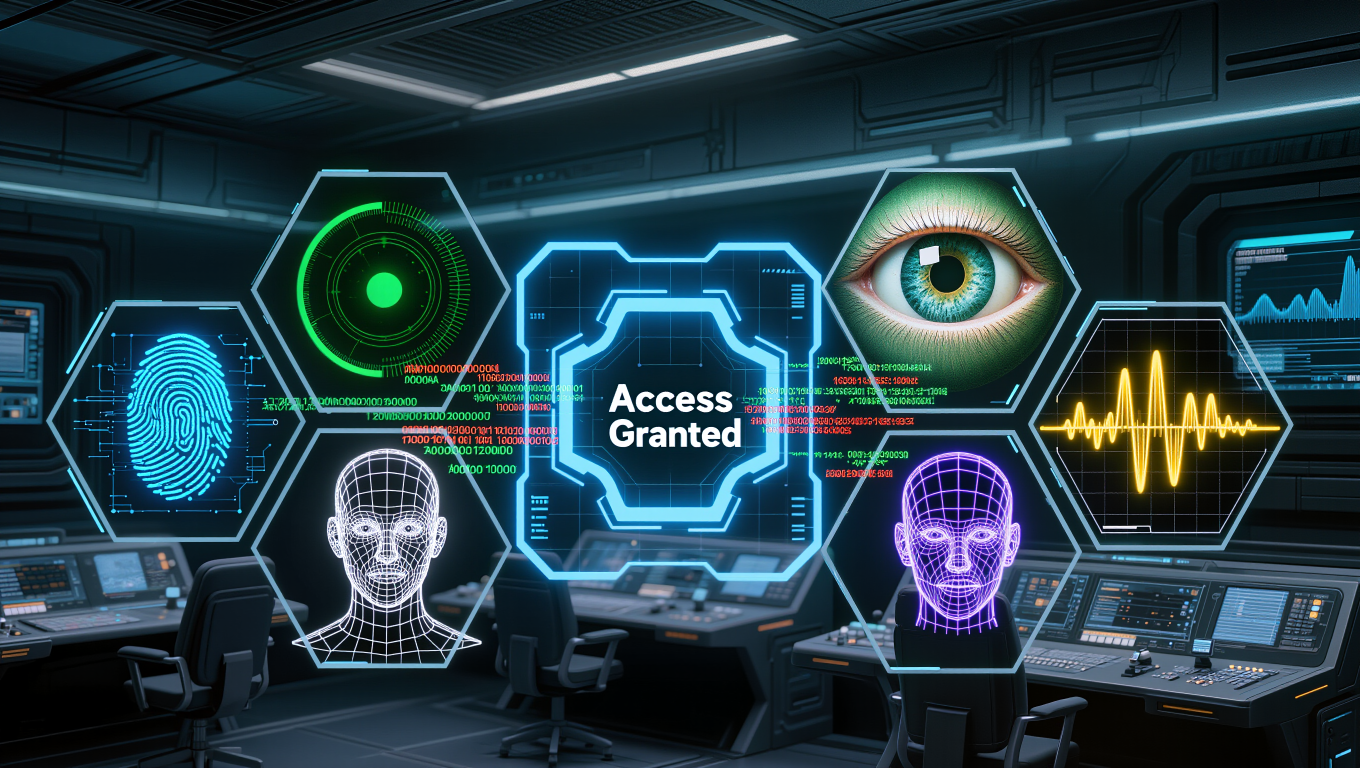
Introduction: Welcome to the Future, Where You Are the Key
Remember when science fiction films showed people opening doors with their eyeballs or unlocking secret vaults with a handprint? Well, congratulations, we’re living in that future now, and honestly, it’s a bit weird when you stop to think about it.
I’ll be straight with you. The first time I realised I was genuinely frightened to shave my beard because my phone might not recognise me, I had a bit of an existential moment. Here I was, a grown adult, held hostage by facial hair and a piece of technology. But that’s the world of biometric authentication we’re living in now, and whether we like it or not, it’s becoming as normal as carrying keys used to be.
Biometric security, in simple terms, is using your unique physical characteristics to prove you are who you say you are. Your fingerprint, your face, your iris, even your voice. These things are uniquely yours, like a biological password that you can’t forget or lose down the back of the sofa. And that’s precisely why this technology has become so incredibly important.
Think about it. We’re living in an age where our entire lives are digital. Our bank accounts, our photos, our medical records, our conversations with friends. All of it sits behind digital doors that need protecting. Traditional keys and passwords have become about as effective as a chocolate teapot in keeping the really determined baddies out. We needed something better, something that couldn’t be easily stolen or guessed. We needed something that was fundamentally us.
That’s where biometric security comes in, and it’s rather brilliant when it works. When it doesn’t work, well, we’ll get to that.
What’s the Big Deal with Biometric Authentication?
So what exactly are we using biometric authentication for these days? The answer is: almost everything.
Your smartphone is probably the most obvious example. Whether you’re using fingerprint recognition to unlock it or facial recognition to approve a payment, you’re using biometrics multiple times a day without even thinking about it. Banks love it too, using it for apps and transactions. Airports have embraced it with facial recognition at passport control. Some office buildings and homes use it for access, like my front door with its fingerprint reader that has developed what I can only describe as a personal vendetta against me after I’ve done the washing up.
But here’s what it’s not used for, and this is important. Biometric authentication isn’t tracking your every movement or reading your thoughts. It’s simply a way of proving you are you when you need to access something that’s yours. The technology checks if your fingerprint matches the one stored in the system, yes or no. It’s not sending your face off to some massive database in the sky for analysis. Well, mostly. We’ll talk about privacy concerns later.
The reason biometric security has become so widespread is delightfully simple: convenience. We humans are spectacularly lazy when given the chance, and I mean that in the nicest possible way. Typing in a sixteen-character password with capitals, numbers, and special characters every time we want to check our phone? Nobody wants that. Pressing your thumb on a sensor for half a second? Now that’s more like it.
What We Used Before: Keys, Passwords, and a Whole Lot of Headaches
Let’s take a little trip down memory lane, shall we? Back to the dark ages of, oh, about fifteen years ago.
Keys were the absolute backbone of security. Physical, metal keys for your house, car, office, possibly your desk drawer where you kept the good biscuits. I once had seventeen keys on my keyring, which made me feel very important until the weight of them tore a hole in my coat pocket.
The problem with keys is that they can be lost, stolen, or copied. I once locked myself out of my house three times in one month. The locksmith started recognising my voice on the phone. Keys are also rubbish at keeping track of who’s been where.
Then came passwords. Oh, passwords. Those wonderful little strings of characters that were supposed to make everything secure. We were told to make them complicated. So we did. Then we forgot them. Then we wrote them down on sticky notes attached to our monitors, which rather defeated the purpose.
Passwords had a fatal flaw that keys didn’t: they could be guessed or hacked remotely. Someone could try thousands of combinations until they got in, all from the comfort of their own home, probably while eating toast.
Neither keys nor passwords were particularly good at proving you were actually you. Anyone with your key or password could pretend to be you. There was no biological certainty, no unique identifier that couldn’t be transferred or shared.
We needed something better. Something undeniably, uniquely ours. Something that couldn’t be forgotten in a taxi or written on a sticky note. We needed our bodies to become our passwords.
The Evolution of Biometric Security: From Clunky to Cool
Fingerprint Recognition: The Early Days
Fingerprint recognition wasn’t actually new when it appeared on our phones. The police have been using fingerprints to identify criminals since the late 1800s. But using fingerprints to unlock things? That’s more recent.
The first attempts at commercial fingerprint recognition started appearing in the 1990s, and they were, how shall I put this, a bit rubbish. These early systems used optical scanners, which essentially took a photograph of your fingerprint and compared it to a stored image.
The problem was they were incredibly temperamental. Too dry, didn’t work. Too wet, didn’t work. A tiny bit of dirt, didn’t work. They were also slow and relatively easy to fool with photographs or moulds. But they proved the concept worked, showing that we could use our fingerprints as authentication. They were just clunky, expensive, and not quite ready for everyday use.
Facial Recognition: The First Attempts
Early facial recognition, which started making commercial appearances in the early 2000s, was even more problematic. These systems tried to map your face using fairly basic measurements: the distance between your eyes, the width of your nose, the shape of your cheekbones.
They were laughably easy to fool. A photograph would do it. Different lighting could confuse them completely. Gain a bit of weight, get a new haircut, or grow a beard, and suddenly you were a stranger to your own security system. These early systems were mostly used in high-security environments where they could be monitored by actual humans. They were far too unreliable for everyday consumer use.
Modern Fingerprint Recognition: The Game Changer
Everything changed when Apple put a fingerprint sensor in the iPhone 5S in 2013. Suddenly, fingerprint recognition wasn’t some futuristic security feature for spy agencies. It was something millions of ordinary people used every single day.
The technology had improved dramatically. Instead of just taking a photograph of your fingerprint, modern sensors use capacitive technology. These sensors detect the actual physical ridges of your fingerprint using tiny electrical currents. They create a detailed map of your fingerprint’s unique pattern.
This made them much more accurate and much harder to fool. They could work with slightly dirty fingers, in different lighting conditions, and they were fast. Really fast. Press your thumb down for a fraction of a second and boom, you’re in.
Where the old optical scanners might work 70% of the time if you were lucky, modern capacitive sensors work 95% or more of the time. They’re also much more secure. Creating a fake fingerprint that can fool them requires serious effort and expertise.
Some modern phones now use ultrasonic fingerprint sensors that send sound waves through your finger to create a 3D map. It’s like the difference between a sketch and a sculpture. Much more detail, much more secure.
But they’re still not perfect, as I can personally attest. My door’s fingerprint reader has a particular hatred for pruney, post-washing-up fingers. The water and soap change the surface of your skin just enough that the sensor gets confused. It’s like my fingerprint temporarily stops being my fingerprint, which is both inconvenient and faintly philosophical.
Modern Facial Recognition: Face ID and Beyond
Facial recognition took a massive leap forward when Apple introduced Face ID in 2017. This wasn’t like those early systems that could be fooled by a photograph. This was proper, sophisticated stuff.
Modern facial recognition systems use multiple technologies working together. They project thousands of invisible dots onto your face using infrared light, creating a detailed 3D map of your facial features. They don’t just see your face, they measure it in three dimensions.
This means they can tell the difference between you and a photograph of you. They can tell the difference between you and your twin, mostly. They work in the dark because they’re using infrared light. They can handle different angles, different expressions, and yes, even facial hair changes, although I remain deeply sceptical about this last point.
The system learns as you use it too. If you gradually grow a beard, it adapts. If you get glasses, it figures it out. It’s constantly updating its understanding of what you look like. Which is brilliant, except when it creates this nagging anxiety that shaving your entire beard off in one go might confuse it so thoroughly that you’ll be locked out of your own phone forever. Is this a rational fear? Probably not. Does it stop me booking that barber’s appointment? Absolutely.
The advantages over early facial recognition systems are enormous. Where those old systems were maybe 60-70% accurate on a good day, modern systems are up around 95-99% accurate. They’re incredibly difficult to fool. Security researchers have tried using detailed silicone masks, 3D-printed heads, even identical twins, and while it’s not impossible to trick them, it requires resources and effort well beyond what a casual phone thief could manage.
How Biometric Security Actually Works (Without the Techy Gobbledygook)
Right, let’s get into the mechanics of how this all actually works. I promise to keep this simple. Think of it like explaining how a car works: you don’t need to understand every bolt and gasket, but it helps to know that petrol goes in, explosions happen, and wheels turn.
Fingerprint Recognition: Step by Step
When you first set up fingerprint recognition, you’re going through what’s called the enrolment process. You place your finger on the sensor multiple times from different angles. The sensor creates a detailed map of your fingerprint’s unique pattern, all those little ridges and valleys, the swirls and loops. Everyone’s fingerprint is different, even identical twins.
The system converts this map into a mathematical representation, essentially a string of numbers and data points. This is important because your actual fingerprint image isn’t usually stored, just this mathematical representation. It’s much more secure that way.
This template gets stored securely in the device, usually in a special secure area of the processor that’s very difficult to access, even if someone steals your phone.
When you want to unlock your phone or open your door, you place your finger on the sensor. The sensor takes a new reading and converts it into a mathematical representation. The system compares this to the stored template, looking for matches in the pattern. It doesn’t need to be 100% identical because your finger might be positioned slightly differently. The system has a tolerance level.
If the match is close enough, usually above about 90% similarity, the system says “yep, that’s you” and unlocks. If not, you get that frustrating “try again” message. The whole process takes milliseconds.
Facial Recognition: Step by Step
Facial recognition works on similar principles but with more complexity because your face is more complex than your fingerprint.
During enrolment, the system captures your face, but not like a photograph. It uses thousands of infrared dots to create a 3D depth map, measuring the distances between your features: how far your nose sticks out, the depth of your eye sockets, the contours of your cheeks. It also takes an infrared photograph that captures details not visible in regular light. This helps it work in the dark and makes it harder to fool with photographs.
Like with fingerprints, this 3D map and infrared image get converted into a mathematical representation. The system creates a unique numerical description of your face’s geometry, which gets stored securely in the device.
When you want to unlock, the system projects those infrared dots onto your face and captures the depth map in a fraction of a second. It converts this into a mathematical representation and compares it to your stored template, looking for matches in facial geometry. If there’s a sufficient match, you’re in.
The sophisticated bit is that the system uses machine learning to improve over time. If you’re wearing glasses one day and it takes an extra second to recognise you, but then you manually enter your password to confirm it’s you, the system learns that you sometimes wear glasses.
This adaptive learning is why modern facial recognition can handle gradual changes like growing a beard or gaining weight. The system slowly adjusts its template as you change. But make a dramatic change all at once, like shaving off a full beard, and you might confuse it temporarily. Hence my ongoing grooming anxiety.
What the Future of Biometric Security Looks Like
If you think biometric authentication is already quite science fiction, hold onto your hat, because it’s about to get more interesting.
Voice recognition is becoming increasingly sophisticated. Your voice is as unique as your fingerprint, shaped by the physical structure of your vocal cords, mouth, and throat. We’re already seeing voice authentication for phone banking and smart home devices. In the future, you might unlock your car or authorise payments just by speaking.
Iris and retina scanning, which reads the unique patterns in your eye, has been around in high-security environments, but it’s starting to appear in consumer devices. Your eye patterns are incredibly complex and unique, making them excellent for identification.
There’s even research into gait recognition, which analyses the way you walk. Everyone has a unique walking pattern. Imagine a security system that knows it’s you just from watching you approach the door. Heartbeat recognition is another avenue, with researchers working on systems that could identify you by your cardiac signature.
The really interesting development is multi-modal biometrics, which means using several types of biometric authentication together. Maybe your phone checks your fingerprint and your face, or your voice and your heartbeat. This would be significantly more secure than any single method alone.
We’re also likely to see biometric authentication become more seamless and invisible. Instead of deliberately placing your finger on a sensor or looking at a camera, future systems might identify you continuously and automatically. Your car might recognise you as you approach, adjusting the seat and mirrors. Your home might identify you as you walk through the door, turning on your favourite lights and music.
The potential is enormous. Banking could become both more secure and more convenient. Healthcare could be transformed with instant patient identification. Travel could become smoother with biometric boarding passes and hotel room access.
But with all this biometric data flying around, security and privacy become even more critical, which brings us rather neatly to…
Don’t Panic, But Be Smart: Security and Vulnerabilities
Now, I don’t want to frighten you, but we do need to talk about the less rosy side of biometric security. The good news is that for the average person, biometric authentication is significantly more secure than passwords. The bad news is that nothing is ever 100% secure.
First, let’s address the elephant in the room: if someone steals your password, you can change it. If someone steals your fingerprint data, you can’t grow a new finger. This is the fundamental challenge with biometric security.
However, here’s where you can stop panicking. Remember how modern biometric systems don’t usually store your actual fingerprint or face image, but rather a mathematical representation? That’s crucial. Even if someone somehow got hold of this data, they couldn’t recreate your fingerprint or face from it.
Most modern devices store this biometric data in a secure enclave, a special isolated part of the processor that’s extremely difficult to access. It doesn’t get sent to the cloud, it doesn’t get shared with apps, it stays locked in your device. When you use your fingerprint to unlock your phone, the comparison happens locally, right there in your device.
That said, there are still vulnerabilities. Biometric systems can potentially be fooled, though it’s not easy. Researchers have successfully tricked fingerprint sensors with detailed moulds or special glues. Facial recognition has been fooled with sophisticated masks. But these attacks require significant resources, expertise, and physical access to you. It’s not something your average thief can manage.
A more realistic concern is that someone could force you to unlock your device with your fingerprint or face. With a password, you can refuse to reveal it. But your face is right there, and your fingers are attached to you. This is why many devices have a “lockdown mode” that temporarily disables biometric authentication. It’s worth knowing how to activate this quickly.
There’s also the question of false matches. No biometric system is perfect. There’s a tiny chance that someone else’s fingerprint or face might be similar enough to yours that the system mistakes them for you. The probability is very low with modern systems, generally less than one in 50,000 for fingerprints, but it’s not zero.
The bigger vulnerability is how biometric data is handled by organisations collecting it. When you go through facial recognition at an airport, where is that data stored? Who has access? How long is it kept? Some organisations handle biometric data responsibly. Others are less careful.
My advice? Use biometric authentication for your personal devices. It’s convenient and generally secure. But read the privacy policies for services that collect your biometric data. Don’t enrol your fingerprint or face in systems unless you trust the organisation.
Also, always have a backup authentication method. Keep your passwords or PINs available for when the biometric system inevitably fails to recognise you after you’ve been doing the washing up or have finally shaved your beard off.
Be sensible, be informed, but don’t lose sleep over it. For most people, the security benefits of biometric authentication far outweigh the risks.
Wrapping It Up: The Good, The Bad, and The Convenient
So here we are at the end of our journey through biometric security, and what have we learned?
We’ve learned that biometric authentication, whether fingerprint recognition or facial recognition, represents a massive leap forward from the keys and passwords we used to rely on. It’s more secure, more convenient, and increasingly sophisticated. What started as clunky, unreliable systems in the 1990s has evolved into technology most of us use multiple times every day without thinking about it.
We’ve learned how it actually works, the clever combination of sensors, mathematics, and pattern matching that can identify us in milliseconds from the unique patterns on our fingers or the geometry of our faces.
We’ve looked at where this technology is heading, towards a future where our bodies become our passwords across all aspects of our digital lives.
And we’ve acknowledged that while biometric security isn’t perfect and does come with legitimate privacy concerns, for most of us, most of the time, it’s a significant improvement over what came before.
The truth is, we’re living through a fascinating transition period. We’re the generation that remembers life before biometric authentication, when we carried bundles of keys and tried to remember dozens of passwords. But we’re also experiencing the convenience and security of this new technology. We’re bridge people, standing between the old world and the new.
Is it slightly odd that my phone won’t let me in if I’ve been enthusiastically washing dishes? Yes. Is it mildly anxiety-inducing that I’m genuinely concerned about shaving my beard for fear of technological rejection? Absolutely. But would I want to go back to typing in a twelve-character password every time I want to check my messages? Not a chance.
Biometric security isn’t the answer to everything. It won’t solve all our security problems, and it comes with its own challenges we need to be aware of. But it’s a powerful tool that, used wisely, makes our digital lives both more secure and more convenient.
And really, in a world that’s becoming increasingly digital and complex, anything that can make our lives easier while keeping our data safer is worth understanding and embracing.
Just maybe keep a backup password handy for those post-washing-up moments. Trust me on this one.
Walter
Leave a Reply