
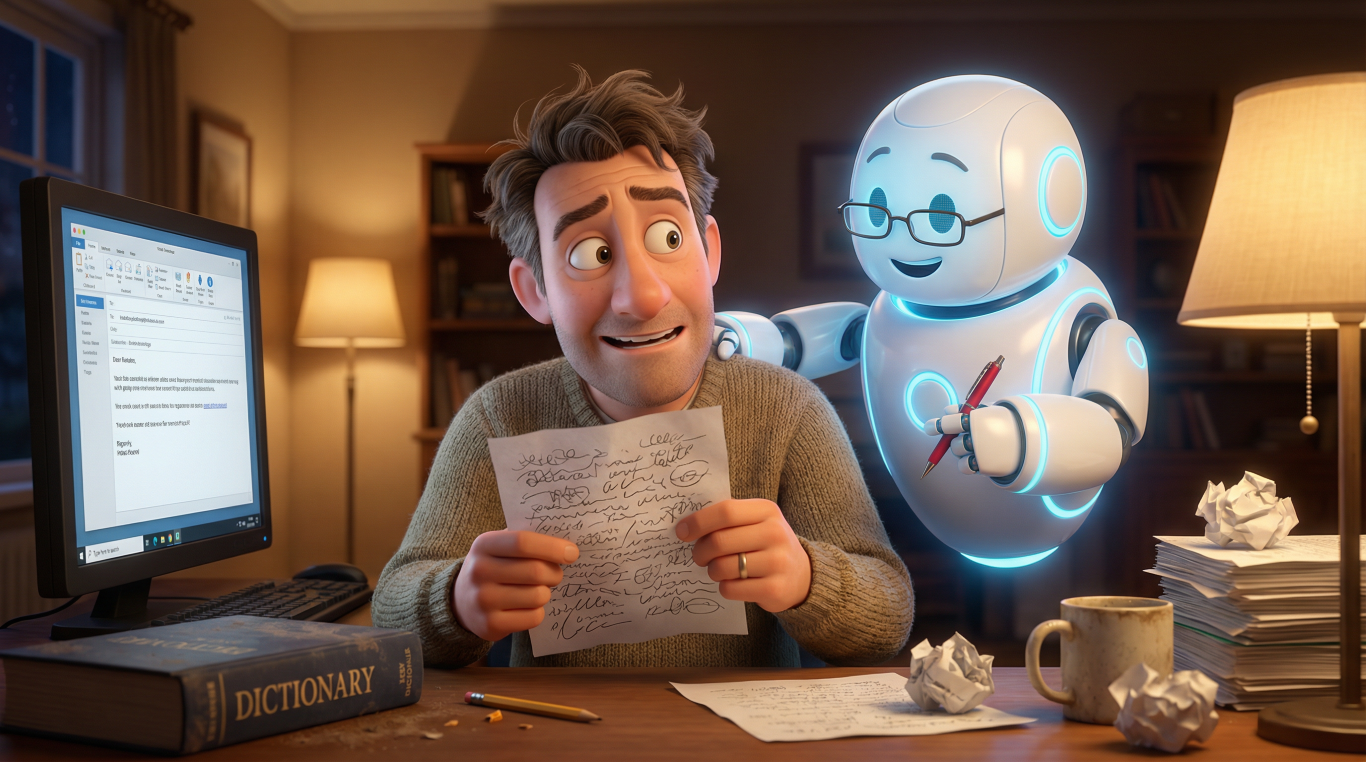
When I first heard about AI writing tools, I thought it was just another tech fad, like those fancy bread makers that promised to revolutionize breakfast but ended up gathering dust in the cupboard. But here’s the thing, I was spectacularly wrong. These tools have genuinely changed how we communicate, and I’m not being dramatic when I say they’re probably the most significant writing development since someone invented the delete key.
Why AI Writing Tools Matter (And Why You Should Care)
Remember when we thought spell-check was revolutionary? That little red squiggle that saved us from embarrassing typos? Well, AI writing tools are like spell-check’s incredibly talented grandchild who went to university, travelled the world, and came back speaking twelve languages.
Here’s why this matters to you, right now, today. We’re all writing more than ever before. Emails, texts, social media posts, work reports, letters to the council about that pothole that’s been there since 1987. The list goes on. And let’s face it, not all of us were English teachers. Some of us were engineers, nurses, accountants, or shop owners. We’re brilliant at what we do, but sometimes getting our thoughts onto paper (or screen) in a way that makes sense? That’s the hard bit.
AI content writing tools step in as your personal writing assistant, one that never gets tired, never judges you for starting a sentence with “and,” and is available at three in the morning when you’re trying to finish that important email. They’re transforming how we communicate because they’re making good writing accessible to everyone, not just those who happened to excel in composition class.
What AI Writing Tools Actually Do (And What They Don’t)
Let me clear something up straight away. The best AI writing tools aren’t here to replace you. They’re not going to write the next great novel under your name, and they shouldn’t be churning out soulless corporate nonsense that sounds like it was written by a robot (even though, technically, it was).
What they’re brilliant for is helping you express yourself more clearly. They catch grammatical mistakes, sure, but they also suggest better ways to structure your sentences. They can help you find that word that’s sitting right on the tip of your tongue. They can adjust your tone, so your email doesn’t accidentally sound passive-aggressive when you meant to be friendly. They can even help you overcome that terrifying blank page syndrome by giving you a starting point.
I use them when I’m writing anything important. (like a blog on AI writing tools! 😉) I’ll run it through to make sure it sounds professional but warm. A tricky text message where tone really matters? Absolutely. A report that needs to be clear and concise? You bet.
What they’re not for is pretending to be you. They shouldn’t be writing your personal correspondence in a voice that isn’t yours. They shouldn’t be doing your grandchild’s homework (we both know that’s cheating). And they absolutely shouldn’t be creating content that misleads people into thinking a human with specific expertise wrote something when they didn’t.
The Old Days: What We Had Before
Cast your mind back to the tools we had before AI writing tools came along. We had spell-checkers, which were helpful but often spectacularly wrong (remember when they tried to correct proper nouns?). We had grammar checkers that were about as reliable as British weather forecasts.
If you wanted writing help, you had a few options. You could buy a style guide and try to decipher it (I still have my dusty copy of “The Elements of Style” somewhere). You could ask a colleague to proofread your work, which was lovely if they had time and weren’t busy with their own deadlines. You could hire a professional editor, which was expensive and not exactly practical for everyday emails.
Microsoft Word’s grammar checker was probably the most advanced thing we had, and bless it, it tried. But it was rigid, rule-based, and often missed the nuance of what you were actually trying to say. It was like having a very pedantic English teacher looking over your shoulder, one who understood the rules but not necessarily the art of communication.
The Thesaurus function was there too, but using it often led to what I call “thesaurus syndrome,” where people would replace perfectly good simple words with unnecessarily complex ones. Suddenly everyone was “utilizing” things instead of “using” them, and meetings became “congregations.” Not helpful.
The Evolution: From Simple Checkers to Smart Assistants
The journey of AI writing tools is actually quite fascinating, and it’s happened remarkably quickly.
The Early Days (2010-2015)
The first generation of what we might call AI writing tools started appearing around 2010. Grammarly launched in 2009, but it wasn’t until the early 2010s that it started incorporating more sophisticated algorithms. These tools were still primarily rule-based, meaning they followed preset grammar rules, but they were getting better at understanding context.
Think of these early versions like a very thorough proofreader. They’d catch your mistakes, but they wouldn’t really understand what you were trying to say. They were following a rulebook, not thinking about your actual message.
The Smart Generation (2015-2020)
Around 2015, things started getting interesting. Machine learning entered the picture properly. Instead of just following rules, these tools started learning from millions of examples of good writing. They began to understand patterns and context.
This is when tools started suggesting not just corrections but improvements. They could tell you that your sentence was technically correct but might be clearer if you restructured it. They understood that “their,” “there,” and “they’re” weren’t just different spellings but had different meanings based on context.
It’s like the difference between someone who’s memorized a recipe book and someone who actually understands cooking. The latter can adapt, improvise, and help you create something better.
The Revolutionary Era (2020-Present)
Then came the big leap. Around 2020 and especially from 2022 onwards, we entered what I call the “actually intelligent” era. Tools powered by large language models, the technology behind systems like GPT (Generative Pre-trained Transformer), changed everything.
These modern AI writing tools don’t just check your writing, they understand it. They grasp nuance, tone, context, and even cultural references. They can help you write in different styles, adjust for different audiences, and genuinely improve your communication.
The benefit over previous versions is night and day. Where older tools might flag a grammatically correct sentence, modern ones understand that technically correct doesn’t always mean effectively communicating. They’re less like a rulebook and more like a knowledgeable friend who happens to be excellent with words.
How These Clever Things Actually Work
Right, let me explain this without making your eyes glaze over. I promise to keep it simple.
At its heart, an AI writing tool is working with something called a language model. Imagine if you read millions of books, articles, websites, and conversations, and your brain started recognizing patterns in how people use language. You’d start to notice that certain words often appear together, that sentences have typical structures, and that good writing has particular qualities.
That’s essentially what these tools have done, except they’ve “read” far more than any human possibly could. They’ve been trained on vast amounts of text, learning the patterns of language.
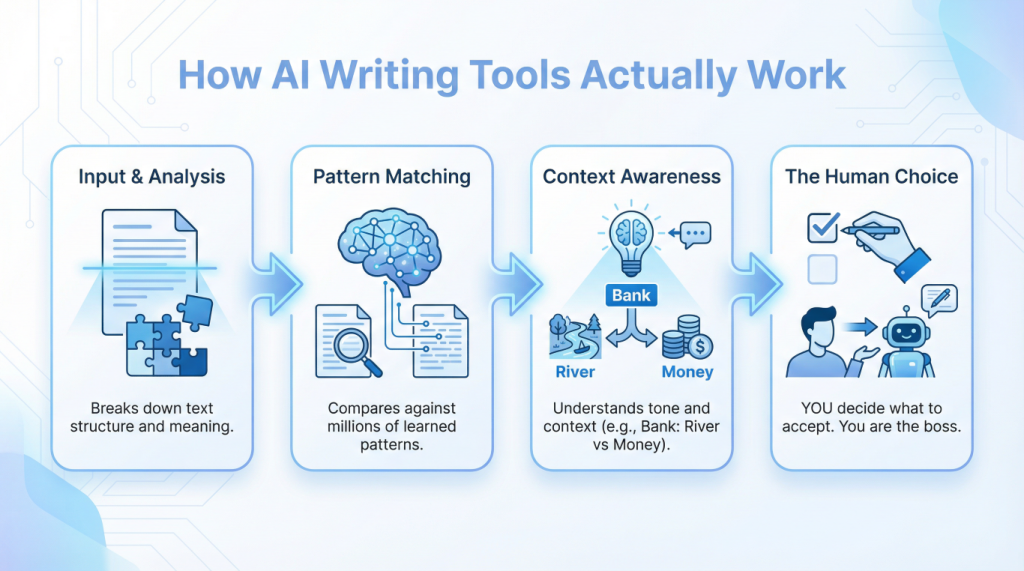
When you type something into an AI writing tool, here’s roughly what happens:
First, it breaks down what you’ve written into smaller pieces, analyzing the structure and meaning. It’s not just looking at individual words but understanding how they relate to each other and what you’re trying to communicate.
Then, it compares what you’ve written against all those patterns it’s learned. It’s asking itself questions: Is this clear? Is this grammatically correct? Does this tone match what the user seems to be going for? Could this be expressed more effectively?
Next, it generates suggestions based on what it’s learned from all that training. It might spot that you’ve used the same word five times in one paragraph and suggest alternatives. It might notice your sentence is a bit convoluted and propose a clearer structure.
The really clever bit is that modern tools understand context. They know that “bank” means something different if you’re talking about rivers versus money. They recognize that the tone appropriate for a formal business letter is different from a friendly email to a colleague.
Finally, they present you with suggestions, but, and this is crucial, you’re still in control. You decide what to accept, what to reject, and what to modify. The AI is the assistant, you’re still the boss.
What’s Coming Next: The Future of AI Writing Tools
I’ve been watching this space closely, and I reckon we’re only scratching the surface of what’s possible. The future of AI content writing tools looks both exciting and, I’ll admit, a bit daunting.
We’re moving towards tools that will understand you personally. Imagine an AI writing assistant that knows your writing style, your common phrases, your typical audience, and adapts its suggestions accordingly. It won’t just help you write clearly, it’ll help you write like you, just better.
Voice integration is coming on strong. Soon, you’ll be able to speak your thoughts naturally, and the AI will help structure them into coherent written communication. This is brilliant for those of us who think better out loud than staring at a blank screen.
Real-time collaboration is another frontier. Picture working on a document with colleagues, and the AI is helping everyone communicate more clearly, suggesting compromises in wording, and even helping translate between different professional jargons.
We’ll also see better emotional intelligence. Tools that can genuinely understand not just what you’re saying but how it might make the reader feel. They’ll help you navigate sensitive topics, adjust tone for difficult conversations, and communicate with genuine empathy.
The integration with other tools will deepen too. Your email client, your word processor, your messaging apps, all seamlessly connected with AI writing assistance that understands the context of each platform.
But here’s what I hope for most: that these tools become even more accessible and intuitive. Technology should serve everyone, not just the tech-savvy. The best AI writing tools of the future will be ones that anyone can use, regardless of their technical knowledge.
The Serious Bit: Security and Things to Watch Out For
AI writing tools are powerful, but like any powerful tool, they come with responsibilities and risks.
First, let’s talk about privacy. When you use an AI writing tool, you’re often sending your text to a server somewhere for processing. That means someone else’s computer is reading what you’ve written. For a casual email, that’s probably fine. For confidential business information, medical records, or anything truly sensitive? You need to be careful.
Always check the privacy policy of any AI writing tool you use. Look for whether they store your data, how long they keep it, and whether they use it to train their models. Some tools offer privacy modes or enterprise versions with better security. If you’re writing anything confidential, these matter.
There’s also the question of accuracy. AI writing tools are impressive, but they’re not infallible. They can make mistakes, sometimes confidently suggesting something that’s completely wrong. I’ve seen them misunderstand context, suggest factually incorrect information, or propose changes that alter your meaning.
Never blindly accept every suggestion. You’re the human, you have judgment and understanding that the AI doesn’t. Read through any AI-assisted writing carefully. Make sure it still sounds like you and says what you actually mean.
Then there’s the dependency risk. These tools are wonderful helpers, but we shouldn’t let our own writing skills atrophy. It’s like using a calculator, brilliant for complex maths, but you still need to understand basic arithmetic. Keep writing, keep thinking about language, keep developing your own communication skills.
Bias is another concern worth mentioning. AI tools are trained on existing text, which means they can inadvertently perpetuate biases present in that training data. They might default to certain assumptions about gender, culture, or perspective. Stay aware of this and don’t let the AI make decisions about sensitive topics without your careful consideration.
Lastly, there’s academic and professional integrity. Using AI writing tools to help clarify your own thoughts is one thing. Using them to generate content and passing it off entirely as your own work is another. Many institutions and employers are developing policies about this. Be transparent, be ethical, and when in doubt, ask.
Wrapping This Up
So here we are, at the end of our journey through the world of AI writing tools. I started this piece admitting I was skeptical, but I’ve become a genuine convert, not because these tools are perfect, but because they’re genuinely useful.
The best AI writing tools aren’t about replacing human communication, they’re about enhancing it. They’re about giving all of us, regardless of whether we’re naturally gifted writers, the ability to express ourselves clearly and effectively. In a world where so much of our communication happens through written words, that’s no small thing.
We’ve come a long way from simple spell-checkers to sophisticated AI assistants that understand context, tone, and nuance. The technology has evolved rapidly, and it’s only going to get better. But with that power comes responsibility. We need to use these tools wisely, understanding both their capabilities and their limitations.
I encourage you to try them. Start small, maybe with checking an important email or polishing a letter. See how they work for you. You might find, as I did, that having a tireless writing assistant makes communication less stressful and more effective.
The future of writing isn’t humans versus machines. It’s humans and machines working together, each bringing their strengths to create clearer, more effective communication. And honestly? I think that’s rather exciting.
Remember, these AI content writing tools are just that, tools. You’re still the craftsperson, the one with something to say. The AI just helps you say it better. And in a world that often feels like it’s shouting past itself, anything that helps us communicate more clearly is worth celebrating.
Now, if you’ll excuse me, I’ve got an email to write. And yes, I’ll probably run it through an AI writing tool first. No shame in that game.
Walter
Leave a Reply