


The $70 Million Domain That Just Went Live
If you watched the Super Bowl last night, you might’ve seen an ad for AI.com. And if you’re anything like me, you probably thought, “Right, another AI company with deep pockets buying expensive ad slots.” But here’s what’s actually interesting: this isn’t just another chatbot. AI.com is a brand new platform for autonomous AI agents that literally launched yesterday, and it might actually change how we use AI.
Let me explain what that means in actual English.
What AI.com Actually Is
AI.com is a consumer platform that lets you create your own personal AI agent—basically a digital assistant that can actually do things for you, not just answer questions. It was founded by Kris Marszalek, the same bloke who created Crypto.com, and he reportedly paid £70 million for the domain name. Yes, seventy million quid for a web address. That’s either mad or brilliant, depending on whether this thing takes off.
The platform launched on February 8, 2026, with that Super Bowl ad, and the pitch is simple: you can create a private AI agent in about 60 seconds, no coding required, and it’ll handle tasks across different apps and services on your behalf.
Here’s what makes it different from ChatGPT or other AI tools you might’ve used: these agents are supposed to be autonomous. You don’t just ask them questions and get text back. You give them tasks, and they actually execute them. Book a restaurant. Schedule meetings. Research products and make purchases. Send emails. That sort of thing.
What These “Autonomous Agents” Actually Do
The term “autonomous AI agent” sounds like marketing waffle, but there’s something real here. Traditional AI tools like ChatGPT are conversational—you ask, they answer. You’re in the driver’s seat the whole time.
AI.com’s agents are meant to work more independently. You set a goal, and the agent figures out the steps needed to achieve it, then actually takes those actions. The clever bit (according to their marketing, at least) is that these agents can supposedly build out missing features themselves if they encounter a task they can’t complete. They learn and adapt, and apparently share improvements across the platform so all agents get better over time.
Whether that actually works as advertised, we’ll have to see. But the concept is: less “chat with AI” and more “delegate to AI.”
The Purpose: AI That Does, Not Just Talks
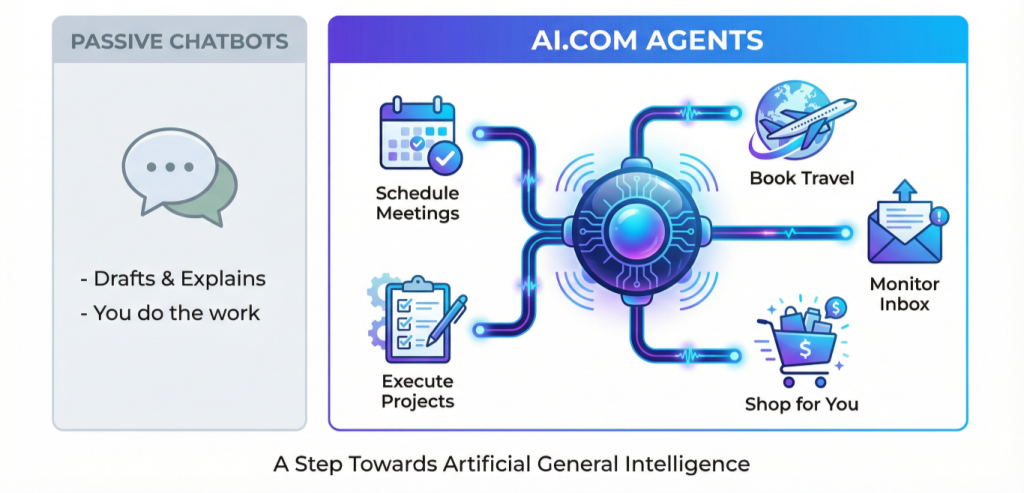
Look, we’ve all used AI chatbots. They’re helpful for drafting emails, brainstorming ideas, or explaining complicated topics. But they’re passive. You still have to do all the actual work yourself.
AI.com’s purpose is to move beyond that. The vision (and take this with a grain of salt because it’s early days) is to create AI that can handle your digital life. Think of it like having an assistant who can:
- Manage your calendar and schedule meetings across time zones
- Research flights, compare prices, and book travel
- Monitor your inbox and draft responses
- Shop for products based on your preferences
- Handle routine communication
- Organize and execute projects
The platform is positioning itself as a step towards AGI (Artificial General Intelligence)—AI that can handle a wide variety of tasks rather than being limited to one specific job. Bold claim, that, but it explains the £70 million domain purchase. If they pull this off, AI.com becomes the front door for how people interact with AI in daily life.
How to Sign Up and Get Started
Right, here’s the practical bit. Getting started with AI.com is apparently straightforward:
Step 1: Get Your Handle
Head to ai.com and claim your unique handle (think of it like a username). The Super Bowl ad literally said “Get Your Handle Now,” which suggests they’re treating these like valuable digital identities. First come, first served.
Step 2: Create Your Agent
Once you’re signed up, you can generate your personal AI agent. According to the platform, this takes about 60 seconds and doesn’t require any technical knowledge. You’ll set up what you want the agent to do and give it access to relevant apps and services.
Step 3: Set It Loose
Give your agent tasks and let it work. The interface is designed to be consumer-friendly—no programming required, just plain language instructions.
The platform operates through your ai.com profile, so everything’s centralized in one place. Early reports suggest it’s meant to be as simple as using any social media platform, just with AI doing work for you instead of you scrolling.
Should You Actually Care?
Here’s my honest take: maybe, but don’t rush in blindly.
Why it might matter:
If autonomous agents actually work as advertised, this could genuinely change how we handle digital tasks. Instead of spending hours comparing flight prices or managing your schedule, you delegate it. That’s valuable. The timing is also interesting—AI.com is launching right as AI agents are becoming technically feasible, not just theoretical.
Why you should be cautious:
This is day one. The platform literally launched yesterday. We don’t know yet if these agents will work reliably, whether they’ll make expensive mistakes, or how well they’ll handle complex tasks. There are also privacy questions. You’re giving an AI agent access to your apps, emails, and personal information. Where does that data go? How secure is it?
And let’s be real: the crypto connection (Kris Marszalek founded Crypto.com) might make some people wary, especially given how that industry can be… let’s say “unpredictable.”
The Risks You Should Know About
Privacy and Security:
An autonomous agent needs access to your accounts to do anything useful. That means you’re trusting AI.com with sensitive information. Before you sign up, understand their data policies. What do they store? Who has access? How secure are their systems?
Agent Mistakes:
What happens when your agent books the wrong flight or sends an email you didn’t want sent? Autonomous systems can make errors, sometimes expensive ones. Start small, with low-stakes tasks, until you trust how it works.
Cost:
The platform’s pricing isn’t entirely clear yet. Will there be subscription fees? Transaction costs? Figure out what you’re paying for before you commit.
Over-reliance:
There’s a risk of becoming dependent on AI for decisions you should probably make yourself. Delegating your calendar is one thing. Letting AI make financial decisions without oversight is another.
The Bottom Line
AI.com is attempting something genuinely new: making AI agents accessible to regular people, not just tech enthusiasts or businesses. Whether it succeeds depends on execution, reliability, and trust.
Should you sign up? If you’re curious about where AI is heading and don’t mind being an early adopter, sure, claim your handle and experiment. But do it with your eyes open. This is emerging technology from a brand-new platform. Expect rough edges. Start with simple tasks. Don’t give it access to anything you can’t afford to have compromised.
The £70 million domain purchase tells you Marszalek is serious about making AI.com the destination for consumer AI. But premium domains don’t guarantee success—remember Pets.com?
Time will tell whether AI.com becomes essential or just another overhyped launch. For now, it’s worth watching, and if you’re feeling adventurous, worth trying. Just don’t bet your life on it quite yet.
Walter
Sources:
- ai.com company announcements and Super Bowl LX launch details
- Financial Times reporting on domain purchase price
- Multiple tech news outlets covering the platform launch (Forbes, CoinDesk, Business Today)
- AI.com official platform descriptions
Note: This platform is less than 24 hours old as of publication. Details may evolve rapidly. Verify current features and pricing directly at ai.com before signing up.
Leave a Reply