
Why This Matters More Than You Might Think
When I first heard about virtual reality therapy being used in dementia care, I thought someone was having me on. VR headsets? For elderly people with memory problems? It sounded like someone had confused their gran’s care home with a gaming convention.
But here’s the thing. I was completely wrong.
What’s happening right now in nursing homes across the UK is nothing short of remarkable. We’re watching technology that was designed for gaming teenagers transform the lives of people living with dementia. And I mean genuinely transform, not in that overblown marketing speak way, but in real, measurable, tears-in-your-eyes kind of ways.
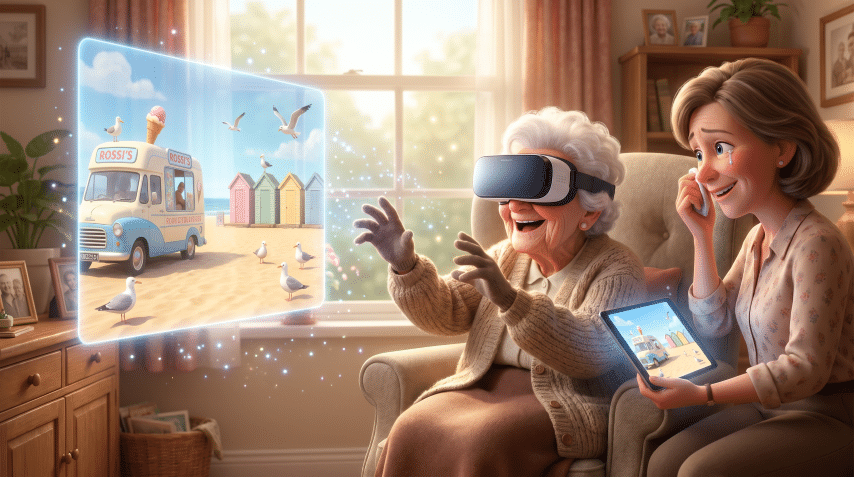
The technology we’re talking about, VR Memory Tourism, lets people with dementia revisit places from their past. Their childhood home. The beach where they spent summer holidays. The street where they grew up. And it’s not just looking at old photographs, it’s stepping back into those spaces, turning around, hearing the sounds, feeling like you’re actually there again.
For someone whose memory is slipping away like sand through fingers, this is profound. It’s giving them back moments they thought were lost forever. And for their families watching it happen? Well, let’s just say there aren’t many dry eyes in the room.
What VR Dementia Technology Is Actually Used For (And What It Isn’t)
Let me clear something up straight away. VR Memory Tourism in dementia care isn’t trying to cure anything. I wish it were that simple, I really do. Dementia remains a progressive condition, and no amount of virtual reality is going to reverse that process.
What it does do, and does brilliantly, is improve quality of life. It reduces anxiety and agitation, two massive challenges in dementia care. It helps people reconnect with their memories, which in turn helps them reconnect with their sense of self. When you’ve forgotten who you are, being reminded through familiar places can be like finding your way home in the dark.
The technology is used for reminiscence therapy, which is exactly what it sounds like. Care staff use these virtual environments to help residents recall memories, tell stories, and engage with the world around them. A person who hasn’t spoken much in weeks might suddenly light up when they’re virtually standing in their old neighbourhood. They’ll start talking about the corner shop, the neighbours, the tree they used to climb as a child.
It’s also used for calming what professionals call “responsive behaviours”, which is a kind way of describing the distress and confusion that can lead to aggression or wandering. Instead of medication, which often just sedates people into zombies, a ten-minute virtual visit to a peaceful garden or a familiar seaside can bring genuine calm.
What it’s not used for is entertainment in the traditional sense. This isn’t about sticking a headset on someone and leaving them to it. It requires trained staff, careful selection of environments, and constant monitoring. It’s not used for people in the very late stages of dementia who might find the technology itself distressing. And it’s definitely not a replacement for human interaction and proper care, it’s an enhancement of it.
What We Had Before Virtual Reality Therapy
Before VR came along, reminiscence therapy was still a thing, but it looked very different. Picture this: care staff sitting with residents, flipping through photo albums, maybe playing old music, showing objects from the past. A ration book. An old telephone. Things that might trigger memories.
It worked, to a degree. Music therapy in particular has always been brilliant for people with dementia. There’s something about songs from your youth that stays locked in your brain long after you’ve forgotten your children’s names. Heartbreaking but true.
Some care homes created reminiscence rooms, decorated like a 1950s living room or a wartime kitchen. Residents could sit in these spaces and hopefully feel that spark of recognition. Better than nothing, certainly, but limited. You can’t recreate every resident’s specific memories in physical rooms.
The problem with all these approaches was that they were static and generic. A photograph is just a photograph. It doesn’t move. It doesn’t surround you. It doesn’t let you look left and see the garden, look right and see the street. It’s a window, not a door.
How We Got Here: The Evolution of VR in Dementia Care
The journey from gaming headsets to dementia care tools is more interesting than you might think. Let me walk you through it without drowning you in technical jargon.
The Early Days: 2016-2018
The first attempts at using VR for dementia care were, let’s be kind and say, experimental. Someone had the bright idea that if VR could transport gamers to fantasy worlds, maybe it could transport elderly people to real places. The problem was that the headsets were heavy, clunky things that looked like you’d strapped a brick to your face. Not ideal for frail elderly people.
The content wasn’t much better. Generic 360-degree videos of beaches and forests. Nice enough, but not personal. Still, even these early attempts showed promise. People responded positively. The technology just needed to catch up with the ambition.
The Middle Period: 2019-2022
This is when things got properly interesting. The headsets became lighter, more comfortable. Companies started developing content specifically for older users, nothing too fast-moving or disorienting. The focus shifted from “wow, look at this technology” to “what do these specific people need?”
Some clever folks started creating location-specific content. Virtual tours of local areas as they looked in the 1950s and 60s. Now we were talking. A resident could virtually walk down their old street, see the shops as they remembered them, hear the sounds of that era.
The research started coming in too, and it was positive. Studies showed reduced agitation, improved mood, better engagement with staff and family. The evidence was building that this wasn’t just a gimmick.
The Current State: 2023-2026
Right now, in 2026, we’re in what I’d call the personalization era. The technology has matured beautifully. Modern VR headsets designed for dementia care are lightweight, comfortable, and simple to use. They don’t require the person wearing them to do anything complicated, no controllers to figure out, no buttons to press.
But here’s where it gets really special. The best systems now allow families to upload their own photographs and videos, which are then transformed into immersive environments. Your mum’s actual childhood home, recreated from family photos. The garden where your dad spent hours tending his roses. These aren’t generic locations anymore, they’re deeply personal memory spaces.
The software has gotten smarter too. It can adapt to how someone responds. If a person seems distressed, the experience can be adjusted or stopped. If they’re engaged and happy, it can continue and even prompt gentle questions to encourage reminiscence.
Some systems now include what they call “companion viewing”, where family members or care staff can see what the resident is seeing on a tablet. This means they can share the experience, ask questions, and help guide the memories. It transforms a solitary activity into a social one, which is crucial.
How VR Memory Tourism Actually Works: A Step by Step Journey
Let me walk you through what actually happens when someone uses VR Memory Tourism. I’ll explain it as if I’m describing it to my own mum, because that’s basically what I’m doing.
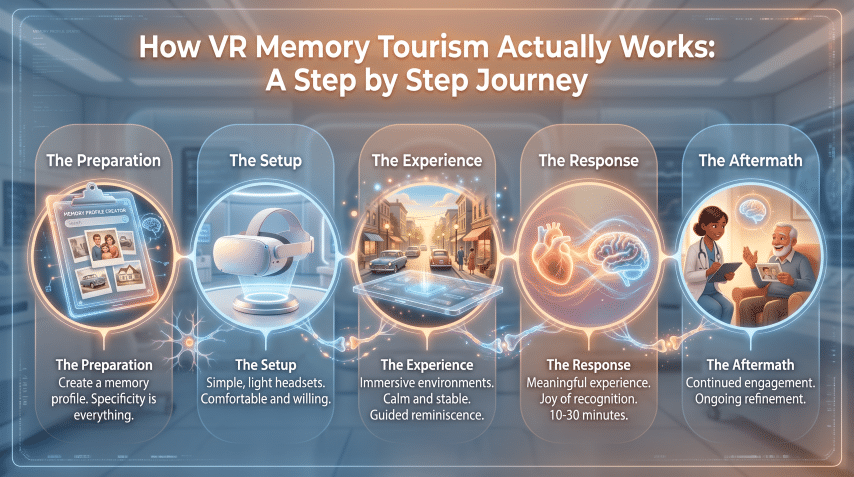
Step One: The Preparation
Before anyone puts on a headset, there’s groundwork to do. Care staff, often with family input, create what’s called a “memory profile”. This is basically a list of significant places and times in the person’s life. Where did they grow up? Where did they go on holiday? What was their favourite place? What period of their life do they remember most clearly?
This matters because showing someone with dementia a random beach is nice, but showing them Blackpool beach in 1965 where they spent their honeymoon is transformative. Specificity is everything.
Step Two: The Setup
The actual headset is surprisingly simple. Modern ones designed for dementia care look more like comfortable goggles than the sci-fi contraptions you might imagine. They’re light, they fit over glasses if needed, and they’re padded for comfort.
A care worker helps the person put it on, talking them through everything. There’s no rush. Some people take to it immediately, others need time and reassurance. The key is that the person is comfortable and willing. Nobody’s forced into anything.
Step Three: The Experience
Once the headset is on and the experience starts, the person finds themselves somewhere else. They might be standing in a street from their childhood. They can look around naturally, just by turning their head. Look up, see the sky. Look down, see the pavement. Look left, see the houses. It’s immersive in a way that photographs simply cannot be.
The environments are designed to be calm and stable. Nothing jumps out at you. Nothing moves too quickly. Often there’s appropriate sound, birdsong in a garden, the sound of waves at the seaside, traffic from the 1960s. These audio cues are powerful memory triggers.
A care worker or family member sits with them throughout, watching what they’re seeing on a screen. They might say, “Can you see the shop on the corner? Do you remember what it sold?” This guided reminiscence is where the real magic happens. The VR is the catalyst, but the human connection is what matters.
Step Four: The Response
What happens next varies enormously. Some people become animated, talking about memories they haven’t accessed in years. Others sit quietly, just experiencing the moment. Some cry, not always from sadness, sometimes from the joy of recognition. “I remember this,” they might say. “I was here.”
Sessions typically last between ten and thirty minutes. Any longer and it can become tiring or overwhelming. The goal isn’t to exhaust someone, it’s to give them a meaningful experience.
Step Five: The Aftermath
After the headset comes off, there’s often a period of continued engagement. The person might want to talk more about what they saw. Family members might hear stories they’ve never heard before. This extended reminiscence is often just as valuable as the VR experience itself.
Care staff document the experience, noting what worked well, what didn’t, and what might be tried next time. It’s an ongoing process of refinement and personalization.
What the Future Holds for VR Dementia Care
I’m going to try not to get too carried away here, but the future looks genuinely exciting. Based on what’s in development right now, here’s what’s coming.
Artificial intelligence is being integrated to create even more responsive experiences. The system will be able to read subtle cues, facial expressions, voice tone, even heart rate, and adjust the experience in real-time. If someone’s becoming distressed, it might gently transition to a calmer environment. If they’re engaged and happy, it might introduce new elements to explore.
We’re also moving towards what’s called “social VR” for dementia care. Imagine multiple residents, each in their own headset, experiencing the same virtual environment together. They could “meet” in a virtual 1950s tea room and have a conversation. For people who struggle with the busy, confusing environment of a real communal space, this filtered, controlled social interaction could be wonderful.
The personalization will get even deeper. As more families contribute photos and videos, AI will be able to create increasingly detailed and accurate recreations of personal spaces. We’re not far from being able to recreate someone’s entire childhood neighbourhood from a handful of old photographs.
There’s also work being done on integrating other senses. Smell is a powerful memory trigger, even more so than vision for some people. Imagine experiencing a virtual garden while subtle scents of roses or cut grass are released. It sounds like science fiction, but the technology exists, it’s just a matter of making it practical and affordable for care homes.
Confidence: Medium – Multi-sensory VR including scent delivery is in research phase. Some commercial products exist but not yet widely adopted in dementia care. Source: Academic research papers on multi-sensory VR therapy.
The Important Bits About Security and Safety
Now, I need to talk about something less fun but absolutely crucial. With any technology involving vulnerable people, we need to think about safety and security.
Physical Safety
The most obvious concern is physical. Someone wearing a VR headset can’t see the real world around them. This means constant supervision is essential. You cannot, and I cannot stress this enough, stick a headset on someone and wander off to make a cup of tea. They could try to stand up, they could reach for something that isn’t really there, they could become disoriented when the headset comes off.
Proper dementia care VR programmes require trained staff who understand both the technology and the specific needs of people with cognitive impairment. Corners cannot be cut here.
Psychological Considerations
VR is powerful, which means it can be powerfully upsetting if not used carefully. The wrong memory or the wrong environment could trigger distress rather than comfort. This is why the memory profiling is so important, and why family input is invaluable. They know what memories are happy and which ones might be painful.
There’s also the risk of confusion. Some people with dementia might struggle to understand that what they’re seeing isn’t real, or they might become upset when the experience ends and they “leave” the place they’ve been visiting. Skilled care staff need to manage these transitions carefully.
Data Privacy
Here’s something that might not immediately occur to you. These systems collect data. They record what environments people visit, how long they stay, how they respond. If families are uploading personal photographs and videos, that’s sensitive family history being stored digitally.
Care homes using VR Memory Tourism need robust data protection policies. Who has access to this information? How is it stored? What happens to it if the person passes away? These aren’t theoretical concerns, they’re practical questions that need clear answers.
Any reputable system should comply with UK data protection regulations, which are quite strict, especially regarding vulnerable people. Families have the right to ask these questions, and care homes have the obligation to answer them clearly.
The Risk of Over-Reliance
There’s a more subtle risk too. VR therapy is brilliant, but it’s not a substitute for human care and attention. There’s a danger that cash-strapped care homes might see it as a way to keep residents occupied with fewer staff. That would be a disaster.
The technology should enhance care, not replace it. It’s a tool, not a solution. The human connection, the hand holding, the real conversations, these remain irreplaceable. VR works best when it facilitates human interaction, not when it replaces it.
Bringing It All Together
So here we are. Virtual reality therapy, something that sounds like it belongs in a sci-fi film, is genuinely revolutionizing dementia care in nursing homes across the UK. And I don’t use that word lightly, I’m usually quite cynical about technology hype.
But this is different. This is technology being used thoughtfully and compassionately to address a real human need. People with dementia are losing their memories, their sense of self, their connection to their own history. VR Memory Tourism gives them, even briefly, a way back.
I think about my own parents getting older, and I hope that if they ever need this kind of care, these tools will be available to them. I hope that instead of sitting in a chair staring at nothing, they might be able to virtually visit the places that mattered to them. I hope they’ll be able to share those memories with me while they still can.
The technology has come so far in just a few years. From clunky headsets and generic content to personalized, responsive, deeply meaningful experiences. And it’s only going to get better. The future developments I mentioned aren’t decades away, they’re happening now, being tested and refined.
But, and this is crucial, the technology is only as good as the care wrapped around it. VR dementia programmes need proper funding, trained staff, family involvement, and robust safety protocols. They need to be part of a holistic approach to dementia care, not a flashy add-on or a cost-cutting measure.
When it’s done right, though, the results speak for themselves. People who haven’t engaged in weeks suddenly telling stories. Families connecting with loved ones they thought they’d lost. Moments of clarity and joy in what can be a very dark journey.
That’s not hype. That’s not marketing nonsense. That’s real people’s lives being genuinely improved by thoughtful application of technology.
And honestly? In a world where technology often seems to be making things worse, creating more anxiety and disconnection, it’s rather lovely to see it doing something unambiguously good.
If you have a loved one in a care home, it’s worth asking whether they offer VR therapy. If they don’t, it’s worth asking why not. If they do, it’s worth asking how it’s implemented, who’s trained to use it, and how families can be involved.
Because this matters. Memory matters. Identity matters. And anything that helps preserve those things, even for a moment, even partially, is worth paying attention to.
The revolution is quiet, happening in care homes rather than headlines. But it’s real, it’s happening now, and it’s making a difference.
And that, frankly, is bloody marvelous.
Walter
Leave a Reply