
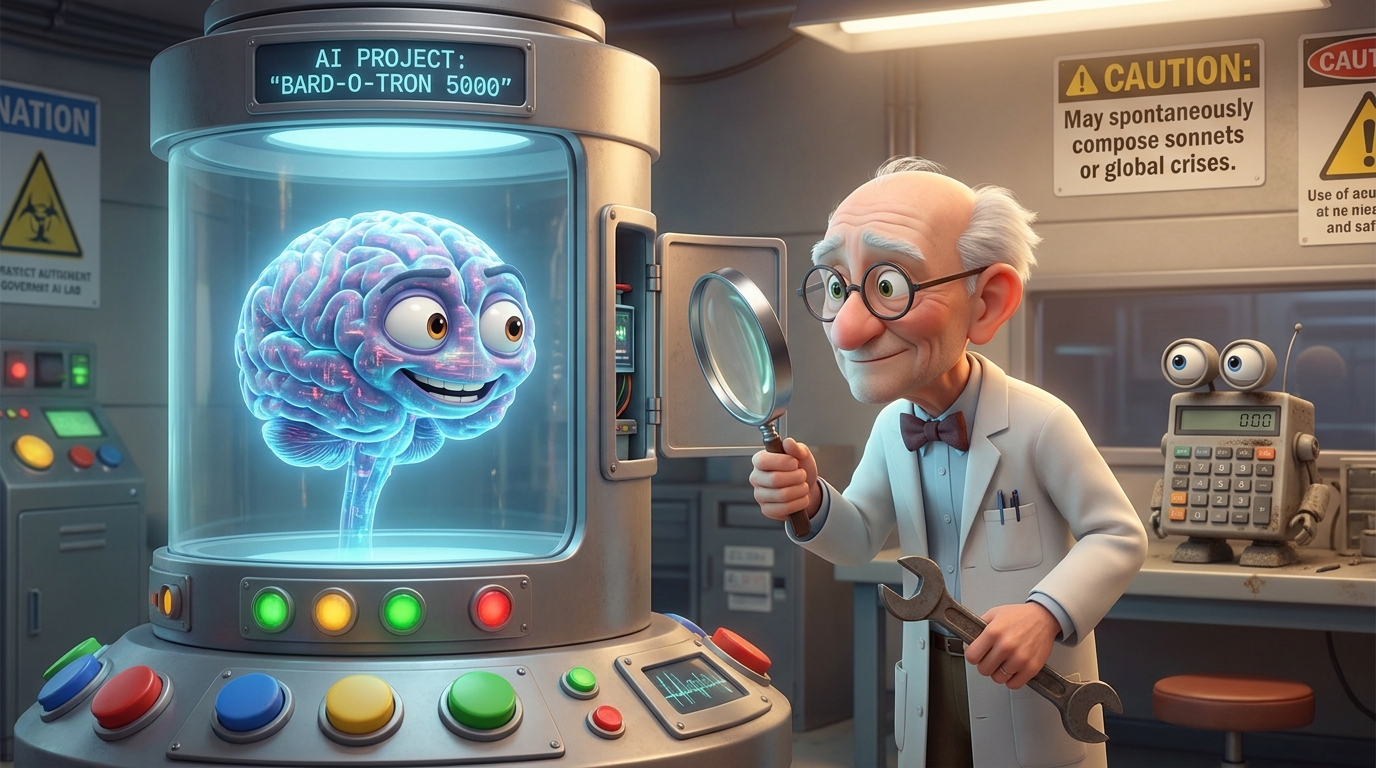
When I first heard that governments were locking AI systems away in secure facilities before letting them loose on the public, my initial thought was, “Brilliant, another thing for conspiracy theorists to obsess over.” But here’s the thing: this isn’t some dystopian science fiction plot. It’s actually rather sensible, like test-driving a car before you hand the keys to your teenager. Except in this case, the car can write poetry, solve complex mathematical equations, and potentially influence millions of people simultaneously.
Why This Matters More Than You Think
Let me paint you a picture. Imagine if pharmaceutical companies could release new medications without any testing whatsoever. No clinical trials, no safety checks, just straight from the laboratory to your medicine cabinet. Terrifying, right? Well, that’s essentially what we’d be doing with advanced AI systems if governments weren’t stepping in to conduct proper AI safety testing.
These AI systems aren’t your grandmother’s calculator. We’re talking about technology that can generate convincing fake videos, write computer code, analyze medical images, and even engage in conversations so realistic you’d swear you were chatting with a human. The potential for both tremendous good and spectacular disaster is enormous, and that’s precisely why government AI regulation has become such a hot topic.
The stakes are genuinely high. We’re not just worried about AI making embarrassing mistakes or giving you dodgy recipe suggestions. We’re concerned about systems that could be manipulated to spread disinformation, create sophisticated scams, design dangerous materials, or even interfere with critical infrastructure. It’s the digital equivalent of letting someone test drive a Formula One car in a controlled environment before they take it on the motorway during rush hour.
What Government AI Security Testing Is Actually Used For
Right, let’s get specific about what happens in these secure testing environments, because I promise you it’s more interesting than watching paint dry.
First and foremost, these facilities test whether AI systems can be tricked into doing things they shouldn’t. Think of it like hiring ethical hackers, the ones who break into systems to show you where the weaknesses are before the bad guys find them. Researchers try to manipulate AI systems into generating harmful content, bypassing safety restrictions, or revealing sensitive information they’ve been trained on. It’s basically a professional game of “can you make the AI misbehave,” and trust me, they’re remarkably good at it.
They’re also testing for what I call the “oops, didn’t see that coming” scenarios. AI systems can behave unpredictably when faced with unusual situations. Imagine teaching someone to drive only in perfect weather conditions, then watching them panic the first time they encounter fog. Government AI security testing helps identify these blind spots before millions of people are relying on the technology.
Another crucial use is evaluating whether these systems could be weaponized. I know that sounds dramatic, but it’s a legitimate concern. Could someone use an advanced AI to design biological weapons? Could it be manipulated to create sophisticated phishing attacks? Could it help coordinate cyberattacks? These aren’t hypothetical questions anymore, they’re scenarios that need proper evaluation.
What It’s Not Used For, and Why That Matters
Now, before your imagination runs wild, let me tell you what these secure testing environments aren’t doing. They’re not censoring AI to align with political ideologies, despite what you might read in certain corners of the internet. The goal isn’t to create AI systems that only say government-approved things. That would be both impractical and rather sinister.
These facilities also aren’t trying to slow down innovation for the sake of it. I’ve heard people grumble that government AI regulation is just bureaucrats trying to feel important. That’s not it. The aim is to identify genuine risks before they materialize, not to wrap everything in red tape until it suffocates. Think of it like building regulations. Yes, they slow down construction a bit, but they also prevent buildings from collapsing on people’s heads.
They’re also not testing every single AI application under the sun. Your phone’s autocorrect isn’t going through government security screening. We’re talking about the most advanced, most capable systems, the ones that represent significant leaps in AI capability. It’s proportionate risk assessment, not blanket paranoia.
What We Had Before All This
Cast your mind back, if you will, to the simpler times of the early 2010s. AI existed, certainly, but it was rather specialized and, frankly, a bit rubbish at anything outside its narrow lane. You had AI that could beat humans at chess, but couldn’t tell you what was in a photograph. You had systems that could recognize speech, but couldn’t understand context or nuance.
Back then, AI safety was mostly an academic concern. A few researchers, often dismissed as worriers, wrote papers about potential future risks. Meanwhile, companies developed AI systems with minimal oversight. If something went wrong, it was usually contained and fixable. An AI recommendation system might suggest inappropriate products, or a chatbot might say something offensive, but the scope of potential harm was relatively limited.
The regulatory landscape was practically non-existent. There were general data protection laws and consumer protection regulations, but nothing specifically addressing AI capabilities. It was a bit like the early days of the automobile, when there were no driving tests, no speed limits, and no real understanding of the risks involved.
The Evolution of AI Safety Testing
The story of how we got to today’s AI safety testing regime is actually quite fascinating, and it happened faster than you might think.
The Wake-Up Call Period (2020-2022)
Around 2020, something shifted. AI systems started getting noticeably more capable, and not always in comfortable ways. GPT-3, released in 2020, could write convincingly human-like text. This was both impressive and slightly unnerving. Suddenly, people realized that AI could be used to generate misinformation at scale, create convincing phishing emails, or impersonate real people.
The initial response was somewhat chaotic. Companies implemented their own safety measures, which varied wildly in effectiveness. Some were quite good, others were essentially security theatre. It was like everyone building their own seatbelts without any standard for what actually worked.
The Framework Years (2022-2024)
Then came the scramble to create proper frameworks. The EU started working on the AI Act, the UK established its AI Safety Institute, and the US issued executive orders on AI safety. These weren’t just bureaucratic exercises, they represented a genuine attempt to get ahead of the technology curve for once.
During this period, the concept of pre-deployment testing in secure environments really took shape. The UK’s AI Safety Institute, established in late 2023, became a pioneer in this approach. The idea was straightforward: before a company releases a significantly advanced AI system, independent experts get to test it thoroughly in a controlled environment.
The benefit over the previous free-for-all was obvious. Instead of discovering problems after millions of people were already using a system, we could identify issues beforehand. It’s the difference between recalling cars after accidents happen versus catching design flaws during safety testing.
The Current Era (2024-2026)
Where we are now is considerably more sophisticated. Multiple countries have established AI safety testing facilities. These aren’t just government bureaucrats with clipboards, they’re staffed by some of the world’s leading AI researchers, security experts, and ethicists.
The current approach involves what’s called “red teaming,” where experts actively try to break the AI system or make it behave dangerously. It’s complemented by technical evaluations of the system’s capabilities, assessments of potential misuse scenarios, and analysis of the training data and methods used.
Companies developing advanced AI systems now expect this scrutiny. It’s become part of the development process, much like clinical trials are for pharmaceuticals. The major AI labs, OpenAI, Google DeepMind, Anthropic, and others, regularly submit their systems for evaluation.
The benefit over earlier approaches is the standardization and expertise. We’re not relying on companies marking their own homework anymore. Independent evaluation provides a level of assurance that simply wasn’t possible before.
How AI Safety Testing Actually Works
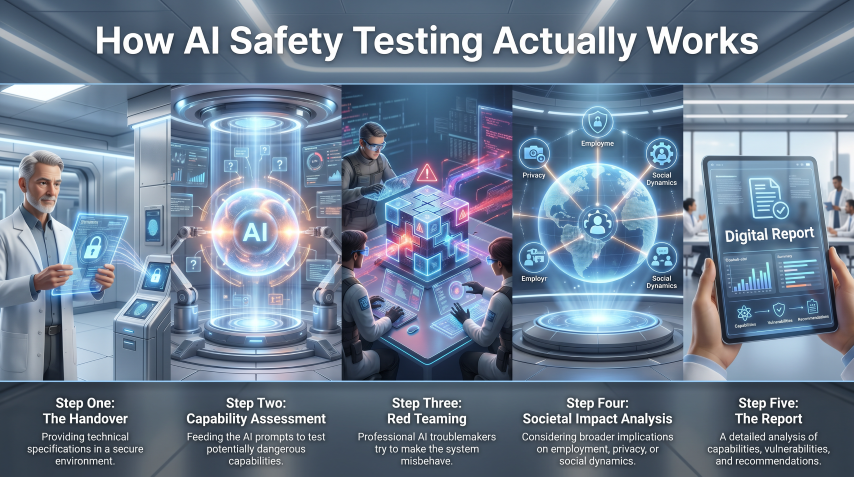
Let me walk you through what actually happens when an AI system enters one of these secure testing facilities. I promise to keep this as jargon-free as possible.
Step One: The Handover
First, the company developing the AI system provides access to the model in a secure environment. They don’t just hand over the keys and walk away, they provide documentation about how the system was built, what data it was trained on, and what safety measures they’ve already implemented. Think of it like a car manufacturer providing technical specifications when submitting a vehicle for safety testing.
Step Two: Capability Assessment
Next, researchers test what the system can actually do. This isn’t about whether it can write a nice poem or answer trivia questions. They’re looking at potentially dangerous capabilities. Can it provide detailed instructions for creating harmful materials? Can it write sophisticated malware? Can it convincingly impersonate specific individuals? Can it manipulate people through psychological techniques?
This phase involves feeding the AI thousands of carefully designed prompts and analyzing the responses. It’s painstaking work, rather like a security audit but for an entity that can generate novel responses to almost anything you ask it.
Step Three: Red Teaming
This is where things get interesting. Red team experts, essentially professional AI troublemakers, try every trick in the book to make the system misbehave. They use techniques like “jailbreaking” (finding ways around safety restrictions), prompt injection (sneaking instructions into seemingly innocent queries), and adversarial attacks (exploiting weaknesses in how the AI processes information).
I rather enjoy this phase conceptually. It’s like watching ethical hackers at work, except instead of breaking into computer systems, they’re trying to convince an AI to ignore its safety training. Some of the techniques are remarkably clever, using wordplay, context manipulation, or multi-step approaches that gradually lead the AI astray.
Step Four: Societal Impact Analysis
Beyond technical testing, evaluators consider broader implications. How might this system be misused? What are the potential impacts on employment, privacy, or social dynamics? Could it amplify existing biases or create new forms of discrimination? This is less about breaking the system and more about understanding its role in the wider world.
Step Five: The Report
Finally, all findings are compiled into a comprehensive evaluation. This isn’t a simple pass or fail. It’s a detailed analysis of capabilities, vulnerabilities, and recommendations. The company receives this feedback and typically needs to address significant concerns before commercial deployment.
The entire process can take weeks or even months, depending on the system’s complexity. It’s thorough, and deliberately so.
The Future of AI Safety Testing
Looking ahead, and I’m gazing into a crystal ball that’s admittedly a bit foggy, AI safety testing is likely to become both more sophisticated and more challenging.
We’re already seeing discussions about international cooperation on AI safety standards. Just as we have international aviation safety standards, we might develop global frameworks for AI evaluation. This makes sense, the internet doesn’t respect borders, and neither do AI systems. An AI system released in one country is accessible globally within minutes.
The testing methodologies themselves will need to evolve. As AI systems become more capable, the range of potential risks expands. We might need to test for capabilities we haven’t even imagined yet. It’s a bit like trying to write safety regulations for technologies that don’t exist yet, which is exactly as difficult as it sounds.
I expect we’ll see more automated testing tools, AI systems designed to evaluate other AI systems. Yes, I appreciate the irony. It’s AI all the way down. But given the complexity and scale of modern AI systems, human evaluation alone won’t be sufficient. We’ll need computational tools to help identify potential issues.
There’s also growing discussion about continuous monitoring rather than just pre-deployment testing. AI systems can behave differently once they’re interacting with millions of real users compared to controlled testing environments. We might see ongoing evaluation requirements, similar to how aircraft are subject to regular safety inspections throughout their operational life.
The challenge, and it’s a significant one, is balancing thorough safety evaluation with innovation speed. Make the process too cumbersome, and you might drive development underground or to jurisdictions with lax oversight. Make it too lenient, and you risk missing critical safety issues. Getting this balance right will be one of the defining challenges of the next few years.
Bringing It All Together
So here we are, at the end of our journey through the world of classified AI testing. Let me bring this all together for you.
Governments testing advanced AI systems in secure environments before commercial deployment isn’t about control or stifling innovation. It’s about responsible development of genuinely powerful technology. These AI systems can do remarkable things, but they also have the potential to cause significant harm if deployed without proper evaluation.
The evolution from the Wild West days of early AI development to today’s structured AI safety testing regime happened remarkably quickly, driven by the rapid advancement of AI capabilities. What we have now, independent evaluation by expert teams using sophisticated testing methodologies, is imperfect but substantially better than what came before.
The process works through a combination of technical testing, adversarial red teaming, and broader impact analysis. It’s not foolproof, but it’s designed to catch major issues before they affect millions of users. As AI systems become more capable, these testing regimes will need to evolve as well.
Looking forward, we’re likely to see more international cooperation, more sophisticated testing methods, and possibly continuous monitoring alongside pre-deployment evaluation. The challenge will be maintaining thorough safety standards while allowing beneficial innovation to proceed.
For you personally, this matters because AI systems are increasingly part of daily life. The security testing happening behind closed doors is attempting to ensure that these systems are as safe and reliable as possible. But you still need to maintain awareness and skepticism, no amount of testing eliminates all risks.
I started this piece with a comparison to test-driving a car, and I’ll end with it too. We wouldn’t accept cars on the road without safety testing, even though it slows down how quickly new models reach the market. The same principle applies to advanced AI systems. A bit of caution and proper evaluation now could prevent significant problems later.
The classified AI testing happening in secure government facilities represents our collective attempt to get ahead of technology for once, to anticipate problems rather than simply react to disasters. It’s not perfect, it’s not complete, and it’s certainly not the final word on AI safety. But it’s a start, and frankly, a necessary one.
As these AI systems become more integrated into healthcare, education, finance, and governance, the importance of thorough evaluation only increases. The work happening in these secure facilities, away from public view but with public benefit in mind, is some of the most important technology policy work of our time.
So the next time you hear about government AI regulation or AI security testing, don’t roll your eyes and assume it’s just bureaucratic nonsense. It’s actually rather important work, carried out by dedicated experts, trying to ensure that the AI future we’re building is one we actually want to live in.
And honestly, given some of the alternatives, I’m rather glad someone’s checking under the hood before we all climb aboard.
Walter

Leave a Reply