
When Robots Stole the Show (And Everyone’s Hearts)
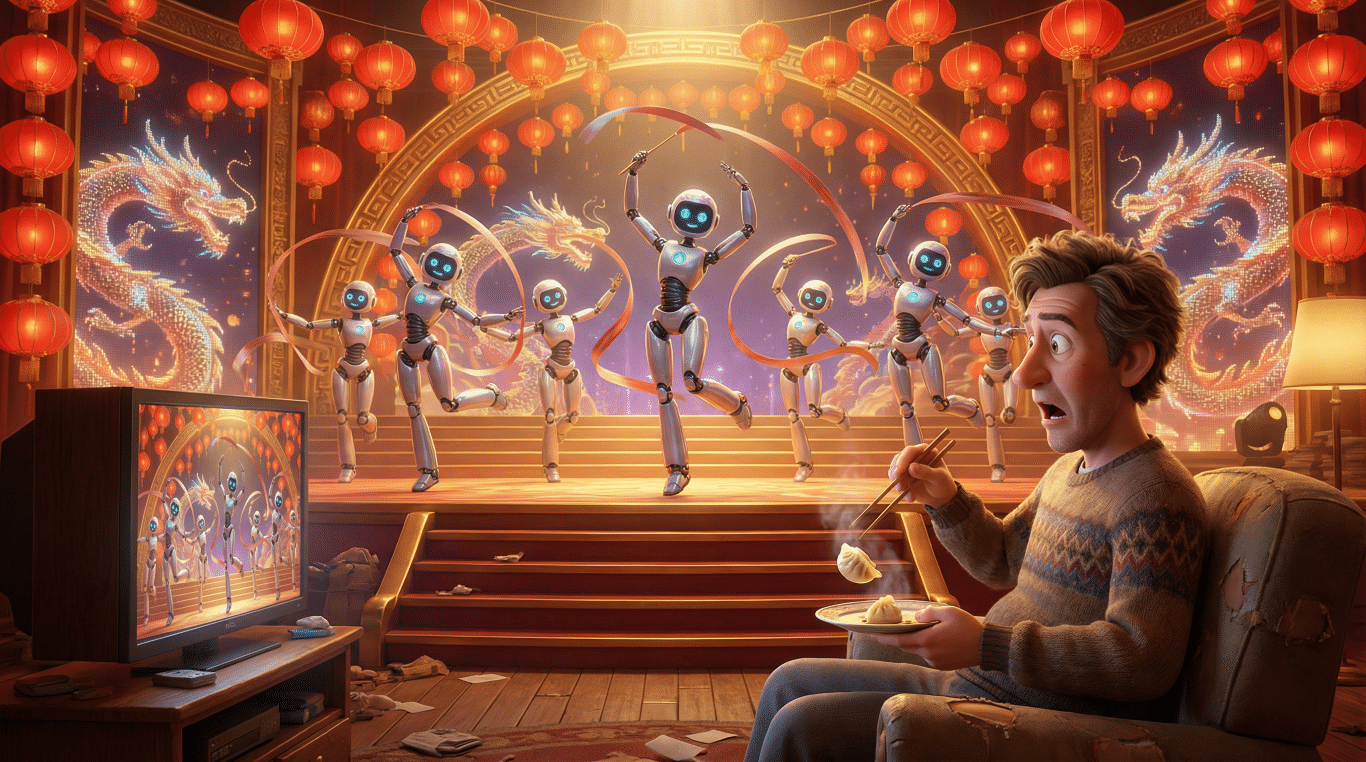
Let me paint you a picture. It’s the eve of Chinese New Year 2025. About a billion people, give or take, are gathered around their televisions for the Spring Festival Gala, which is essentially China’s version of the Royal Variety Performance, but with a viewing audience that makes our little British tradition look like a village fête. And then, right there on one of the most watched television broadcasts in human history, something extraordinary happens.
Robots start dancing.
Not the clunky, awkward, “please-don’t-fall-over” robots you might remember from science fiction films of the 1980s. Not the robotic arms you see welding cars together in factory footage. Actual humanoid robots, moving with grace, coordination, and a kind of fluid elegance that made millions of people simultaneously drop their dumplings and reach for their phones.
The footage went absolutely everywhere. The China Spring Festival Gala robots became the most talked-about technology moment of 2025, and honestly, rightly so. Because what we witnessed wasn’t just a clever party trick. It was a genuine milestone in the history of human achievement. And I want to explain exactly why, in plain English, without any of the technical gobbledygook that usually makes people’s eyes glaze over.
So grab a cup of tea. This is a good one.
Why This Actually Matters (More Than You Think)
You might be thinking, “Dancing robots? Sounds like a gimmick.” And I completely understand that reaction. We’ve been promised the robot revolution for decades, and mostly what we’ve got is a Roomba bumping into the furniture.
But here’s why humanoid robots dancing at the 2025 Spring Festival Gala was genuinely significant. Dancing is, without question, one of the most technically demanding things a human body does. Think about it for a moment. When you watch a professional dancer, every tiny movement requires the brain to process balance, spatial awareness, rhythm, muscle coordination, and real-time adjustment, all simultaneously, all in fractions of a second. It’s extraordinarily complex.
Getting a robot to walk in a straight line took engineers decades of work. Getting a robot to dance in synchronisation with dozens of other robots, on a live television broadcast, in front of a billion people, with no room for error, that’s a completely different level of achievement. It’s the difference between getting your car to start and winning the Formula One World Championship.
The company behind this remarkable moment was Unitree Robotics, a Chinese robotics firm that has been quietly doing extraordinary work for several years. The Unitree Robotics Spring Festival performance featured their H1 humanoid robots, and it was the moment the world truly sat up and paid attention to where robotics technology actually is right now, in 2025, not in some distant science fiction future.
What Robots Like These Are Actually For (And What They’re Not)
Before we go any further, let me be honest with you about something, because I think the media coverage of this event got slightly carried away, as media coverage tends to do.
These robots are not about to take over the world. They’re not going to replace all human workers next Tuesday. And they’re certainly not plotting anything sinister in a warehouse somewhere. The reality of what humanoid robots are currently used for is actually quite sensible and, in many cases, genuinely beneficial.
Where they genuinely shine is in environments that are dangerous or difficult for humans. Think about situations where you’d rather send a machine than a person, such as disaster zones, collapsed buildings, areas with toxic chemicals, or extreme heat. A humanoid robot can navigate these environments using the same physical form factor as a human, which means it can use tools, open doors, and climb stairs that were designed for human bodies. That’s enormously useful.
They’re also being explored for manufacturing environments where precision and repetition matter, for logistics and warehousing tasks, and increasingly for assistive roles where they might help elderly or disabled individuals with physical tasks. Japan, which has an ageing population and has been thinking about this problem for longer than most countries, has been particularly interested in this application.
What they’re not yet ready for is anything requiring genuine emotional intelligence, nuanced human judgment, or the kind of common sense that you and I take completely for granted. A humanoid robot can perform a choreographed dance routine with remarkable precision. Ask it to improvise when something unexpected happens, and it’s a different story entirely. The gap between “impressive performance” and “genuinely autonomous intelligent agent” remains significant, and anyone who tells you otherwise is trying to sell you something.
A Brief History of Robots: From Tin Men to Dancers
To appreciate just how far we’ve come, you need to understand where we started. And the history of robotics is, genuinely, one of the most fascinating stories in all of human endeavour.
The word “robot” itself comes from a 1920 Czech play called R.U.R., written by Karel Čapek. The word derives from a Czech word meaning “forced labour” or “drudgery.” Which tells you something about how humans have always imagined these machines, as tireless workers doing the jobs we’d rather not do ourselves.
The earliest practical industrial robots appeared in the 1960s. General Motors installed the first industrial robot arm, called Unimate, in their factory in 1961. It was essentially a very sophisticated mechanical arm that could perform repetitive tasks on an assembly line. Impressive for its time, certainly, but about as graceful as a mechanical digger.
Through the 1970s and 1980s, robots remained largely confined to factory floors, doing things like welding, painting, and assembling components. They were powerful and precise within their very narrow, very controlled environments. Take them out of that environment and they were completely useless.
The real breakthrough in humanoid robotics came from Japan. Honda began their humanoid robot project in 1986, and after years of painstaking research, they unveiled ASIMO in 2000. ASIMO could walk, climb stairs, and even run at a modest pace. Watching ASIMO walk for the first time felt genuinely magical, even if it moved with the cautious deliberateness of someone navigating a very icy pavement in leather-soled shoes.
Boston Dynamics then entered the scene and genuinely changed the game. Their Atlas robot, first revealed in 2013, was a revelation. Early versions were connected to a power tether and moved with considerable effort. But the company kept iterating, and by the late 2010s, Atlas was doing backflips. Actual backflips. I remember watching that footage for the first time and genuinely not believing what I was seeing.
Then came the 2020s, and everything accelerated dramatically.
The Unitree Robotics Story: From Stumbling to Spectacular
Unitree Robotics was founded in 2016 by Wang Xingxing, a young Chinese engineer who had become obsessed with building affordable, capable robots. The company initially focused on quadruped robots, the four-legged variety, and their early models like the Laikago were genuinely impressive for their price point.
Their quadruped robots got progressively more capable and more affordable through successive generations. Where Boston Dynamics’ quadruped robot Spot cost tens of thousands of pounds, Unitree was producing comparable machines at a fraction of the price, which matters enormously for how widely the technology can actually be deployed.
The move into humanoid robots came with the H1, unveiled in 2023. This was a significant moment. The H1 stood at roughly 1.8 metres tall, weighed around 47 kilograms, and could walk at speeds that genuinely surprised observers. It wasn’t perfect, of course. Early demonstrations showed it walking carefully, managing steps, and performing basic tasks. Impressive, but not yet spectacular.
What happened between 2023 and the China Spring Festival Gala robots performance in 2025 was a period of intense development and refinement. The engineers at Unitree worked on what’s called whole-body control, which is essentially teaching the robot’s computer brain to coordinate every joint in the body simultaneously, the way your nervous system coordinates your muscles without you consciously thinking about it.
They also worked extensively on balance and recovery, teaching the robots to make thousands of tiny adjustments per second to stay upright, the same way you unconsciously shift your weight when you’re standing on a moving bus. And they worked on synchronisation, developing the software systems that allow multiple robots to coordinate their movements precisely with each other and with external timing signals like music.
By the time of the Unitree Robotics Spring Festival performance in February 2025, the result of all that work was there for a billion people to see. Dozens of H1 robots, moving in perfect synchronisation, performing a dance routine that would have been genuinely impressive even from human performers. It was extraordinary.
How It Actually Works: The Bits Under the Hood
Right, let me explain how these robots actually function, because understanding this makes the achievement even more impressive.
Think of the robot’s control system a bit like the relationship between a conductor and an orchestra. The conductor, in this case the robot’s central computer, needs to receive information from dozens of different sources simultaneously, process all of it, make decisions, and send precise instructions to every section of the orchestra, every joint and motor in the robot’s body, many times per second.
The robot is covered in sensors. There are cameras that work like eyes, giving the computer a visual picture of the environment. There are gyroscopes and accelerometers, similar to what’s inside your smartphone, that constantly measure which way the robot is tilting and how fast it’s moving. There are sensors in each joint measuring exactly what angle that joint is at and how much force is being applied.
All of this information pours into the central computer many hundreds of times per second. The computer runs sophisticated software, much of it developed using artificial intelligence training methods, that processes all this information and works out what instructions to send to each of the robot’s motors to achieve the desired movement.
The AI training aspect is particularly interesting. Rather than programmers writing out every possible movement in code, which would be impossibly complex, the robots are trained using a technique called reinforcement learning. Imagine teaching a child to ride a bike. You don’t give them a manual explaining the physics of balance. They try, they wobble, they fall, they try again, and gradually their brain learns the patterns that work. Reinforcement learning does something similar, running millions of simulated attempts in a computer, rewarding the virtual robot when it does something right and penalising it when it falls over, until the software learns the patterns that produce stable, coordinated movement.
For the synchronised dancing specifically, the robots were also receiving timing signals from a central system, keeping them all locked to the same beat, much like how musicians in an orchestra follow the conductor’s baton. The choreography itself was programmed as a sequence of movements, but the robots’ balance systems were continuously adapting in real time to keep them stable as they performed each move.
What Comes Next: The Future Is Closer Than You Think
Here’s where things get genuinely exciting, and I say this as someone who has watched technology trends for a long time.
The trajectory of humanoid robotics right now reminds me very much of the early days of smartphones. In 2005, mobile phones were useful but limited. By 2010, the iPhone had changed everything, and within another five years, smartphones had transformed virtually every aspect of daily life. The pace of change was breathtaking, and most people didn’t see it coming until it had already happened.
Humanoid robotics feels like it’s at that 2007 moment right now. The fundamental capabilities are there. The hardware is good enough. The AI software is advancing rapidly. What’s happening now is the refinement, the cost reduction, and the scaling up of manufacturing, all of which tend to happen faster than anyone expects once a technology reaches a certain threshold.
Unitree has already released successors to the H1, and other companies, including Tesla with their Optimus robot and Figure AI, are racing to bring capable humanoid robots to market. The competition is fierce, which historically means rapid improvement and falling prices.
In practical terms, within the next five to ten years, we’re likely to see humanoid robots working in warehouses and logistics centres, performing tasks that are currently done by human workers in difficult physical conditions. We’ll likely see them in construction and manufacturing. And yes, we’ll probably see them in care settings, helping with physical tasks for elderly people, though I want to be clear that this is a supplement to human care, not a replacement for it.
The Spring Festival Gala performance was, in a very real sense, a coming-out party. It announced to the world that this technology has arrived.
Bringing It All Together
So there you have it. The China Spring Festival Gala robots moment wasn’t just a spectacular television performance. It was a genuine marker in the history of technology, a moment when the gap between science fiction and science fact visibly, dramatically narrowed.
The humanoid robots dancing at the 2025 Spring Festival Gala represented decades of accumulated engineering knowledge, years of AI research, and the particular determination of a Chinese company called Unitree Robotics that refused to accept that capable robots had to be impossibly expensive or impossibly clumsy. The Unitree Robotics Spring Festival performance was, in the most literal sense, a show-stopping demonstration of where we actually are.
We’ve come from factory arms that could barely move in a straight line, through the cautious walking of ASIMO, through the increasingly capable demonstrations of Boston Dynamics, to dozens of humanoid robots dancing in perfect synchronisation on the most watched television broadcast on earth. That’s an extraordinary journey.
The future of this technology is going to be remarkable, and probably a little unsettling at times, because genuinely transformative technology always is. But understanding it, rather than fearing it, is always the better path.
And if nothing else, you can now tell people exactly why those dancing robots were such a big deal. Which, at a dinner party, is worth considerably more than you might think.
Walter
Leave a Reply