
When I first got a fitness tracker about a decade ago, I thought I was living in the future. It counted my steps. It told me when I’d been sitting too long. Revolutionary, right? Well, hold onto your reading glasses, because what’s happening now with wearable biosensors makes that old step counter look like an abacus.
We’re standing at a fascinating crossroads in healthcare technology. The next generation smartwatch sitting on your wrist isn’t just counting steps anymore. It’s becoming a miniature medical laboratory, capable of detecting everything from irregular heartbeats to early signs of diabetes, and it’s doing all this while you’re just going about your day. No needles, no lab visits, no waiting rooms with outdated magazines.
This matters because our healthcare system is, let’s be frank, a bit overwhelmed. Doctors are stretched thin, appointments are harder to get, and many health problems only get caught when they’ve already become serious. These new biosensors are like having a vigilant medical assistant who never sleeps, never takes a day off, and is always paying attention to what your body is telling it. For those of us over 50, when our bodies start sending us more frequent reminders that we’re not 25 anymore, this technology could be genuinely life-saving.
What These Clever Devices Actually Do (And What They Don’t)
Let me paint you a picture of what modern smartwatch health monitoring can actually accomplish. It’s impressive, but it’s also important to understand the limitations.
These devices can now monitor your blood oxygen levels, something that became rather important during the recent pandemic. They can detect irregular heart rhythms that might indicate atrial fibrillation, a condition that affects millions and often goes undiagnosed until it causes a stroke. Some can measure your blood pressure without that uncomfortable arm cuff. Others are working on tracking blood glucose levels without pricking your finger, which would be absolutely brilliant for people managing diabetes.
The newest wearable biosensors can even analyze your sweat to detect dehydration, monitor stress levels through skin conductivity, and track your body temperature continuously to spot potential infections before you feel properly ill. Some experimental versions are measuring alcohol levels, detecting falls, and even monitoring medication levels in your bloodstream.
But here’s what they can’t do, and this is crucial: they cannot replace your doctor. They’re not diagnostic tools in the medical sense. Think of them more like smoke detectors in your home. A smoke detector alerts you to potential danger, but it doesn’t put out the fire, and it doesn’t tell you exactly what’s burning or how to fix it. These devices are early warning systems, incredibly sophisticated ones, but they’re the beginning of the conversation with your healthcare provider, not the end of it.
They also can’t read your mind, despite what the marketing might suggest. They can’t tell you why you’re stressed, only that you are. They can’t diagnose the cause of that irregular heartbeat, only alert you that it’s happening. And they absolutely cannot cure anything. They’re observers, not healers.
The Road We’ve Travelled: From Pedometers to Prediction Machines
Remember the pedometer? That little plastic clip-on gadget that bounced on your belt and sort of, kind of, maybe counted your steps if you walked in a very specific way and didn’t sneeze too hard? That’s where this journey began, believe it or not.
The pedometer has been around since the 1960s, working on a simple mechanical principle. A small metal ball would swing on a spring with each step, completing an electrical circuit that advanced the counter. Brilliant in its simplicity, absolutely useless for anything except a rough step count, and even that was generous.
Then came the early 2000s, and suddenly we had digital accelerometers. These were the same sensors that could tell your mobile phone which way was up. Someone clever realized you could use them to detect movement patterns and distinguish walking from running, stairs from flat ground. Companies like Fitbit emerged in 2007, and suddenly everyone was comparing step counts at dinner parties. Riveting stuff, truly.
The first proper smartwatches arrived around 2013 and 2014. The Pebble, Samsung’s Galaxy Gear, and then Apple’s Watch in 2015 changed the game entirely. But here’s the thing, those early versions were still pretty basic from a health perspective. They had accelerometers and heart rate monitors using LED lights that shone through your skin to detect blood flow. Useful, yes, but hardly revolutionary.
The real transformation began around 2018 when the FDA approved the Apple Watch’s ECG function. This was the moment when smartwatch health monitoring shifted from “interesting data” to “potentially life-saving medical information.” Suddenly, your watch could detect atrial fibrillation with surprising accuracy. People started discovering serious heart conditions they had no idea they had.
Since then, it’s been like watching evolution on fast-forward. Blood oxygen sensors arrived in 2020, just in time to become rather important during COVID-19. Temperature sensors followed. And now, we’re seeing the emergence of truly sophisticated wearable biosensors that can measure things I wouldn’t have believed possible five years ago.
Each generation has built on the previous one, not just adding features but fundamentally improving accuracy. The early heart rate monitors were, let’s be kind, approximations. Modern ones can match medical-grade equipment in many situations. The early sleep tracking was basically guesswork based on movement. Now, these devices can identify different sleep stages with remarkable precision.
How These Little Miracles Actually Work
Right, let’s demystify this technology without requiring an engineering degree. I promise to keep this straightforward.
The magic happens through a combination of different sensors working together, like a small orchestra playing in harmony on your wrist. Each sensor has a specific job, and the real cleverness is in how they all work together.
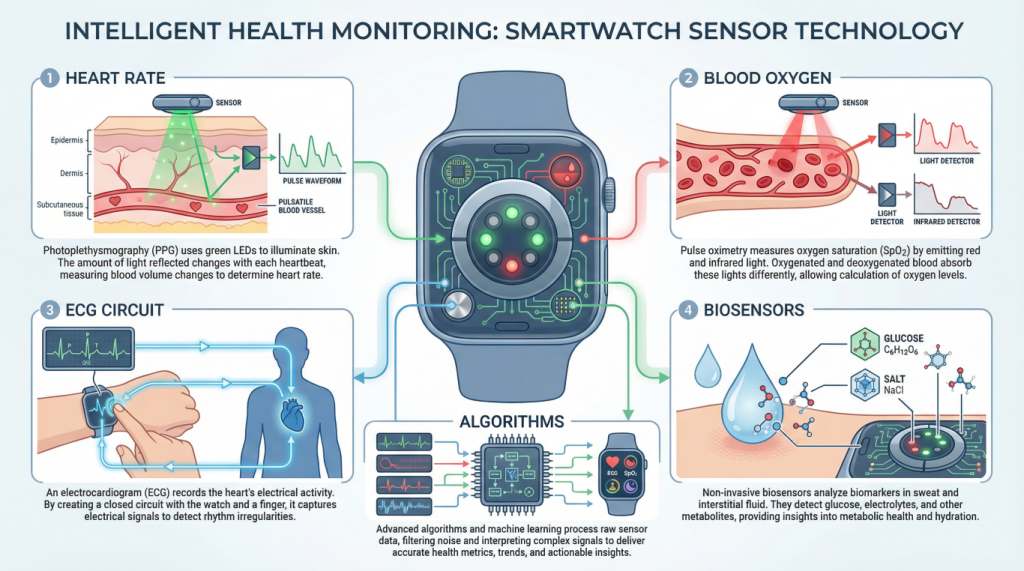
Let’s start with the optical heart rate sensor, because it’s the foundation of most health watches. This uses a principle called photoplethysmography, which is a magnificently long word for a fairly simple concept. The watch shines LED lights, usually green ones, through your skin. Your blood absorbs green light, so when your heart beats and pushes blood through your wrist, the amount of light reflected back changes. The sensor detects these changes and calculates your heart rate. It’s like watching ripples in a pond, except the ripples are your pulse and the pond is your wrist.
The ECG function is more sophisticated. It requires you to touch the watch with your other hand, completing an electrical circuit through your body. Your heart generates tiny electrical signals to coordinate its beating, and the watch can detect these signals, just like the ECG machine at your doctor’s office, but smaller and less intimidating. It then analyzes the pattern of these signals to spot irregularities.
Blood oxygen sensors work similarly to the heart rate monitor but use different colored lights, usually red and infrared. Oxygenated blood and deoxygenated blood absorb these lights differently, so by measuring the difference, the watch can calculate what percentage of your blood is carrying oxygen. It’s the same principle hospitals use with those clip-on finger monitors, just miniaturized.
Temperature sensors are straightforward, they measure the heat your skin is radiating. But the clever bit is tracking patterns over time. Your baseline temperature at 3 AM is different from 3 PM, and the watch learns your personal patterns so it can spot when something’s off.
The newest biosensors are where things get really interesting. Some use electrochemical sensors that can analyze the chemical composition of your sweat. When you perspire, you’re not just releasing water, you’re releasing a cocktail of chemicals that tell a story about what’s happening inside your body. Glucose, lactate, cortisol, sodium, all of these can be detected in sweat. The sensor creates a tiny electrical reaction with these chemicals, and by measuring that reaction, it can determine how much of each substance is present.
All of this data, hundreds of measurements per second, flows into sophisticated algorithms. These are essentially very clever mathematical models that have been trained on millions of data points from thousands of people. They can spot patterns that would be impossible for a human to see. They know what normal looks like for you specifically, and they can alert you when something deviates from your personal normal.
The Future Is Almost Here (And It’s Fascinating)
I’ve been following this technology for years, and I can tell you, what’s coming next is genuinely exciting. We’re not talking science fiction, we’re talking about innovations that are already in development and testing.
The holy grail right now is continuous, non-invasive glucose monitoring. Imagine if people with diabetes never had to prick their fingers again. Several companies are working on this using various approaches, from optical sensors that can detect glucose through spectroscopy to sensors that measure glucose in the fluid between your skin cells. It’s proving tricky, glucose is harder to measure accurately than oxygen or heart rate, but progress is being made. I’d bet good money we’ll see this in consumer devices within the next few years.
Another frontier is hydration monitoring. Current versions can make educated guesses, but next-generation sensors will be able to tell you precisely how hydrated you are by analyzing your sweat composition and skin impedance. For those of us who forget to drink enough water, this could be genuinely useful.
Mental health monitoring is also advancing rapidly. By combining heart rate variability, skin conductivity, temperature, and even voice analysis in some cases, these devices are getting better at detecting stress, anxiety, and mood patterns. This is delicate territory, obviously, but the potential to help people manage mental health proactively is enormous.
Some researchers are working on sensors that can detect specific biomarkers for diseases. Imagine a watch that could alert you to early signs of inflammation that might indicate arthritis, or changes in your biochemistry that suggest your kidneys aren’t functioning optimally. We’re talking about shifting from reactive healthcare to predictive healthcare.
The integration with artificial intelligence is going to transform these devices from data collectors into health advisors. Not replacing doctors, but providing personalized insights that actually mean something. Instead of just telling you your heart rate is elevated, it might tell you that based on your patterns, you should probably take it easy today because your body is showing signs of being run down.
The Dark Side: Security and Privacy Concerns You Should Actually Think About
Now, I need to put on my serious hat for a moment, because this is important and not enough people are talking about it.
Your health data is some of the most personal, sensitive information about you that exists. It reveals patterns about your life, your habits, your medical conditions, and potentially your future health risks. And right now, it’s sitting on servers somewhere, protected by privacy policies that most of us have never read and wouldn’t understand if we did.
Here’s the uncomfortable truth: health data is valuable. Insurance companies would love to know your real health status. Employers might be interested in whether you’re likely to need extensive medical care. Marketers would pay handsomely for information about your health conditions. And while reputable companies claim they’re not selling your data, the definition of “selling” can be surprisingly flexible in privacy policies.
There’s also the security question. These devices connect to your phone, which connects to the internet, which means they’re potentially vulnerable to hacking. Now, I’m not trying to make you paranoid, the risk of someone specifically targeting your fitness data is probably low. But data breaches happen. Companies get hacked. And when they do, your health information could be exposed.
My advice, and I’m being completely serious here, is to read the privacy policy of whatever device you’re using. I know, I know, they’re written in impenetrable legal language specifically designed to make your eyes glaze over. But at minimum, understand what data is being collected, where it’s being stored, who has access to it, and what happens to it if you stop using the service.
Use the security features available to you. Enable two-factor authentication on your accounts. Use strong passwords. Be cautious about which third-party apps you give access to your health data. And think carefully before sharing your health data on social media, even those innocent-looking fitness achievement posts can reveal more than you realize.
Also, understand that these devices aren’t regulated as strictly as medical devices in many cases. A blood pressure monitor you buy at the pharmacy has to meet certain standards. Your smartwatch’s blood pressure feature might not be held to the same standard. This is changing, regulators are catching up, but it’s worth being aware of.
Bringing It All Together
So here we are, at the end of our journey through the world of wearable biosensors and next generation smartwatch technology. It’s been quite a ride, hasn’t it?
We’ve come from simple pedometers that could barely count steps accurately to sophisticated devices that can monitor our heart rhythms, blood oxygen, temperature, and soon potentially our blood glucose and hydration levels. These aren’t just gadgets anymore, they’re becoming genuine health tools that can provide early warnings of serious conditions.
The technology works through a clever combination of optical sensors, electrical sensors, and increasingly, chemical sensors that can analyze what’s happening in your body in real time. It’s all coordinated by sophisticated algorithms that learn your personal patterns and can spot when something’s not quite right.
The future looks even more promising, with continuous glucose monitoring, better mental health tracking, and predictive health insights on the horizon. We’re moving toward a world where your watch doesn’t just tell you what’s happening, it helps you understand what it means and what you might want to do about it.
But, and this is important, we need to stay smart about this technology. It’s not a replacement for proper medical care. It’s a tool, a very good tool, but still just a tool. And we need to be mindful of the privacy and security implications of having so much personal health data floating around in the digital ether.
For those of us over 50, this technology offers something genuinely valuable. It gives us more awareness of our health, more ability to catch problems early, and more agency in managing our wellbeing. That’s not nothing. That’s actually quite wonderful.
I’m excited about where this technology is going. I’m cautiously optimistic that it will genuinely improve healthcare outcomes and help people live healthier, longer lives. But I’m also realistic about the challenges and limitations.
So if you’re considering getting one of these devices, or if you already have one and want to make better use of it, my advice is this: embrace the technology, but don’t worship it. Use it as a tool for awareness and early detection. Share the data with your doctor. But also remember that the most important health sensor you have is your own body and your awareness of how you feel.
And for goodness’ sake, read the privacy policy. You’ll thank me later.
Walter
Leave a Reply