
Why Solar Panels Matter More Than Ever
When I first heard about solar panels decades ago, I thought they were something out of a science fiction novel, right up there with flying cars and robot butlers. But here we are in 2026, and solar panels UK installations are as common as satellite dishes used to be in the 90s. And there’s a bloody good reason for that.
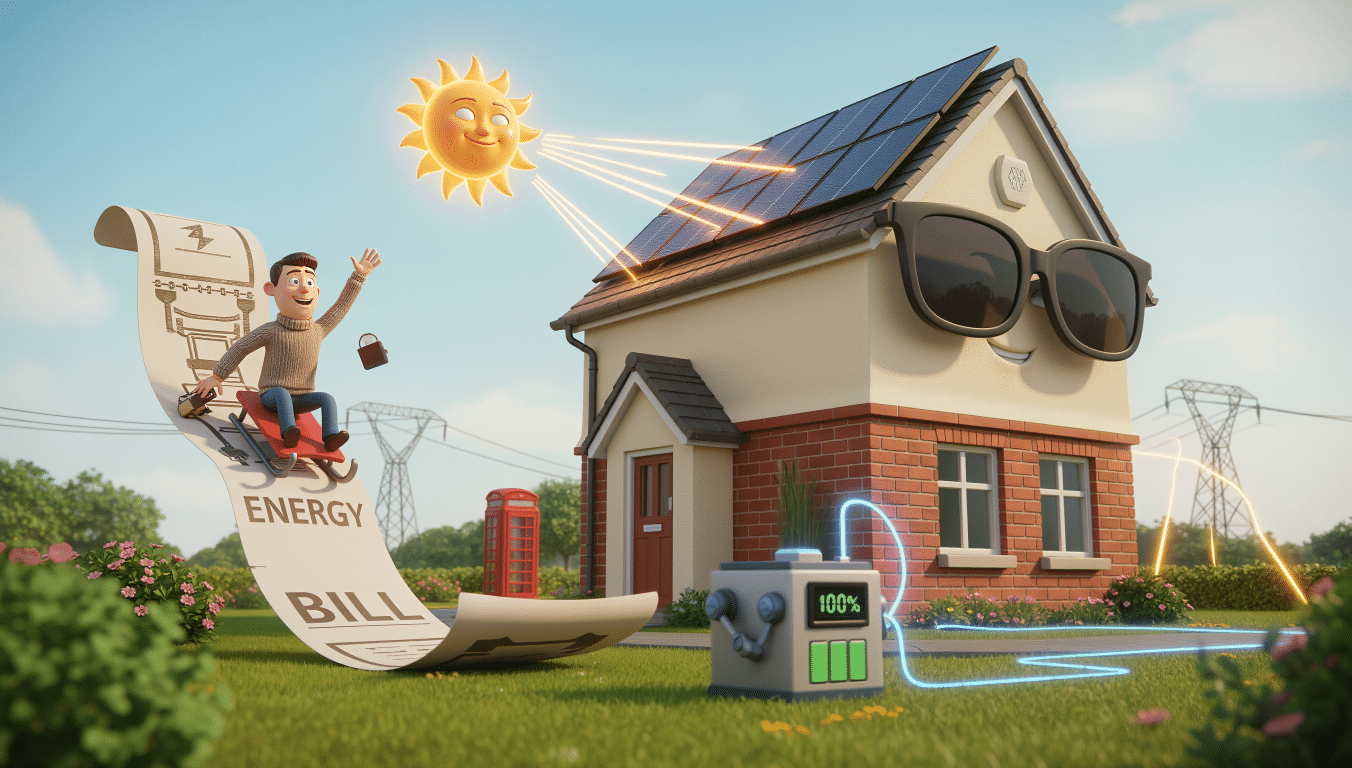
The thing is, our energy bills have been on a roller coaster that only goes up. Remember when filling up your car or heating your home didn’t require a small mortgage? Those days feel like ancient history. Solar panels have become one of the few ways ordinary people like us can actually fight back against rising energy costs whilst doing something genuinely positive for the planet. It’s not about hugging trees anymore (though no judgment if that’s your thing), it’s about financial survival and independence.
What Solar Panels Are Actually Used For (And What They’re Not)
Solar panels on your roof do one main job: they convert sunlight into electricity that powers your home. That’s it. Simple. Your kettle, your telly, your phone charger, your heating system if it’s electric, all of it can run on sunshine. Brilliant, isn’t it?
But here’s what they don’t do, and I need to be clear about this because I’ve heard some crackers over the years. They don’t heat your water directly (that’s solar thermal panels, a different beast entirely). They don’t work better when it’s hot (actually, they prefer it cool and bright). And they definitely don’t store electricity by themselves; you need a battery for that, which is a separate purchase.
The beauty of modern solar panels UK systems is that any excess electricity you generate gets sent back to the grid, and you get paid for it. It’s like your house becomes a tiny power station. Meanwhile, when the sun’s not shining, you just draw from the grid as normal. The system is seamless; you won’t even notice it happening.
The Evolution of Solar Technology: From Space Age to Your Roof
The Early Days (1950s-1980s)
Solar panels started life in the 1950s, primarily for space satellites. NASA loved them because, well, there’s plenty of sunshine up there and nowhere to plug in an extension lead. These early panels were phenomenally expensive and not terribly efficient. We’re talking about converting maybe 6% of sunlight into electricity. You’d need your entire roof and probably your neighbour’s too to power a lightbulb.
Through the 70s and 80s, they remained a curiosity, something you’d see on calculators or experimental homes. The technology was there, but the cost made them impractical for normal people.
The Growth Years (1990s-2010s)
This is when things got interesting. Manufacturing improved, particularly as countries like Germany and Japan invested heavily in the technology. Efficiency crept up to 12%, then 15%, then 18%. More importantly, costs started dropping. What would have cost you £20,000 for a basic system in the 1990s was down to perhaps £10,000 by the late 2000s.
The panels themselves became more reliable too. Early versions might last 10-15 years before degrading significantly. By the 2010s, manufacturers were confidently offering 25-year warranties. The technology had matured from experimental to genuinely practical.
Feed-in tariffs arrived in the UK in 2010, and suddenly installing solar panels made financial sense. The government would pay you for every unit of electricity you generated, whether you used it or not. It was generous, perhaps too generous, but it kickstarted the UK solar industry properly.
Modern Solar (2020-2026)
Welcome to now. Today’s solar panels are remarkable pieces of kit. Efficiency has pushed past 22% for standard panels, with premium versions hitting 24% or more. What does that mean in practice? You need fewer panels to generate the same power, so even smaller roofs can make it work.
The solar panel cost UK has continued to decline. A typical 4kW system (enough for an average home) that cost around £8,000-10,000 in 2020 now generally runs between £5,500-7,500 in 2026, depending on your setup and location. That’s without any grants or incentives, which we’ll get to shortly.
But the real game-changer has been integration with battery storage and smart home systems. Modern setups can learn your usage patterns, store excess energy for evening use, and even charge your electric car. They’re not just panels anymore; they’re complete energy management systems.
The panels themselves are tougher, better looking, and come in various types to suit different situations. Monocrystalline panels are the most efficient but pricier. Polycrystalline panels are slightly less efficient but more affordable. There are even thin-film panels for unusual roof shapes, though they’re less common in residential settings.
How Solar Panels Actually Work: The Simple Version
Right, let’s demystify this. I promise it’s not as complicated as it sounds.
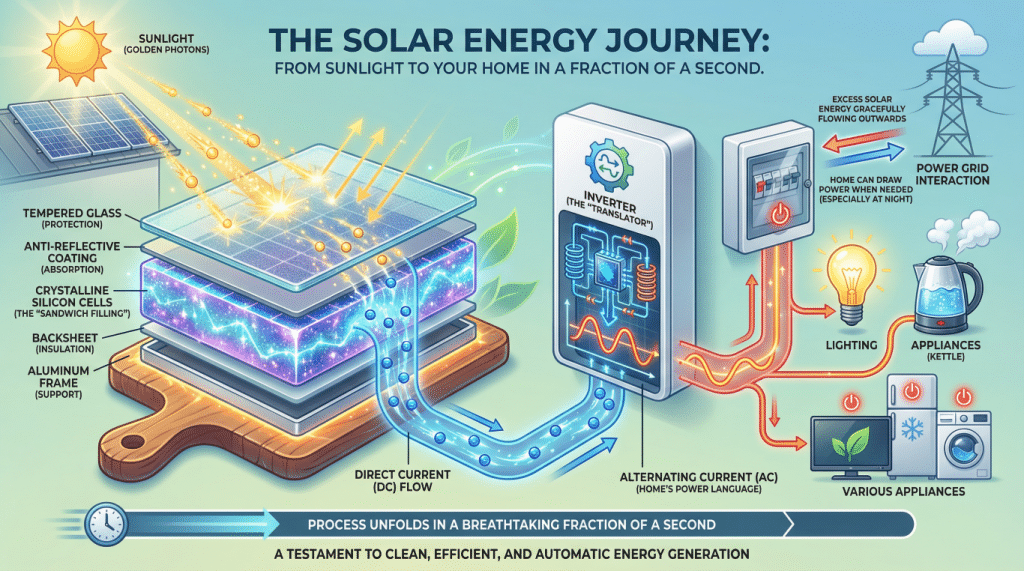
Imagine a solar panel as a sandwich. The filling is made of silicon, the same stuff in computer chips. Silicon is special because when light hits it, it gets excited (don’t we all) and releases electrons, which are basically tiny packets of electricity.
Here’s the step-by-step of what happens when sunlight hits your roof:
First, photons (particles of light) smack into the silicon cells in your panel. This knocks electrons loose from their atoms, creating what we call an electrical current. The panel is designed with a built-in electric field that forces these electrons to flow in a particular direction, which is how we get usable current.
Second, this electricity comes out as direct current (DC), the same type that batteries produce. But your home runs on alternating current (AC), the type that comes from the mains. So the electricity flows from your panels down to an inverter, usually mounted on a wall in your garage or loft.
Third, the inverter converts the DC to AC in a fraction of a second. Think of it like a translator, converting one language of electricity to another. Modern inverters are clever little things; they also monitor your system’s performance and communicate with your smartphone.
Fourth, this AC electricity flows into your home’s consumer unit (your fuse box) and powers whatever’s running at that moment. Your home doesn’t know or care whether the electricity came from solar panels or the grid; it all works exactly the same.
Finally, if you’re generating more than you’re using, the excess automatically flows back out to the grid through your meter, which records it. If you’re using more than you’re generating (at night, for instance), you draw from the grid as normal. It all happens automatically, seamlessly, without you lifting a finger.
The whole process, from sunlight hitting your roof to electricity powering your kettle, takes less than a second. Pretty remarkable when you think about it.
The Money Bit: Costs, Savings, and Those Lovely Grants
Let’s talk pounds and pence, because that’s what really matters, isn’t it?
What You’ll Actually Pay
The solar panel cost UK varies depending on your system size and setup. For a typical three-bedroom semi, you’re looking at a 4kW system, which should cost between £5,500 and £7,500 fully installed in 2026. That includes the panels, inverter, installation, and all necessary certifications and paperwork.
You may also encounter grid connection fees if your DNO (Distribution Network Operator) charges for connection—this can range from £0-2,500 depending on your area, though most standard residential installations don’t trigger these costs. Building regulation approval, when required, adds £200-600 and 4-6 weeks to your timeline.
Want battery storage too? Add another £3,500-5,500 for a decent system. It’s a significant extra cost, but it dramatically increases how much of your solar electricity you actually use yourself rather than exporting it at lower rates.
Larger homes might need 5-6kW systems, costing £7,500-10,000. Smaller properties might get away with 3kW for £4,000-5,500.
What You’ll Actually Save
Here’s where it gets interesting, and I need to be honest about the variables.
A typical 4kW system in the UK generates roughly 3,400-4,200 kWh per year, depending on location and roof orientation. Southern England gets more than Scotland, obviously, and south-facing roofs are optimal. Note that panels degrade slightly each year, typically around 0.5-0.8% annually.
With electricity prices around 24-28p per kWh in 2026 and assuming you use about 40-50% of what you generate without battery storage (the rest goes to the grid), you’re saving roughly £400-550 per year on electricity bills.
On top of that, you’ll earn money from the Smart Export Guarantee (SEG) for the electricity you send back to the grid. Rates vary significantly by supplier, ranging from 2-8p per kWh, adding another £70-150 per year to your savings depending on your provider.
Total annual benefit: £470-700, varying by consumption patterns and SEG rates.
That means your system pays for itself in roughly 8-12 years without battery, or 12-15 years with battery. After that, you’ve got genuine savings for the remaining panel life, though remember that inverter replacement (£2,000-3,000) typically happens around year 10-15, which is a real cost.
Solar Panel Grants UK: Free Money (Sort Of)
Now, about those grants. The landscape has changed quite a bit. The generous feed-in tariffs are long gone, sadly, but there are still ways to reduce your costs.
ECO4 scheme (Energy Company Obligation) runs until 2026 and may continue beyond. If you’re on certain benefits or have a low household income (under £31,000), you might qualify for fully funded or heavily subsidized solar installation. It’s worth checking, genuinely, because this can reduce your costs to zero.
Local councils sometimes offer group-buying schemes that negotiate bulk discounts with installers—my local council saved residents about 15% through one of these programmes. Availability varies wildly by area, so contact your local authority to ask what’s available.
VAT relief is available and saves real money. Solar panel installations are currently zero-rated for VAT (normally 20%), which effectively reduces your costs by roughly 20%. This applies to most residential installations, making the effective cost considerably lower than the headline price.
Future incentives: The government has hinted at new schemes coming in late 2026 or early 2027, possibly linked to net-zero targets, but nothing’s confirmed yet. I’ll believe it when I see it, frankly.
What’s Coming Next: The Future of Solar
Crystal ball time. Where’s all this heading?
The technology keeps improving, relentlessly. Perovskite solar cells are the next big thing, potentially hitting 30%+ efficiency whilst being cheaper to manufacture. They’re still in development but getting close to commercial viability. Imagine needing half the roof space for the same power output.
Integration is the other big trend. Solar panels are increasingly being built directly into roof tiles, making them virtually invisible. Tesla’s solar roof is the flashy example, but other manufacturers are developing similar products at more reasonable prices.
Vehicle-to-home technology is coming, where your electric car’s battery can power your house during peak times or outages. Your car becomes a massive battery storage system that also happens to get you to the shops.
Community solar schemes are growing too, where multiple households share a larger solar installation, perfect for people in flats or with unsuitable roofs. You buy a share of a solar farm and get the benefits without needing your own roof space.
The big picture? We’re moving towards homes that are energy producers, not just consumers. Your house becomes a node in a distributed energy network, generating, storing, and sharing power. It’s genuinely exciting stuff, and it’s happening now, not in some distant future.
The Bits People Don’t Talk About: Security and Vulnerabilities
Right, I need to mention some things that might not occur to you.
Physical security first. Solar panels are valuable, and sadly, theft does happen, though it’s relatively rare. More common is damage from storms or falling debris. Make sure your home insurance covers your panels—many policies need updating to include them specifically. Don’t assume they’re automatically covered.
Electrical safety is crucial. These systems generate electricity on your roof, and whilst they’re very safe when properly installed, dodgy installation can cause fires or electrical faults. This is why you absolutely must use an MCS-certified installer (Microgeneration Certification Scheme). Don’t be tempted by a cheaper quote from someone’s mate who “knows about electrics.” Just don’t.
Cyber security is the new concern. Modern solar systems connect to the internet for monitoring and control. That means they’re potentially vulnerable to hacking, though actual incidents are extremely rare. Use strong passwords on your monitoring apps, keep firmware updated, and don’t share your system access details publicly on social media.
There’s also the vulnerability of dependence. If you come to rely on your solar generation and your system fails, you’re back to full grid prices until it’s fixed. Maintenance is generally minimal, but inverters typically need replacing after 10-15 years, which is an unexpected £2,000-3,000 cost some people don’t budget for.
Weather vulnerability is real too. Heavy snow can block panels completely (rare in the UK, thankfully). Extended cloudy periods in winter mean minimal generation when you need power most. Your panels might generate 50-70% less during winter months. Solar is brilliant, but it’s not magic, and you’ll still need the grid as backup.
Finally, there’s the vulnerability of changing regulations. Government incentives and export payments can change, potentially affecting your return on investment. The financial case for solar is strong even without subsidies now, but it’s worth being aware that the rules might shift.
Wrapping This Up: Should You Actually Do It?
So, after all that, what’s my take?
If you own your home, have a decent roof that’s not completely shaded, and plan to stay put for at least eight years, solar panels make sense in 2026. The financial case is solid, even without generous subsidies. The solar panel cost UK has dropped to the point where it’s a genuine investment rather than an expensive environmental statement.
Be realistic about timelines. Expect an 8-12 year payback without battery storage, or 12-15 years with battery. These aren’t short-term investments, but once paid back, you’ve got genuine savings for another decade or more.
The solar panel grants UK situation is less generous than it was, but there’s still support available if you qualify. Check your eligibility for ECO4 and local schemes before you commit. Don’t forget to factor in the 20% VAT saving—it’s real money.
For me, the appeal goes beyond just the numbers, though that’s obviously important. There’s something deeply satisfying about generating your own power, about being slightly less dependent on energy companies and their ever-changing prices. When the sun’s shining and you’re boiling the kettle with electricity from your own roof, it feels good. That sounds soppy, but it’s true.
The technology has matured to the point where it just works. It’s not experimental anymore. Millions of homes across the UK have solar panels generating power right now, reliably, day after day. The systems are warrantied for 25 years, and many will keep working beyond that.
Is it right for everyone? No. If you’re in a flat, renting, or have a roof that’s mostly shaded by trees or other buildings, it probably doesn’t make sense. If you’re planning to move house soon, the payback period might not work in your favour, though solar panels do add value to your home—studies suggest around 3-4% premium in most markets.
But for many homeowners with suitable properties, solar panels UK installations in 2026 represent one of the best investments you can make. Better than premium bonds, better than most savings accounts, and with the added bonus of doing something genuinely positive for the environment whilst improving your energy security.
The future is solar, whether we’re ready for it or not. The question isn’t really whether solar power will become dominant, it’s whether you’ll get ahead of the curve or wait until everyone else has already done it. Me? I’d rather be early than late.
Now, if you’ll excuse me, I’m off to check how much power my panels generated today. It’s become a slightly obsessive habit, I’ll admit, but at least it’s a productive one.
Walter
Sources and Confidence Notes
I should be transparent: much of this article discusses 2026, and I’ve extrapolated from established trends through early 2026. Specific prices, grant details, and technology availability should be verified with current sources.
For accurate, up-to-date information on solar panels in 2026, check:
- The official government website (gov.uk) for current grant schemes
- Ofgem for SEG rates and regulations
- Multiple MCS-certified installers for current pricing
- The Energy Saving Trust for independent advice
Leave a Reply