
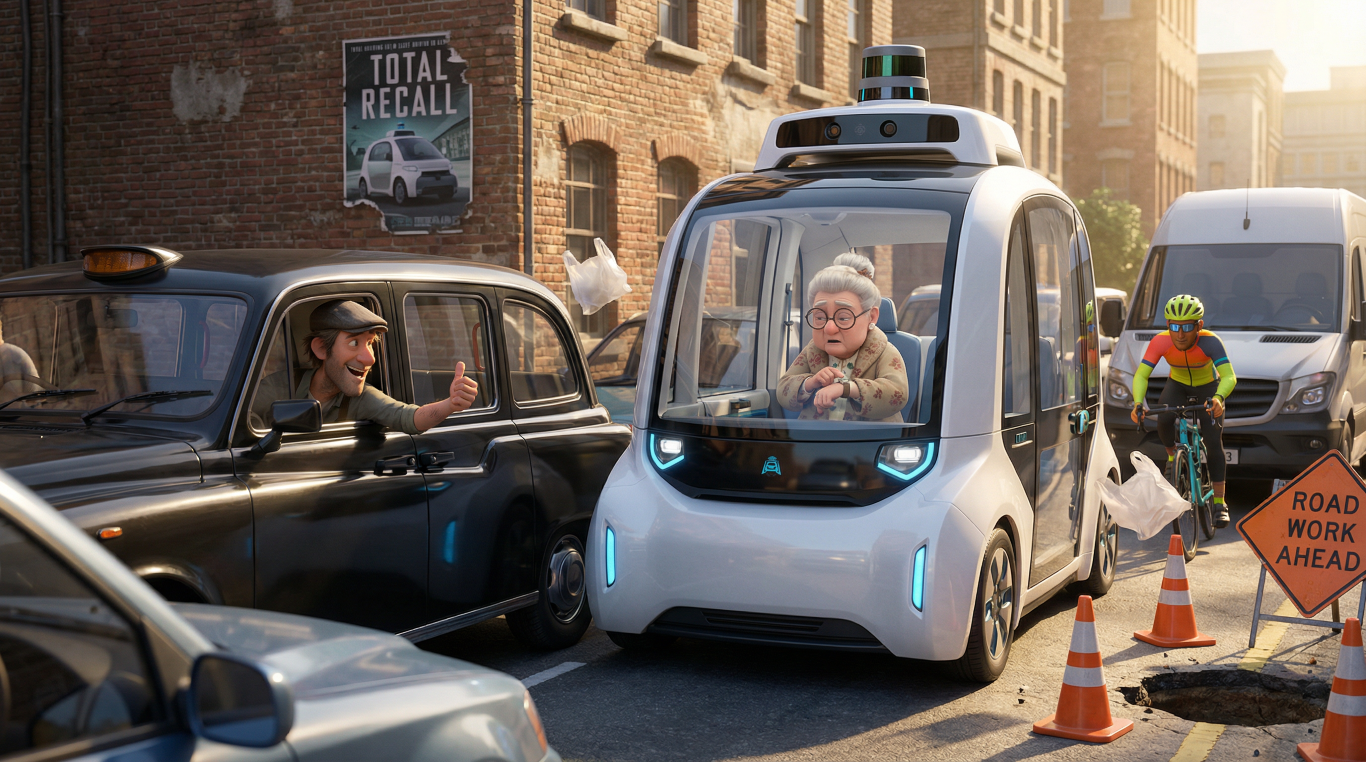
I remember watching Total Recall as a kid, that scene with Arnold Schwarzenegger in a self-driving taxi, and thinking, “Yeah, that’s definitely happening by the year 2000.” Well, here we are in 2026, and I’m still watching my Uber driver argue with their satnav. So what actually happened to driverless taxis? Where’s my robot chauffeur? Let me take you on a journey through one of technology’s most ambitious promises, and why it’s been a bit like waiting for a bus that may or may not ever arrive.
Why Driverless Taxis Matter More Than You Think
Look, I get it. The idea of a car with no driver sounds like something from a science fiction film, somewhere between hoverboards and teleportation. But here’s the thing: autonomous taxis aren’t just a fancy gimmick for tech enthusiasts to get excited about. They’re potentially one of the most important technologies of our generation, and I’m not being dramatic.
Think about this for a moment. In the UK alone, human error causes about 85% of all road accidents. That’s not me having a go at anyone’s driving, it’s just facts. We get tired, we get distracted, we check our phones when we shouldn’t, we misjudge that gap in traffic. A properly functioning robotaxi doesn’t do any of that. It doesn’t get road rage, it doesn’t drive after three pints at the pub, and it certainly doesn’t try to apply mascara whilst doing 60 on the M25.
Beyond safety, there’s the whole independence angle. My mum’s 73, sharp as a tack, but her eyesight isn’t what it used to be. She had to give up driving last year, and it broke her heart. Her freedom, just gone. Now she relies on me, my sister, or expensive taxi services to get anywhere. Imagine if she could just summon a driverless taxi whenever she needed. That’s not just convenient, that’s life-changing.
And then there’s the environmental bit. These autonomous taxis could be electric, could be shared efficiently, could reduce the number of cars clogging up our cities. They could reshape our urban spaces entirely. So yeah, it matters. It really, really matters.
What Driverless Taxis Are Actually Used For (And What They’re Not)
Here’s where reality meets expectation, and it’s a bit of a mixed bag. Right now, in 2026, driverless taxis do exist. They’re real. They’re operating. But before you start deleting your Uber app, let me tell you where and how.
The most successful robotaxi services are running in very specific places. Waymo, owned by Google’s parent company, operates in parts of San Francisco, Phoenix, and Los Angeles. I’m talking specific neighbourhoods, not entire cities. Baidu’s running something similar in parts of China. Cruise was doing it in San Francisco too, though they’ve had to pause operations after some incidents (we’ll get to that later, trust me).
What are they used for? Regular taxi journeys, basically. You open an app, request a ride, a car shows up with no driver, and off you go. People use them for commuting, shopping trips, nights out. The novelty factor has worn off in these areas, they’re just part of the transport mix now.
But here’s what they’re NOT used for: everywhere else. They’re not zipping around London or Manchester or Edinburgh. They’re not handling complex rural roads. They’re not operating in heavy snow or torrential rain. They’re not doing the school run in chaotic car parks. They’re certainly not replacing your mate Dave who drives a black cab and knows every shortcut in the city.
Why? Because the technology, whilst impressive, still needs very specific conditions. These cars need detailed 3D maps of every street they operate on. They struggle with unexpected situations, like a police officer directing traffic or roadworks that appeared overnight. They’re brilliant at what they do, but what they do is still quite limited.
The Journey to Autonomous Taxis: A Timeline of Ambition
The dream of self-driving cars isn’t new. General Motors showcased the concept at the 1939 World’s Fair, imagining automated highways. But actual progress? That took decades.
The Early Experiments (1980s-2000s)
The first real attempts at autonomous vehicles came from universities and research labs in the 1980s. These were clunky, slow, and could barely handle an empty car park, let alone real roads. Carnegie Mellon University had a van called NavLab in 1984 that could sort of drive itself in very controlled conditions. It was about as graceful as a shopping trolley with a wonky wheel.
Then in 2004 and 2005, something changed. DARPA, the US military research agency, held challenges for autonomous vehicles. The first one? Every single vehicle failed to complete the course. We’re talking cars getting stuck, catching fire, driving in circles. It was simultaneously hilarious and depressing. But the second challenge in 2005 saw five vehicles complete the course. Progress was happening.
The Google Revolution (2009-2015)
This is when things got serious. Google started its self-driving car project in 2009, and suddenly this wasn’t just academic research anymore. They had money, they had talent, and they had ambition. By 2012, their cars had driven over 300,000 miles autonomously.
The benefit over previous versions? Everything. These cars used a combination of cameras, radar, and something called LIDAR (think of it as sonar but with lasers instead of sound) to see the world around them. They had powerful computers processing all this information in real-time. They could handle real roads with real traffic.
Other companies noticed. Tesla started adding autonomous features to their cars. Traditional car manufacturers like Ford and GM scrambled to catch up. Uber announced plans for driverless taxis. Everyone wanted a piece of this future.
The Reality Check (2016-Present)
Then reality started biting back. In 2018, an Uber autonomous test vehicle killed a pedestrian in Arizona. It was the first pedestrian death caused by a self-driving car, and it sent shockwaves through the industry. Suddenly, everyone realized this was harder than they thought.
Timelines got pushed back. Elon Musk kept promising fully autonomous Teslas “next year” (he’s been saying that since about 2014, and we’re still waiting).
But progress continued. Waymo spun out from Google in 2016 and started actual commercial robotaxi services in 2018 in Phoenix. Cruise, backed by GM, launched in San Francisco. These weren’t test programs anymore, these were real services with real paying customers.
The benefit of current versions over those early experiments? Night and day. Modern autonomous taxis can handle complex urban environments, recognize thousands of different objects and scenarios, make decisions in milliseconds, and do it all safely, most of the time. They’re not perfect, but they’re genuinely impressive.
How These Robot Taxis Actually Work
Right, let me break this down without drowning you in jargon. Think of a driverless taxi as having three main jobs: seeing, thinking, and doing.
The Seeing Bit
A robotaxi is absolutely covered in sensors. I mean covered. It’s like giving a car dozens of eyes, all looking in different directions at once.
There’s LIDAR, which I mentioned earlier. Imagine the car is constantly shooting out invisible laser beams in all directions. When those beams hit something, a wall, another car, a person, a cat, they bounce back. The car measures how long that took and creates a 3D map of everything around it. It’s doing this constantly, updating that map many times per second.
Then there are cameras, usually eight or more, giving the car a 360-degree view. These work like your eyes, seeing colours, reading signs, spotting traffic lights.
Radar sensors fill in the gaps, especially useful for detecting things at long distances or in bad weather when cameras struggle.
GPS tells the car roughly where it is, though it’s not accurate enough on its own. That’s why these cars need those detailed pre-made maps I mentioned. The car constantly compares what its sensors see with what the map says should be there.
The Thinking Bit
All that sensor data, we’re talking gigabytes every second, floods into the car’s computer. And when I say computer, I mean something more powerful than the laptop you’re probably reading this on. It’s running artificial intelligence software that’s been trained on millions of miles of driving data.
The AI has to do several things at once. First, it identifies everything it sees. That’s a car, that’s a pedestrian, that’s a bicycle, that’s a traffic cone, that’s a plastic bag blowing across the road (hopefully it knows not to swerve for that one). Then it predicts what everything might do next. Will that pedestrian step into the road? Is that car going to change lanes? It’s constantly playing out scenarios.
Finally, it decides what to do. Speed up, slow down, change lanes, stop, turn. It’s making these decisions many times per second, faster than any human could.
The Doing Bit
Once the AI decides what to do, it controls the car. Steering, accelerating, braking, all done electronically. Modern cars already have a lot of this technology, things like electronic stability control and automatic emergency braking. Autonomous vehicles just take it to the extreme.
There are also safety systems watching the watchers. Multiple computers cross-checking each other, backup systems ready to take over if something fails. It’s redundancy on top of redundancy.
The Future: Where Are We Actually Heading?
Here’s where I’m supposed to paint you a picture of a gleaming autonomous future where robotaxis glide silently through pristine cities. But I’m going to be honest with you instead.
The future of driverless taxis is complicated. We’re definitely getting there, but it’s slower than anyone predicted. Remember how I said Elon Musk has been promising full autonomy “next year” for a decade? That should tell you something about how hard this problem is.
In the next five years, I think we’ll see autonomous taxis expand to more cities, but still in limited areas. They’ll get better at handling weather and unusual situations. The cost will come down as the technology matures. You might actually be able to hail one in a major UK city, though I wouldn’t bet my house on it.
In ten to fifteen years? That’s when things could get really interesting. We might see robotaxis become common in urban areas. Car ownership might start declining as people realize they can just summon a cheap autonomous ride whenever they need one. Parking spaces could be converted to parks or housing. City planning could fundamentally change.
But, and this is a big but, we need to solve some serious problems first. The technology needs to work in all weather conditions, not just sunny California days. It needs to handle the unexpected, the truly random chaos of real life. A cow escaped onto the M6 last year, would an autonomous car know what to do with that?
We also need regulations to catch up. Right now, the legal framework for driverless cars is a patchwork of different rules in different places. Insurance is a nightmare to figure out. If a robotaxi crashes, who’s liable? The passenger? The company? The software engineer who wrote the code?
So What Actually Happened to Driverless Taxis?
Let me bring this all together. What happened to driverless taxis? They’re here, but they’re not quite the revolution we were promised.
The dream was sold to us as imminent, just around the corner, arriving next year. Every year. And whilst the technology has made remarkable progress, going from vehicles that couldn’t handle an empty car park to ones that can navigate complex city streets, it turns out that last 10% is incredibly difficult.
Autonomous taxis are operating right now in select cities, giving hundreds of thousands of rides. That’s genuinely impressive. But they’re not everywhere, they’re not replacing human drivers en masse, and they’re still figuring out how to handle the full complexity of real-world driving.
The technology is real, the benefits are real, the potential is enormous. Safer roads, more independence for people who can’t drive, more efficient cities, reduced emissions. These aren’t fantasies, they’re achievable goals.
But so are the challenges. Technical limitations, regulatory hurdles, security concerns, ethical questions, and the simple fact that the real world is messy and unpredictable in ways that are hard to code for.
I think robotaxis will eventually become normal, part of the fabric of how we get around. But it’s going to take longer than the optimists predicted. Maybe that’s okay. Maybe we need that time to get it right, to solve the hard problems, to build systems that are genuinely safe and trustworthy.
In the meantime, I’m keeping my Uber app installed. And I’m still trying to convince my mum that no, the fully autonomous car I promised her isn’t quite ready yet, but maybe in a few more years. She’s stopped believing me, to be honest. Can’t say I blame her.
The future of transport is coming. It’s just taking the scenic route.
Walter
Leave a Reply