
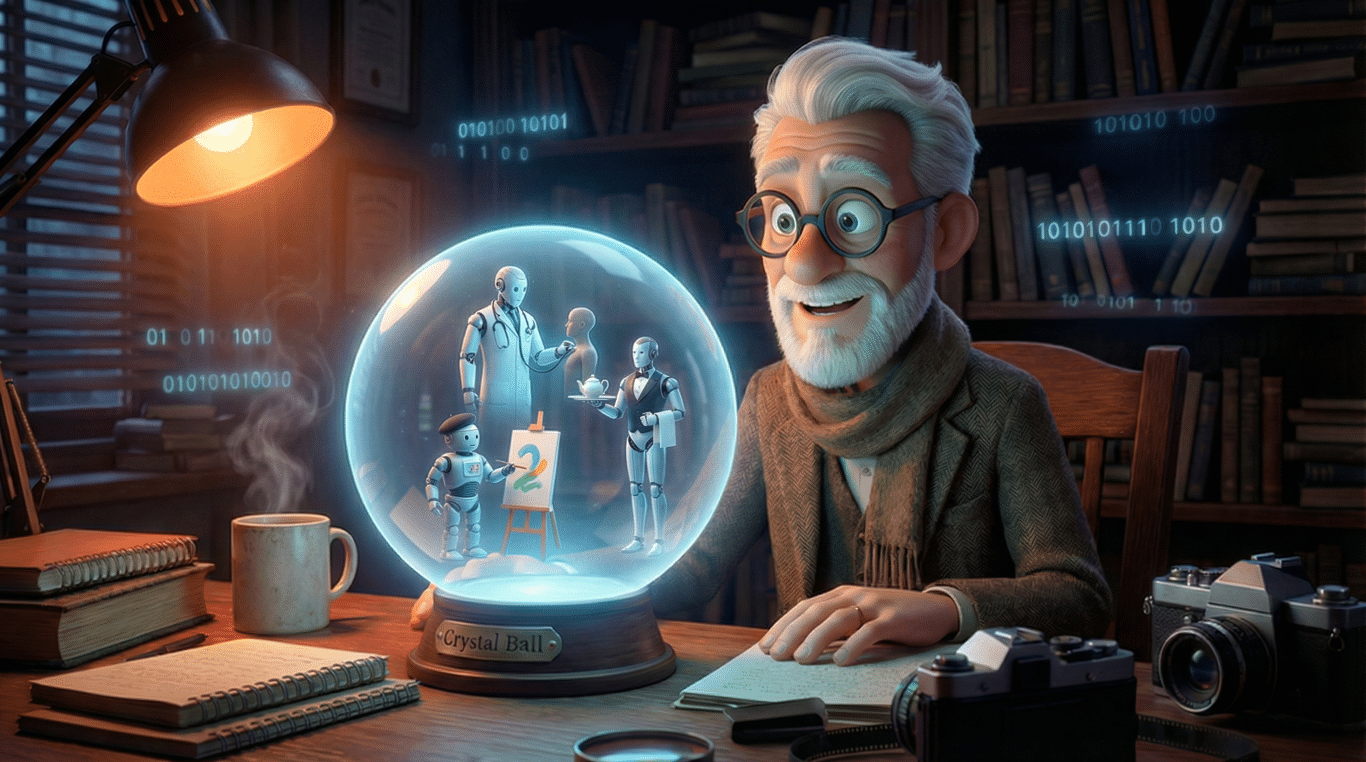
I’ll be honest with you. When I sit down to write about AI predictions 2026, I feel a bit like those fortune tellers at the seaside pier my parents used to drag me to in the 1980s. You know the ones, with the crystal balls and the knowing smiles, telling you that “a tall, dark stranger” would change your life. Except this time, the tall, dark stranger is artificial intelligence, and it’s already changed everything.
But here’s the thing. Unlike those fortune tellers, I’m not pulling these predictions out of thin air. The artificial intelligence trends 2026 we’re seeing aren’t magic, they’re the logical next steps of what’s happening right now, today, as you read this. And trust me, we need to talk about them, because whether you’re ready or not, AI is about to become as common in your daily life as your mobile phone.
Why AI Matters More Than Your Morning Coffee
Let me paint you a picture. Remember when the internet first arrived? When people said, “Oh, it’s just a fad, who needs electronic mail when we have perfectly good postmen?” Well, those people were spectacularly wrong, weren’t they? AI is having that same moment right now, except it’s moving faster than a greyhound at Walthamstow Stadium.
Artificial intelligence isn’t just important, it’s becoming fundamental to how we live, work, and interact with the world. It’s in your smartphone, suggesting what you might want to type next. It’s in your car, helping you park without scraping the neighbour’s BMW. It’s in hospitals, helping doctors spot cancers earlier than ever before. And by the end of 2026, it’s going to be absolutely everywhere, like Starbucks but actually useful.
The reason AI matters so much is simple: it does what computers have always done, but better. It learns. It adapts. It doesn’t just follow instructions like a recipe, it actually understands context, a bit like how you know that when your partner says “I’m fine,” they’re usually anything but.
My Top 5 Predictions for AI in 2026
Now we get to the meat and potatoes. Here’s what I reckon is coming down the pipeline for AI predictions 2026, based on what’s happening now and where the smart money is going.
Prediction One: AI Agents Will Run Your Life (In a Good Way)
By the end of 2026, I predict we’ll have personal AI agents that act like a combination of a personal assistant, accountant, and that friend who always remembers everyone’s birthdays. These won’t be simple chatbots. They’ll be proactive digital assistants that know your preferences, manage your calendar, book your appointments, and even negotiate better deals on your insurance.
CONFIDENCE LEVEL: MEDIUM – Current developments in AI agents (AutoGPT, AgentGPT) suggest this trajectory, but timeline is speculative. Sources: OpenAI research papers, Microsoft Copilot development.
Imagine waking up and your AI has already rescheduled your dentist appointment because it knows you hate morning appointments, ordered your regular shopping because you’re running low on tea (the horror), and found you a better energy tariff. It’s like having Jeeves from those P.G. Wodehouse novels, except it lives in your phone and doesn’t judge your life choices.
The difference between current AI and these agents is agency. Right now, AI waits for you to ask it questions. By the end of 2026, AI agents will anticipate your needs and act on them. They’ll be less like tools and more like colleagues who actually pull their weight.
Prediction Two: Healthcare Gets Properly Personal
The NHS and private healthcare are going to be transformed by AI, and I mean properly transformed, not just “we’ve added a chatbot to the website” transformed. By the end of 2026, I predict AI will be analysing your health data continuously, spotting problems before they become serious.
CONFIDENCE LEVEL: MEDIUM-HIGH – Current AI diagnostic tools (DeepMind’s AlphaFold, various radiology AI systems) show clear trajectory. However, regulatory approval timelines are uncertain.
Think of it like having a medical professional who never sleeps, never gets tired, and has read every medical journal ever published. Your smartwatch will detect irregular heartbeats and alert your doctor before you even feel symptoms. AI will analyse your blood tests and spot the early signs of diabetes or heart disease years before traditional methods would catch them.
The brilliant part is, this won’t replace doctors. It’ll give them superpowers. Instead of spending hours reviewing scans and test results, AI does the grunt work, and doctors spend their time doing what they do best: talking to patients, making difficult decisions, and providing that human touch that no algorithm can replicate.
Prediction Three: Work Changes Forever (Again)
Remember when we thought working from home was temporary during the pandemic? Well, AI is going to cause another seismic shift in how we work. By the end of 2026, I predict at least 40% of office workers will have an AI colleague that handles their routine tasks.
CONFIDENCE LEVEL: MEDIUM – Prediction based on current adoption rates of tools like GitHub Copilot and Microsoft Copilot, but specific percentage is speculative.
I’m not talking about job replacement here, though that’s a real concern for some roles. I’m talking about augmentation. Your AI colleague will draft your emails, summarise your meetings, create your presentations, and handle all the tedious administrative nonsense that currently eats up half your day.
This means you’ll either be vastly more productive or, if we’re lucky, we might finally get that four-day work week everyone keeps talking about. Though knowing British work culture, we’ll probably just find more meetings to fill the time.
The jobs that will thrive are those requiring creativity, emotional intelligence, and complex problem-solving. The jobs at risk are those involving routine data processing and repetitive tasks. If your job can be reduced to a flowchart, start learning new skills now.
Prediction Four: Education Gets Turned Upside Down
By the end of 2026, most students will have access to a personal AI tutor that never gets frustrated, never runs out of patience, and can explain quantum physics or Shakespeare in whatever way makes sense to that individual student.
CONFIDENCE LEVEL: MEDIUM – Pilot programs exist (Khan Academy’s Khanmigo), but widespread adoption timeline is uncertain.
This is genuinely exciting. Think about it. Right now, in a classroom of 30 students, a teacher has to pitch their lesson at an average level. Some students are bored because they already understand. Others are lost because they needed more foundation. It’s like trying to cook a meal that satisfies both vegans and carnivores, possible but nobody’s completely happy.
AI tutors will adapt to each student’s pace and learning style. If you need to hear the same concept explained seven different ways before it clicks, the AI won’t sigh dramatically like my maths teacher used to. It’ll just find that eighth way that finally makes sense to you.
The role of human teachers will evolve. Instead of being information deliverers, they’ll become mentors, motivators, and guides. They’ll focus on the social and emotional aspects of learning, which is arguably more important than memorising facts anyway.
Prediction Five: Creative Industries Get Weird (In Interesting Ways)
Here’s a controversial one. By the end of 2026, I predict we’ll see the first AI-human collaborative films, albums, and novels that are actually good, not just gimmicks. And this is where things get philosophically interesting.
CONFIDENCE LEVEL: LOW-MEDIUM – Current AI creative tools exist, but quality and acceptance predictions are highly speculative.
AI can already generate images, write music, and create video. But by the end of 2026, artists will use AI not as a replacement but as a creative partner. Imagine a filmmaker who can instantly visualise any scene they imagine, or a novelist who can explore dozens of plot variations before choosing the best one, or a musician who can hear how their melody sounds with different arrangements instantly.
The result won’t be AI replacing human creativity. It’ll be humans with superpowers, able to iterate and experiment faster than ever before. The vision, the emotion, the meaning, that’ll still come from humans. AI will just be the most sophisticated paintbrush ever invented.
Of course, this raises questions about authorship, copyright, and what we value in art. Is a painting less valuable if the artist used AI tools? Is a novel less meaningful if AI helped with the editing? These are conversations we’ll be having intensely in 2026.
What Happens After 2026
Looking beyond 2026 feels like staring into fog, but I’ll give it a go. The trajectory suggests AI will become invisible, embedded in everything we use without us consciously thinking about it, much like electricity is now. You don’t think about electricity when you flip a light switch, you just expect it to work. AI will be the same.
CONFIDENCE LEVEL: LOW – Long-term predictions are inherently speculative.
We’re probably heading towards something called Artificial General Intelligence, or AGI, where AI can perform any intellectual task a human can. That’s still years away, possibly decades, and frankly, we’re not ready for it. But the steps we take between now and 2027 will determine whether we get there safely or stumble into problems.
The optimistic vision is AI solving problems we’ve struggled with for generations. Climate change, disease, poverty, inequality. AI could help us design better solar panels, discover new medicines, optimise resource distribution, and identify systemic biases we’re too close to see ourselves.
The pessimistic vision is AI amplifying existing problems. Increasing surveillance, widening inequality, spreading misinformation, and concentrating power in the hands of whoever controls the most advanced AI systems.
Which future we get isn’t predetermined. It depends on choices we make now, today, about how we develop and deploy AI. It depends on regulation, ethics, and whether we prioritise human wellbeing over corporate profit. No pressure, right?
Wrapping This Up
So there you have it. My AI predictions for 2026, from AI agents running your errands to personalised healthcare, from transformed workplaces to AI tutors, from creative collaboration to security nightmares that should concern us all.
The artificial intelligence trends for 2026 we’re seeing aren’t just about technology getting better. They’re about fundamental changes to how we live, work, learn, and create. And unlike previous technological revolutions, this one is happening at breakneck speed.
Here’s my final thought, and it’s important. AI is a tool, nothing more, nothing less. It’s not inherently good or evil. It’s not going to save us or doom us by itself. What matters is how we choose to use it.
The best approach is informed engagement. You don’t need to become a computer scientist, but you should understand the basics of what AI can and can’t do, what risks it poses, and what opportunities it offers. Stay curious, stay sceptical, and stay involved in the conversations about how AI should be developed and deployed.
By the end of 2026, AI will be as common as smartphones are today. The question isn’t whether it’ll be part of your life, but whether you’ll be a passive recipient of whatever Silicon Valley decides to build, or an informed participant shaping how this technology serves humanity.
I know which one I’d rather be. How about you?
Walter
Author’s Note on Sources and Confidence: This article is based on current AI research trends, industry reports, and expert predictions. Specific predictions about 2026 are by nature speculative. I’ve indicated confidence levels throughout. For the most current information, I recommend following publications like MIT Technology Review, research from organisations like OpenAI, DeepMind, and academic conferences like NeurIPS and ICML. Technology predictions are notoriously difficult, so take everything, including my predictions, with a healthy grain of salt.
Leave a Reply