
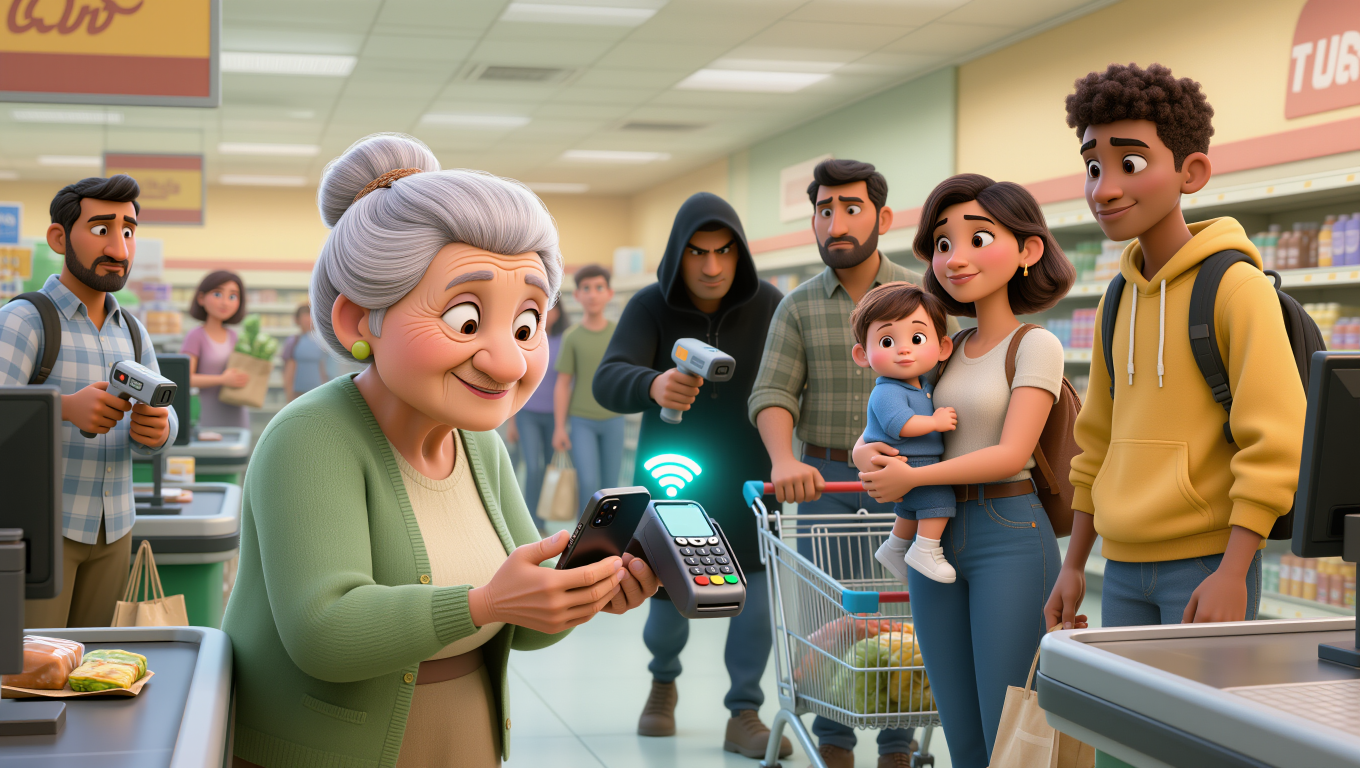
When I first heard about NFC, I thought someone was talking about a new football league. Near Field Communication? Sounds like something from a sci-fi film, doesn’t it? But here’s the thing: you’ve probably been using it for ages without even realising it. Every time you tap your card at the checkout, or hold your phone up to pay for your morning coffee, that’s NFC doing its magic. And like most magic tricks, once you understand how it works, it’s both brilliant and slightly terrifying.
So let’s talk about whether this technology is the best thing since sliced bread, or whether we should all be wrapping our wallets in tin foil and hiding under the bed. Spoiler alert: it’s a bit of both.
Why Should You Even Care About NFC Technology?
Remember when paying for something meant fumbling around for exact change, or worse, writing a cheque whilst everyone behind you in the queue gave you the evil eye? Those days are gone, and near field communication is largely responsible for that small miracle.
NFC technology has quietly revolutionised how we do dozens of things every single day. It’s made our lives faster, simpler, and honestly, a bit more futuristic. We’re living in a world where you can tap your phone against a poster and instantly get information, or share photos with a friend just by bumping phones together. It’s the kind of technology that seemed impossible when we were younger, yet now we barely notice it.
But here’s why it matters more than you might think. This technology is everywhere now. It’s in your bank cards, your phone, your travel pass, even some modern car keys. It’s handling your money, your personal information, and your daily movements. That makes it incredibly important to understand, because something this useful and this widespread deserves more than just blind trust.
What NFC Is Actually Used For (And What It Isn’t)
Let me paint you a picture of where NFC pops up in your daily life. The most obvious one is contactless payments. That little tap of your card or phone at the till? That’s NFC. Your Oyster card or travel pass? NFC again. Those new passports that you just hold up to the scanner at the airport? You guessed it.
But it goes further than that. Some people use NFC tags in their homes, little stickers you can tap with your phone to automatically adjust your lights, heating, or music. Fancy, right? Museums and galleries use NFC to let you tap your phone against exhibits for more information. Some modern hearing aids use it to adjust settings. Even some washing machines now let you download new cycles via NFC. I know, I didn’t believe that last one either until I saw it myself.
Now, what isn’t NFC used for? Well, it’s not for long-distance communication. If someone tells you they can read your NFC card from across the room, they’re having you on. It’s also not used for transferring large amounts of data, it’s far too slow for that. You won’t be streaming films over NFC, and you can’t use it to connect to the internet. It’s a specialist tool, not a Swiss Army knife.
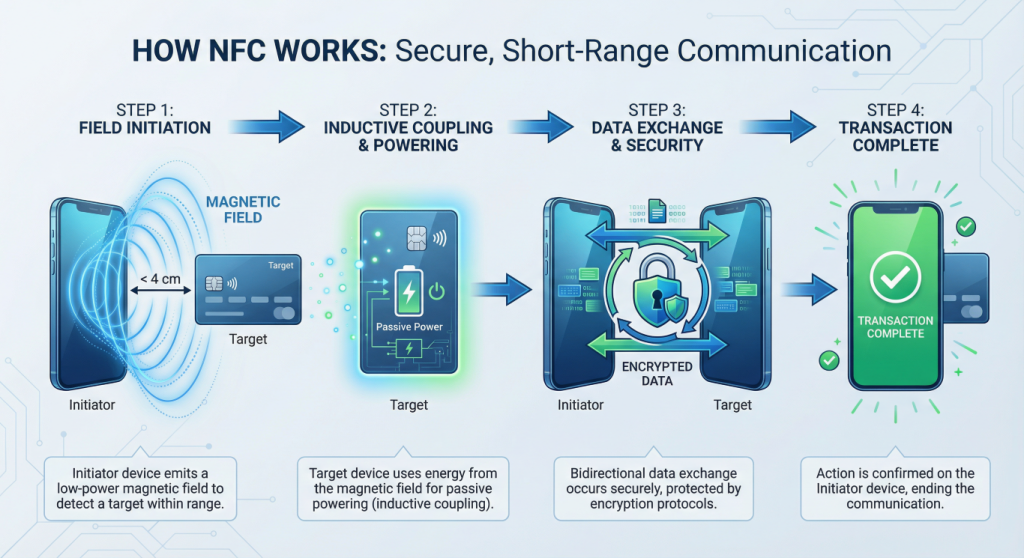
The reason it’s not used for these things is simple: NFC only works over very short distances, usually less than four centimetres. That’s about the length of a matchbox. This limitation is actually part of its security design, though as we’ll discuss later, it’s not foolproof.
The Old Days: What We Had Before NFC
Cast your mind back to the 1990s and early 2000s. If you wanted to pay for something, you either used cash or you stuck your card in a machine and waited whilst it made those delightful beeping and whirring sounds. Sometimes it would dial up through a phone line, which took ages. We had magnetic stripes on our cards, the same technology that’s been around since the 1960s.
For access control, we had those chunky proximity cards you’d wave near a reader, or worse, actual physical keys. Sharing information between devices meant infrared beaming, where you had to line up two devices perfectly and pray nobody walked between them. Or you’d use Bluetooth, which required about fifteen steps to pair devices and usually ended with you wanting to throw something out the window.
Everything was slower, clunkier, and required more steps. We accepted it because we didn’t know any better. It’s like how we used to think dial-up internet was perfectly acceptable. The memory makes me shudder now.
The Evolution of NFC: From Clunky to Clever
The story of NFC technology starts properly in the early 2000s, though its roots go back further. Sony and Philips, two tech giants, were working on similar technologies. Sony had something called FeliCa, which was big in Japan for transit cards, and Philips had their own system. In 2002, they decided to stop competing and start cooperating, which is refreshingly mature for tech companies.
In 2004, they joined forces with Nokia (remember them?) to create the NFC Forum. This was crucial because they established standards, which meant different manufacturers’ devices could actually talk to each other. Without this, we’d have ended up with the same mess we had with video formats, remember Betamax versus VHS?
The first NFC-enabled mobile phone appeared in 2006. It was a Nokia, naturally, and it was mainly used in trials. Most people didn’t have one, and there wasn’t much you could do with it anyway. It was a solution looking for a problem.
The real breakthrough came around 2011 when Google started pushing NFC in Android phones. Suddenly, the technology had a champion with deep pockets and big ambitions. Apple, being Apple, held off until 2014 when they added NFC to the iPhone 6, but only for Apple Pay. They’ve since opened it up more, though they’re still more restrictive than Android.
Each version and update has focused on three things: making it faster, making it more secure, and making it use less battery power. The latest versions can transfer data at up to 424 kilobits per second, which sounds slow compared to Wi-Fi, but remember, NFC isn’t meant for big files. It’s meant for quick, simple exchanges. Think of it as the difference between sending a postcard and mailing a whole photo album.
The benefits over each previous iteration have been incremental but important. Better encryption, longer battery life, more reliable connections, and wider compatibility. It’s not exciting stuff, but it’s the kind of steady improvement that makes technology actually useful rather than just clever.
How NFC Actually Works: The Simple Version
Right, let’s demystify this. I promise to keep it simple, no physics degree required.
Imagine two people having a conversation while standing very close together, whispering. That’s basically NFC. One device (let’s call it the initiator) creates a small magnetic field. The other device (the target) sits in that field and uses the energy from it to power up and communicate back. It’s rather elegant, really.
Here’s how it works step by step. First, you bring two NFC devices close together, within a few centimetres. The initiator, which is usually your phone or the payment terminal, sends out a radio signal. This creates that magnetic field I mentioned.
The target device, perhaps your contactless card, doesn’t even need its own power source. It uses the energy from the magnetic field to wake up and respond. Clever, isn’t it? This is why your contactless card works even though it doesn’t have a battery.
Once they’re talking, they exchange information. For a payment, your card sends your payment details to the terminal. The terminal checks with your bank, gets approval, and sends back a confirmation. All of this happens in less than a second.
The devices use something called inductive coupling, which is the same principle that lets you charge some phones wirelessly. The magnetic field transfers both power and data. It’s like having a conversation and charging your phone at the same time, if that makes sense.
The security comes from several layers. The communication is encrypted, which means the data is scrambled so eavesdroppers can’t read it. Each transaction often uses a unique code that can’t be reused. And the short range means someone would need to be suspiciously close to intercept anything.
The Future: Where Is NFC Heading?
Crystal ball time. Where’s all this going? Well, near field communication isn’t standing still. The technology keeps evolving, and its uses keep expanding.
We’re already seeing NFC being built into more and more things. Smart packaging is coming, where you’ll tap products in shops to see where they came from, how they were made, and whether they’re genuine. No more fake designer handbags, at least in theory.
Healthcare is getting interested. Imagine tapping your phone to your medication bottle and having it remind you when to take your pills, or warn you about interactions with other medicines. Some diabetes monitors already use NFC to share readings with your phone.
Car manufacturers are increasingly using NFC for keyless entry and starting. Your phone becomes your car key, which is brilliant until your phone battery dies and you’re locked out. I’m sure they’ll sort that bit out eventually.
The smart home market is embracing NFC too. Tap your phone here to turn on the lights, tap it there to start the coffee maker. It’s all very Jetsons, isn’t it?
One interesting development is NFC-enabled clothing and accessories. Yes, really. Jackets with NFC tags in the cuffs, rings that can make payments, even nail art with NFC chips embedded. Whether we need any of this is debatable, but it’s certainly creative.
The technology itself is getting faster and more capable. Future versions will handle more complex transactions, work over slightly longer distances, and integrate better with other technologies like blockchain for enhanced security.
Security and Vulnerabilities: The Bit That Should Keep You Slightly Concerned
Now we get to the uncomfortable bit. Is NFC secure? Well, yes and no. It’s like asking if your front door is secure. It’s better than no door at all, but a determined burglar with the right tools can still get through.
Let’s talk about NFC security risks honestly. The short range is your first line of defence. Someone would need to get their device within a few centimetres of yours to intercept anything. That’s difficult to do without you noticing, though not impossible in a crowded tube or busy shop.
The first real concern is eavesdropping. In theory, someone with sophisticated equipment could intercept the radio signals between your card and a payment terminal. In practice, this is quite difficult because the signals are weak and the encryption is strong. But difficult isn’t the same as impossible.
Then there’s data manipulation, where an attacker intercepts and changes the data being transmitted. Again, encryption makes this hard, but vulnerabilities have been found in some implementations over the years. They usually get patched quickly, but there’s always a window of risk.
Relay attacks are more worrying. This is where criminals use two devices, one near your card and one near a payment terminal, to relay the signal between them. They could theoretically make a payment using your card whilst you’re nowhere near the shop. It’s sophisticated, but it has happened.
There’s also the risk of malicious NFC tags. Someone could stick a dodgy NFC sticker over a legitimate one, say on a poster or in a shop. When you tap it, instead of getting the information you expected, your phone gets directed to a phishing website or downloads malware. Always be cautious about tapping random NFC tags.
Lost or stolen devices are perhaps the biggest practical risk. If someone nicks your phone and it’s not properly secured, they might be able to use your NFC payment apps. This is why PIN codes, fingerprints, and face recognition are so important.
So what should you do about these NFC security risks? First, don’t panic. The actual risk of being targeted is quite low for most people. But do be sensible. Use a phone case that blocks NFC when you’re not using it, or keep your cards in an RFID-blocking wallet. These are cheap and effective.
Keep your phone’s software updated. Those annoying update notifications? They often include security patches. Enable all the security features on your payment apps, lock screens, biometric authentication, transaction notifications, the lot.
Be cautious about what NFC tags you tap. If something seems dodgy, it probably is. Check your bank statements regularly. Most fraud is caught by the banks’ systems, but it’s worth keeping an eye out yourself.
And here’s a practical tip: set low limits on your contactless payments if you can. Many banks let you do this. If your card gets skimmed, at least the damage is limited.
Wrapping This All Up
So, is NFC technology a great technology or a security threat? The answer, annoyingly, is both. It’s genuinely brilliant technology that’s made our lives easier in countless ways. The convenience of tap-and-go payments alone has saved us all hundreds of hours of standing around waiting for chip-and-PIN machines.
But like any technology, it’s not perfect. There are genuine security concerns, and while the risks are generally low, they’re not zero. The key is to understand both the benefits and the risks, and to use the technology sensibly.
Think of it like driving a car. Cars are incredibly useful, they’ve transformed society, and most of us use them daily without incident. But they’re also potentially dangerous if misused or if safety features are ignored. You wouldn’t stop driving because of the risks, but you would wear a seatbelt and follow the speed limits.
That’s how we should approach near field communication. Use it, enjoy the convenience it brings, but take sensible precautions. Keep your devices secure, stay aware of your surroundings when making payments, and keep your software updated.
The technology isn’t going anywhere. If anything, it’s going to become even more prevalent. More devices, more uses, more integration into our daily lives. That makes understanding it, and understanding its limitations, more important than ever.
I’ve gone from thinking NFC was some obscure technical acronym to realising it’s one of the most important technologies in my daily life. I use it dozens of times a week without thinking about it. And now that I understand how it works and what the risks are, I can use it confidently.
You can too. Just maybe don’t tap every random NFC sticker you see, and definitely don’t throw away that software update notification. Your future self will thank you.
Walter
Leave a Reply