

Why This Technology Matters More Than You Think
Look, I’ll be straight with you. The first time I learned that shops were using cameras to read my face and detect my emotions, I felt a bit like I’d walked into a science fiction film. Not the fun kind with time travel and flying cars, but the slightly unsettling kind where everything feels a bit too clever for its own good.
But here’s the thing: AI facial recognition retail technology isn’t just some futuristic gimmick anymore. It’s already here, quietly working away in shops you’ve probably visited. And whether that makes you excited or slightly queasy (or both, like me), it’s become one of the most important technologies reshaping how businesses understand and interact with customers.
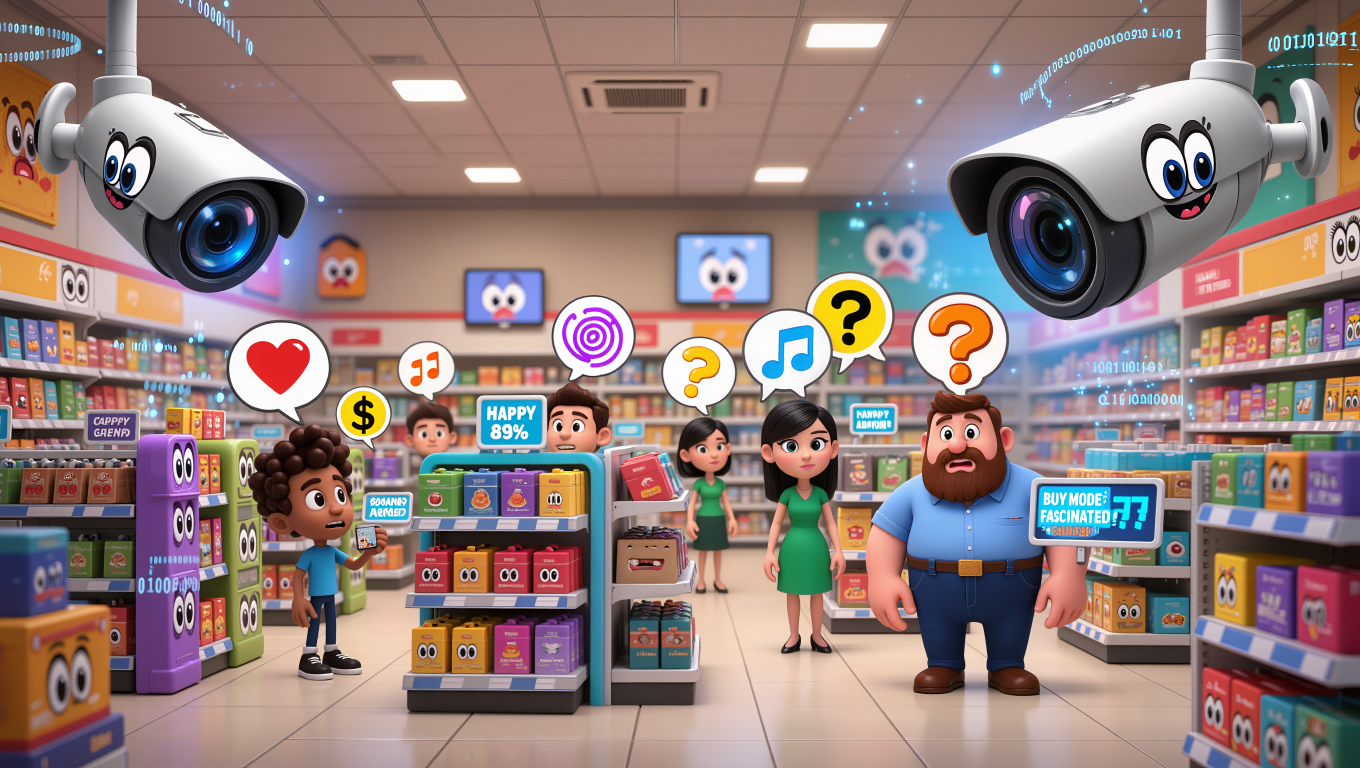
Why does it matter? Because for the first time in retail history, shops can understand not just what you buy, but how you feel while you’re shopping. They can see if you’re confused by a product display, frustrated at a queue, or delighted by a special offer. It’s like giving every shop assistant a superpower to read minds, except it’s cameras and algorithms doing the heavy lifting.
And yes, before you ask, this does raise some rather significant questions about privacy. Questions we absolutely need to talk about. But first, let me take you on a journey through this technology, because understanding it is the first step to deciding how you feel about it.
What Facial Recognition Technology Is Actually Used For (And What It Isn’t)
Let me clear something up right away. When we talk about facial recognition technology in retail, we’re actually discussing two related but different things.
First, there’s traditional facial recognition, which identifies who you are. Think of it like the technology that unlocks your smartphone when it sees your face. In retail, this might be used for security purposes, like spotting known shoplifters or identifying VIP customers for special treatment.
Then there’s emotion detection technology, which is the newer, slightly more peculiar cousin. This doesn’t identify you personally. Instead, it analyses your facial expressions to guess what you’re feeling. Are you happy? Confused? Bored? Annoyed? The system makes educated guesses based on your expression.
Now, what are shops actually using this for? Primarily, they’re trying to understand customer behaviour in real time. If the system notices that people consistently look confused in a particular aisle, perhaps the signage needs improving. If customers appear frustrated near the checkout, maybe more tills need opening. If someone lingers by a product display looking interested, that’s valuable data about what catches attention.
Some shops use it for targeted advertising too. Digital displays can change their content based on who’s looking at them, showing different products to different age groups or genders. A bit like having a shop window that rearranges itself depending on who walks past.
What it’s NOT used for, at least in most legitimate retail settings, is creating detailed personal profiles of your shopping habits linked to your identity without consent. It’s not (supposed to be) following you from shop to shop building a dossier on your life. And it’s definitely not meant to be shared with random third parties who want to bombard you with marketing.
The key word there, though, is “supposed.” And that’s exactly why we need to stay informed and a bit cautious.
The Old Days: How Shops Understood Customers Before All This
Remember when understanding customer behaviour meant actually watching customers? I do. I worked a summer job in a department store back in the day, and management would literally stand on the shop floor with clipboards, counting footfall and observing where people went.
They’d use those clicker counters, the mechanical ones that made a satisfying click each time you pressed them. Someone would stand by the door clicking away every time a customer entered. Riveting stuff, let me tell you.
For more detailed insights, shops relied on sales data and the occasional customer survey. They’d look at what sold and what didn’t, and they’d make educated guesses about why. Mystery shoppers would visit and write reports. Focus groups would sit around tables eating biscuits and sharing opinions.
It was all rather analogue, slow, and based heavily on human observation and interpretation. Not terrible, mind you, just limited. You couldn’t track every customer’s journey through the shop. You couldn’t know how many people picked up a product and put it back. You certainly couldn’t tell if someone was having a lovely time or feeling overwhelmed.
The closest thing to emotion detection was a good shop assistant who could read body language and facial expressions naturally. You know, the kind who’d notice you looking puzzled and ask if you needed help. Humans being human, essentially.
The Evolution: From Simple Cameras to AI That Reads Emotions
The journey to AI facial recognition retail technology has been gradual, like watching a child grow up. You don’t notice the changes day by day, but look back a decade and it’s remarkable.
The CCTV Era (1990s-2000s)
It started with basic CCTV cameras, which shops installed primarily for security. These were dumb cameras, really. They recorded everything but understood nothing. Someone had to actually watch the footage to gain any insights, which meant most recordings were never viewed unless there was an incident.
Some shops started using these recordings to understand customer flow by having staff review footage and manually track patterns. Tedious work, but it was a start.
Basic Analytics (Mid-2000s)
Then came the first generation of video analytics software. These systems could do simple things like count people entering and exiting, or create heat maps showing which areas of a shop got the most foot traffic.
Think of it like the difference between a regular thermometer and a thermal imaging camera. One gives you a single reading, the other shows you patterns across an entire area. This was genuinely useful. Shops could optimize layouts and staff positioning based on actual data rather than guesswork.
Facial Detection (Late 2000s-Early 2010s)
The next step was facial detection, which is different from facial recognition. These systems could identify that a face was present and might determine basic demographics like approximate age and gender. They couldn’t tell who you were, but they could tell that a woman in her thirties was looking at the display.
This allowed for more targeted digital advertising and better demographic understanding of who visited the shop and when. The benefit over the previous generation was specificity. Instead of just knowing “100 people visited today,” shops knew “30 were men aged 20-35, 45 were women aged 35-50,” and so on.
True Facial Recognition (Mid-2010s)
This is where things got more sophisticated and, frankly, more controversial. True facial recognition technology could identify individual faces by measuring the distances between facial features and creating a unique mathematical signature.
Initially, this was used primarily for security and for identifying VIP customers. Some luxury retailers would use it to alert staff when high-value customers entered, allowing for personalized service. The benefit was genuine personalization, but it also marked the point where many people started feeling a bit uncomfortable.
Emotion Detection Technology Arrives (Late 2010s-Present)
And now we’ve arrived at the current generation: AI-powered emotion detection. These systems use machine learning algorithms trained on millions of images to recognize facial expressions associated with different emotions.
The benefit over previous generations is that shops can now understand not just who is in their store or where they go, but how they feel about the experience. It’s the difference between knowing someone visited your party and knowing whether they enjoyed it.
Modern systems can detect micro-expressions, those tiny fleeting facial movements that happen in fractions of a second. They can gauge attention levels, interest, confusion, satisfaction, and frustration with remarkable accuracy. Or at least, that’s what the companies selling these systems claim.
How This Technology Actually Works: A Step-by-Step Journey
Right, let’s demystify this. I’m going to walk you through how emotion detection technology works in a retail setting, and I promise to keep it straightforward.
Step One: The Camera Captures Your Image
When you walk into a shop equipped with this technology, cameras positioned around the store capture video footage. These aren’t necessarily obvious cameras, they might be integrated into displays or ceiling fixtures. The cameras are typically high-resolution and positioned to get clear views of faces.
Think of this like the shop taking a photograph of everyone present, except it’s continuous video rather than still images.
Step Two: The System Detects Faces
The AI software analyses the video feed and identifies faces within it. It’s looking for the characteristic patterns that indicate a human face is present, things like two eyes above a nose above a mouth, all in the right proportions and positions.
This is similar to how your camera app can automatically focus on faces. The technology draws a virtual box around each face it detects.
Step Three: Facial Landmarks Are Mapped
Once a face is detected, the system identifies specific points on your face, called facial landmarks. These might include the corners of your eyes, the tip of your nose, the edges of your mouth, your eyebrows, and your jawline. Typically, systems track between 68 and 468 different points on a face.
Imagine someone drawing dots on your face at all the key points, then connecting them to create a map of your facial structure. That’s essentially what’s happening, except virtually.
Step Four: The AI Analyses Expressions
Here’s where the clever bit happens. The system looks at the positions and movements of those facial landmarks and compares them to patterns it’s been trained to recognize. It knows that when the corners of your mouth turn up and your eyes crinkle slightly, that typically indicates happiness. When your eyebrows draw together and your mouth turns down, that might indicate confusion or displeasure.
The AI has been trained on enormous datasets of labelled images, millions of photos of people displaying different emotions. It’s learned the patterns through repetition, rather like how you learned to recognize emotions in others as you grew up, except much faster and more mechanically.
Step Five: An Emotion Is Classified
Based on its analysis, the system assigns an emotion classification to your expression. This might be one of the basic emotions like happy, sad, angry, surprised, fearful, or disgusted. More sophisticated systems might identify more nuanced states like interested, confused, or bored.
The system typically assigns a confidence score too. It might be 85% confident you’re happy, or only 60% sure you’re confused. These aren’t certainties, they’re educated guesses.
Step Six: Data Is Aggregated and Analysed
Individual emotional readings are then combined with other data. The system might note that you showed interest when looking at a particular product, or that you appeared frustrated when you couldn’t find something. This information is aggregated with data from all other customers to identify patterns.
The shop then receives reports showing things like: “65% of customers showed positive emotions in the electronics section” or “Customer confusion increased near the new product display.” This data informs business decisions about layout, staffing, product placement, and more.
Step Seven: The Image Is (Usually) Discarded
In most systems, once the emotional data is extracted and recorded, the actual image of your face is discarded. The shop keeps the data (woman, approximately 45, showed interest in kitchen appliances, appeared satisfied overall) but not the image itself.
At least, that’s how it’s supposed to work. Whether it always works that way is another question entirely.
The Future: Where This Technology Is Heading
I’ll be honest, the future of facial recognition technology and emotion detection in retail feels a bit like standing at a crossroads. One path leads somewhere genuinely useful, the other somewhere rather dystopian.
On the optimistic side, this technology could make shopping genuinely better. Imagine walking into a shop and never feeling lost or confused because the system notices your expression and immediately sends assistance. Imagine queues that never get too long because the system predicts demand and adjusts staffing in real time. Imagine product displays that actually make sense because they’ve been optimized based on genuine emotional feedback.
Some developers are working on systems that could help people with social or communication difficulties by providing real-time feedback about social interactions. Others are exploring applications in healthcare, where emotion detection could help identify patients in distress or pain who might not be able to communicate verbally.
The technology is also becoming more accurate and more nuanced. Future systems might detect not just basic emotions but complex mental states, stress levels, even potential health issues visible in facial patterns. They might understand context better, distinguishing between a grimace of concentration and one of displeasure.
But here’s the other path, the concerning one. This same technology could enable unprecedented surveillance and manipulation. Shops could use emotional data to identify when you’re most vulnerable to certain marketing tactics. They could adjust prices in real time based on how much you seem to want something. They could create detailed psychological profiles without your knowledge or consent.
Imagine a world where every public space monitors your emotional state, where your feelings become just another data point to be bought and sold. Where you can’t have a bad day in public without it being recorded and analysed. Where the simple act of looking at products generates data that follows you around the internet.
The technology itself is neutral, it’s a tool. But tools can be used well or poorly, and this particular tool is powerful enough that we need to be thoughtful about its deployment.
I suspect the actual future will land somewhere in the middle, as futures often do. Some applications will become normalized and accepted, others will be regulated or rejected. But the trajectory is clear: this technology is becoming more sophisticated, more widespread, and more integrated into daily life.
Security and Vulnerabilities: Why You Should Pay Attention
Now we need to talk about the elephant in the room, or rather, the camera in the ceiling. Because while AI facial recognition retail technology offers benefits, it also creates risks that we’d be foolish to ignore.
The Privacy Problem
The fundamental issue is consent and control. When you walk into a shop, you might not know you’re being analysed. There might be a small sign somewhere mentioning video surveillance, but it probably doesn’t explain that AI is reading your emotions and recording data about your responses.
You can’t opt out without simply not shopping there, and in some cases, you might not even know which shops use this technology. Your face, your expressions, your emotional responses, all become data without you actively agreeing to it.
This feels different from traditional CCTV because it’s not just recording what happens, it’s interpreting and analysing you. It’s making judgments about your internal state based on your appearance. That’s a level of intrusion that deserves more transparency than it currently gets.
Data Security Concerns
Any system that collects data can be breached. We’ve seen massive data breaches at major retailers, banks, even government agencies. Now imagine if the data being stolen isn’t just your credit card number but detailed information about your emotional responses, your shopping patterns, your demographic information.
That data could be used for identity theft, targeted scams, or manipulation. It could be sold to data brokers and used in ways you never anticipated. Once that information exists in digital form, it’s vulnerable.
Accuracy Issues and Bias
Here’s something that doesn’t get discussed enough: these systems aren’t perfectly accurate, and they’re not equally accurate for everyone. Research has shown that facial recognition technology often performs worse on people with darker skin tones, women, and older adults. The systems are trained primarily on datasets that skew towards young, white, male faces.
This means the technology might misread your emotions, or fail to detect your face properly, leading to different treatment or experiences based on factors that have nothing to do with your actual behaviour or intentions. That’s not just inaccurate, it’s potentially discriminatory.
The Creep Factor
Even if all the technical and privacy issues were solved, there’s still the simple fact that many people find this technology unsettling. There’s something fundamentally uncomfortable about being watched and analysed without your active participation or awareness.
That discomfort isn’t irrational, it’s a reasonable response to a genuine shift in the relationship between businesses and customers. Shopping used to be relatively anonymous. Now it’s becoming increasingly surveilled and analysed. That changes the dynamic in ways that deserve serious consideration.
What You Can Do
So what’s a concerned citizen to do? Start by being aware. Ask shops about their policies. Look for signs indicating facial recognition or emotion detection is in use. Support retailers who are transparent about their practices and who give you genuine choice.
Support strong privacy regulations. The UK has GDPR, which provides some protections, but specific regulations around biometric data and emotion detection are still evolving. Let your representatives know this matters to you.
Use your consumer power. If you’re uncomfortable with a shop’s practices, shop elsewhere and tell them why. Businesses respond to customer concerns, especially when those concerns affect the bottom line.
And stay informed. This technology is evolving rapidly, and the rules around it are still being written. The more people understand what’s happening, the better chance we have of shaping how this technology is deployed in ways that respect privacy and dignity.
Wrapping This Up: Where Do We Go From Here?
Look, I started this article feeling a bit uneasy about emotion detection technology in retail, and having researched and written all this, I still feel uneasy. But I also feel more informed, and that’s worth something.
The truth is, AI facial recognition retail systems and emotion detection technology aren’t inherently good or evil. They’re tools, powerful ones, that can make shopping more efficient and personalized, or they can enable surveillance and manipulation. Which path we go down depends largely on the choices we make collectively about regulation, transparency, and consent.
I can see the genuine benefits. I can imagine walking into a shop and having a smoother, more pleasant experience because the business understands customer needs better. I can appreciate the efficiency gains and the potential for reducing frustration and confusion.
But I also see the risks. I see how easily this technology could be misused, how it could erode privacy and autonomy, how it could make public spaces feel less free and more monitored. I worry about the data security implications and the accuracy issues that could lead to discrimination.
What strikes me most is how quickly this has all happened. A decade ago, emotion detection technology in shops was science fiction. Now it’s reality, deployed in stores you’ve probably visited. And most of us had no say in whether that should happen or how it should be regulated.
That needs to change. We need more transparency about when and how facial recognition technology is being used. We need stronger regulations protecting biometric data. We need genuine consent mechanisms, not just tiny signs you might not notice. And we need ongoing public conversation about where the boundaries should be.
The technology isn’t going away. If anything, it’s going to become more sophisticated and more widespread. But that doesn’t mean we have to accept it uncritically or allow it to be deployed without safeguards.
So stay curious, stay informed, and stay engaged. Ask questions. Read the signs. Understand your rights. And remember that you have power as a consumer and as a citizen to shape how this technology is used.
Because ultimately, the future of AI facial recognition retail technology isn’t just about algorithms and cameras. It’s about what kind of world we want to live in, what kind of relationship we want to have with the businesses we patronize, and how much privacy we’re willing to trade for convenience.
Those are questions worth thinking about, even if they don’t have easy answers. Especially because they don’t have easy answers.
Now, if you’ll excuse me, I’m off to do some shopping. And yes, I’ll be wondering if any cameras are reading my face while I decide between the regular biscuits and the fancy ones. Because once you know this technology exists, you can’t quite unknow it.
And maybe that’s exactly as it should be.
Walter
Leave a Reply